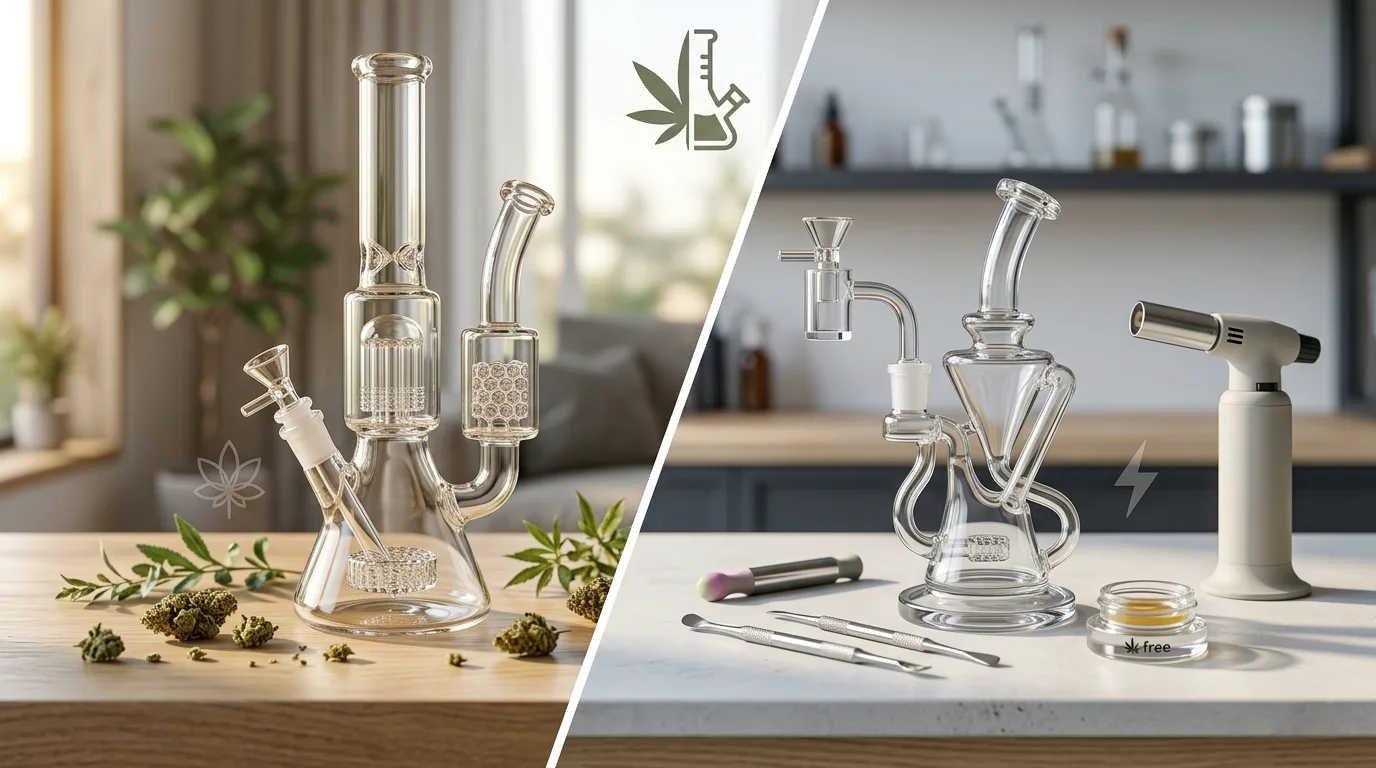
You're standing in front of two pieces of glassware that look almost identical. Both have a chamber, both hold water, both promise smooth hits. But one costs $60 and the other $180. One works with the flower you've been buying for years, the other requires a completely different product format that's sold by the gram at prices that make you wince. The difference between a dab rig and a bong isn't just about the hardware,it's about committing to an entirely different consumption method with distinct cost structures, maintenance routines, and ritual habits.
The question isn't which piece is "better." It's which consumption method fits your actual usage pattern, budget, and tolerance level. This guide breaks down the real-world differences between flower consumption through bongs and concentrate consumption through dab rigs, focusing on the factors that actually impact your wallet and daily routine: product cost per session, equipment investment, cleaning frequency, and the learning curve involved in each method.
Understanding the Core Difference: Flower vs Concentrate Chemistry
Before you can make an informed choice about hardware, you need to understand what each device is designed to vapourize. The fundamental distinction between bongs and dab rigs isn't the glass,it's the combustion temperature and product form factor they're optimized for.
How Bongs Process Cannabis Flower
A bong combusts dried cannabis flower at temperatures between 400-460°F. You're lighting plant material on fire with a standard lighter, creating smoke that travels through water for filtration and cooling. The water percolation removes some particulates and tar, but you're still inhaling smoke from burned organic material. The THC content in flower typically ranges from 15-30%, meaning you're consuming cannabinoids alongside plant matter, chlorophyll, and combustion byproducts.
The advantage of this method is simplicity. Pack a bowl, apply flame, inhale. The flower itself requires minimal preparation beyond grinding, and the effects build gradually over 5-10 minutes, giving you time to gauge your dosage. For Canadian consumers who prefer high-quality flower with visible trichomes, the bong maximizes the sensory experience,you can taste strain-specific terpenes and appreciate the craftsmanship of well-cured buds.
How Dab Rigs Vapourize Cannabis Concentrates
A dab rig vapourizes concentrated cannabis extracts at temperatures between 450-650°F using a heated nail or banger. You're not burning anything,you're flash-vapourizing a substance that's 60-95% pure cannabinoids. The concentrate (whether it's shatter, wax, live resin, or distillate) has already undergone extraction, removing all plant material and isolating the active compounds.
This concentration means dramatically different effects. A single dab the size of a grain of rice can deliver the equivalent THC of an entire joint. The onset is nearly instantaneous, and the intensity is significantly higher. This isn't necessarily better or worse,it's a different use case. Concentrates suit experienced users with high tolerances, medical patients requiring precise dosing, and consumers who prioritize efficiency over ritual.
The Material Science Behind the Hardware
Bongs and dab rigs look similar because they share basic filtration principles, but the heating elements are fundamentally different. A bong bowl is designed to hold combustible plant material and withstand direct flame contact. A dab rig nail or banger is engineered to be heated to extreme temperatures (often with a butane torch), retain that heat long enough to vapourize concentrate, and cool quickly for repeated use.
Quartz, titanium, and ceramic,the materials used in dab nails,have thermal properties that regular borosilicate glass lacks. Quartz bangers, the current industry standard, heat evenly and provide flavour clarity that doesn't interfere with delicate terpene profiles. This material specificity adds cost and fragility to the setup.
Equipment Investment: Initial Cost and Hidden Expenses
The sticker price you see online is only the beginning of your financial commitment. Both consumption methods require ongoing purchases and occasional replacements, but the cost structures differ significantly.
Bong Setup: What You're Actually Buying
A functional bong setup requires surprisingly little. A basic straight-tube bong runs $40-80, a decent four-piece grinder costs $25-40, and you're operational. Add $10 for a basic lighter and you have a complete consumption system for under $100.
The optional upgrades are genuinely optional. Ash catchers ($30-60) reduce cleaning frequency but aren't essential. Glass screens ($5-10) prevent debris from entering the chamber but finger-blocking works fine. Ice catchers and percolators are built into many mid-range bongs, not separate purchases. The right bong for beginners is usually a simple beaker or straight tube without elaborate percolation systems that just add cleaning difficulty.
Dab Rig Setup: The Real Total Cost
A dab rig setup has more non-negotiable components. The rig itself starts at $60-150 for quality glass. A quartz banger costs $20-80 depending on thickness and joint angle. A butane torch runs $25-50. A carb cap (essential for low-temp dabbing) is another $15-40. Dab tools are $10-20. Silicone containers for concentrate storage add $5-15.
You're looking at a minimum investment of $150-250 before you've purchased any actual concentrate. And several of these components are consumables. Quartz bangers develop chazzing (heat staining) over time and need replacement every 6-12 months with proper care, or every 2-3 months with heavy use. Butane refills run $8-15 and last 2-4 weeks of daily use.
The alternative is an electronic nail (e-nail), which eliminates the torch but adds $150-300 to your initial investment. E-nails offer temperature precision and safety advantages, but they're an entirely separate cost category that doesn't replace the rig,it replaces the heating method.
Long-Term Replacement and Maintenance Costs
Bongs rarely need replacement parts unless you break the main chamber. The bowl piece might crack after a few years of daily thermal stress, but a replacement is $10-20. Downstems break occasionally,another $15-30. Most bong users go years without any equipment-related expenses beyond cleaning supplies.
Dab rigs have higher ongoing costs. The banger is a wear item, not a one-time purchase. Even with careful cleaning and low-temp techniques, quartz degrades. Most daily dabbers budget for 2-3 banger replacements per year. Butane costs add up to $100-180 annually for regular users. Concentrate-specific cleaning solutions (isopropyl alcohol at higher concentrations, specialty cleaners) cost more than basic bong cleaning supplies.
Product Cost Per Session: Flower vs Concentrate Economics
The equipment is a one-time expense. The cannabis itself is the recurring cost that defines the affordability of each method. And the math is more complex than simple price-per-gram comparisons.
Flower Consumption Cost Breakdown
An average bong bowl holds 0.3-0.5 grams of ground flower. At $6-8 per gram for mid-shelf cannabis in Canada (the realistic price range for quality flower), that's $1.80-4.00 per bowl. Most consumers get 2-4 hours of effects from a single bowl, depending on tolerance.
Daily flower consumers typically use 1-2 grams per day, putting the monthly cost at $180-480 for mid-grade cannabis. Bulk purchasing reduces this significantly,an ounce (28 grams) of quality flower ranges from $120-180, bringing the per-gram cost down to $4.30-6.40. At bulk prices, the monthly cost for daily use drops to $120-360.
Concentrate Consumption Cost Reality
Cannabis concentrates in Canada range from $25-50 per gram for quality extracts, with premium live resin and rosin reaching $60-80 per gram. A typical dab is 0.025-0.05 grams (25-50 milligrams of concentrate), which translates to $0.60-2.50 per dab at standard pricing.
This looks cheaper per session than flower,until you factor in tolerance development and the efficiency paradox. Concentrates contain 2-4 times the THC of flower. A 0.03 gram dab of 70% THC concentrate delivers 21mg of THC. That same quantity in flower form would be physically impossible to smoke in one hit. Users develop higher tolerances faster, requiring larger or more frequent dabs to achieve the same effects.
Regular dabbers typically consume 0.5-1 gram of concentrate per week, putting monthly costs at $100-200 for moderate use and $200-400+ for daily heavy use. The per-session cost advantage disappears as tolerance climbs and dab sizes increase.
The Hidden Cost: Tolerance Management
Both methods build tolerance, but concentrate use accelerates the process significantly. The high cannabinoid concentration means your endocannabinoid system adapts more quickly. Many daily dabbers find they need regular tolerance breaks to maintain efficacy, or they cycle back to flower periodically to moderate their intake.
Flower users build tolerance more gradually, and switching between strains provides enough variation to prevent rapid adaptation. The slower tolerance development means longer periods between required increases in consumption, keeping monthly costs more stable over time.
Cleaning and Maintenance: Time Investment and Difficulty
The real-world hassle of keeping your device functional is rarely discussed in buying guides, but it's one of the primary factors that determines whether you'll actually enjoy using your purchase.
Bong Cleaning: Frequency and Methods
Bongs accumulate resin, tar, and plant particulates with every use. The water turns brown or black after 3-10 sessions depending on water volume and how often you change it. Most users clean their bong weekly to biweekly, though daily water changes are recommended for taste and health reasons.
The standard cleaning method is simple: pour out water, add isopropyl alcohol (70-91%) and coarse salt, shake vigourously, rinse thoroughly. For glass without complex percolation, this takes 10-15 minutes including drying time. Bongs with multiple chambers, percolators, or intricate designs can take 30-45 minutes to clean properly.
Neglected bongs develop stubborn resin buildup that requires soaking or commercial cleaning solutions. The longer you wait between cleanings, the more difficult it becomes. But a dirty bong is still functional,it just tastes worse and looks unpleasant. You can delay cleaning for weeks without rendering the device unusable.
Dab Rig Cleaning: Non-Negotiable Maintenance
Dab rigs require more frequent cleaning than bongs because concentrate residue solidifies and becomes nearly impossible to remove if left to accumulate. The banger needs cleaning after every 3-5 dabs to prevent chazzing and maintain flavour quality. This isn't optional,neglected bangers develop permanent carbon deposits that affect heat retention and taste.
The cleaning process is more involved. After each dab, while the banger is still warm (not hot), you wipe it with a cotton swab and isopropyl alcohol. This takes 30-60 seconds but must be done immediately. Wait until the residue cools and hardens, and you'll need to reheat the banger to loosen it,wasting butane and accelerating quartz degradation.
The rig chamber itself needs weekly cleaning similar to a bong, but concentrate reclaim is stickier and harder to remove than flower resin. Many users keep their dab rigs cleaner than their bongs simply because dirty concentrate residue affects the experience more noticeably than dirty bong water.
Time Cost Over a Year
Calculating the annual time investment reveals a significant difference. Bong users who clean weekly spend roughly 10-12 hours per year on maintenance. Dab users who properly maintain their banger after each session and deep-clean weekly invest 40-50 hours annually in cleaning activities.
This time cost is rarely mentioned in equipment comparisons, but it's substantial. If you value convenience and minimal ritual, the bong's lower maintenance burden is a genuine advantage. If you prioritize flavour and equipment longevity, the dab rig's higher maintenance requirement is the cost of that priority.
Learning Curve and Technique: Ease of Use Comparison
The skill required to use each device effectively impacts user satisfaction and waste. Nobody wants to struggle with their consumption method or wonder if they're doing it correctly.
Bong Technique: Minimal Learning Required
Using a bong successfully requires basic motor skills and breath control. Pack the bowl loosely to allow airflow, apply flame to one edge while inhaling slowly, pull the bowl piece when the chamber fills with smoke, inhale the chamber contents. First-time users typically master the technique within 2-3 sessions.
The main variables are grind consistency and bowl packing density, both of which affect airflow. Too fine a grind and you'll inhale plant material through the stem. Too coarse and the flower won't burn evenly. But these are forgiving parameters,even suboptimal technique delivers functional results. If you can roll a joint, you can use a bong effectively.
Dab Rig Technique: Precision Matters
Dabbing involves precise temperature control, timing, and coordination. Heat the banger with a torch for 30-60 seconds until it glows faintly red, let it cool for 30-60 seconds (timing varies by banger thickness and desired temperature), apply concentrate to the heated surface with a dab tool while inhaling, cap with the carb cap to retain vapour, continue inhaling until the dab is fully vapourized.
The temperature window is critical. Too hot and you combust the concentrate, creating harsh smoke and destroying terpenes. Too cool and the concentrate doesn't fully vapourize, wasting product and leaving residue. Finding the optimal cool-down time for your specific banger requires experimentation, and different concentrate consistencies (shatter vs wax vs live resin) vapourize at slightly different temperatures.
New dabbers routinely waste product during the learning phase. You'll heat the banger too hot and cough violently. You'll wait too long and the concentrate will puddle without vapourizing. You'll apply too much concentrate and leave puddles of waste. Most users need 10-20 sessions to develop consistent technique.
Safety and Burn Risk
Both methods involve controlled fire, but the risk profiles differ. Bongs use standard lighters or hemp wick, keeping the flame small and manageable. The glass gets warm but rarely hot enough to cause burns. The primary safety concern is tipping over the device and spilling water.
Dab rigs require butane torches that produce flames hot enough to heat quartz to 600°F+. The torch itself is a safety consideration,you're operating a tool that can cause immediate second-degree burns if mishandled. The banger remains dangerously hot for several minutes after heating, and you need a safe torch storage location during cooldown.
E-nails eliminate torch risks but introduce electrical hazards and the danger of forgetting a heating element is active. Neither method is particularly dangerous with proper precaution, but dab rigs require more spatial awareness and respect for the equipment.
Effects Profile and Use Case Scenarios
Beyond logistics and cost, the experiential difference between flower and concentrate consumption determines which method suits your specific needs. The effects aren't interchangeable, and pretending they are sets users up for disappointment.
When Bongs Make More Sense
Flower consumption through a bong suits users who value gradual onset, strain-specific flavours, and moderate effects. The entourage effect,the synergistic interaction between cannabinoids, terpenes, and other plant compounds,is more pronounced with whole-plant products. You're consuming the full spectrum of compounds present in the cultivar, which many users report as a more "complete" or nuanced high.
Social use favours bongs. Passing a bong around a circle is a shared ritual with cultural significance. Flower sessions last longer than dab sessions, creating more opportunity for conversation and connection. The equipment is less intimidating to inexperienced users, and the effects are more predictable and manageable.
Medical users seeking mild to moderate symptom relief without heavy sedation often prefer flower. The lower THC concentration per hit makes it easier to microdose and find the minimum effective dose. And for consumers who simply enjoy the taste and smell of quality cannabis, flower showcases those qualities better than concentrates.
When Dab Rigs Are the Better Choice
Concentrates suit users with high tolerances who find flower consumption inefficient. If you need multiple bong bowls to achieve desired effects, you're spending more time consuming and more money on product. A single dab can replace 3-4 bowls of flower, condensing the experience into seconds rather than minutes.
Medical patients requiring high doses of specific cannabinoids benefit from concentrate precision. Distillates and isolates allow targeted consumption of CBD, THC, or other cannabinoids without the variable composition of flower. The immediate onset and intense effects provide rapid symptom relief for conditions like severe chronic pain or chemotherapy side effects.
Discretion favours concentrates. A dab produces less odour than burning flower, and the scent dissipates faster. The vapour is less visible than smoke, and the entire consumption process takes seconds. For users in living situations where odour control matters, concentrates minimize detection risk.
Tolerance and Consumption Patterns
Your current tolerance level is the most honest predictor of which method suits you. If you're consuming more than 2 grams of flower daily, concentrates become cost-effective despite higher per-gram prices. But if you're a weekend user or consume less than a gram daily, the tolerance acceleration that comes with dabbing will likely push your consumption upward rather than replacing flower on a 1:1 basis.
Many experienced consumers maintain both setups and alternate based on context. Flower for social sessions and leisurely evening use, concentrates for quick mediation or when discretion is necessary. There's no rule requiring commitment to a single method, and the flexibility of owning both pieces of equipment might be worth the combined investment for regular users.
Making the Purchase Decision: Which Investment Makes Sense
After considering equipment costs, product prices, maintenance requirements, and use cases, the decision framework becomes clearer. You're not choosing between objectively good and bad options,you're aligning your purchase with your actual consumption habits and priorities.
Choose a Bong If You:
Are new to cannabis or have low to moderate tolerance. Want to minimize initial investment and ongoing costs. Prefer gradual onset and the ability to control dosage through small repeated hits. Value the ritual of grinding, packing, and smoking. Consume socially and want shareable equipment. Appreciate strain-specific flavours and the entourage effect. Want minimal learning curve and low-maintenance equipment. Smoke daily but in moderate amounts (under 2 grams per day).
Choose a Dab Rig If You:
Have high tolerance and find flower consumption inefficient. Can afford the higher initial investment ($150-250) and ongoing banger replacements. Value potency and rapid onset over gradual experience. Primarily consume alone or with experienced concentrate users. Need discretion and minimal odour. Are comfortable with butane torches and precise temperature control. Have the patience to develop proper dabbing technique through trial and error. Require high-dose medical cannabis for symptom management.
The Hybrid Approach: Budget for Both
If you're a daily consumer with budget flexibility, owning both pieces of equipment provides maximum versatility. Start with a bong ($50-100), add a quality grinder ($30-40), and establish your baseline consumption pattern. After 3-6 months, assess whether flower alone meets your needs or if tolerance has climbed to the point where concentrates become economically viable.
Adding a dab rig to an existing bong setup costs less than starting with a rig, because you already own cleaning supplies, storage containers, and other accessories. You can experiment with concentrates without abandoning your proven consumption method. And the ability to alternate between flower and concentrates helps manage tolerance and prevents the habituation that makes either method less effective over time.
Frequently Asked Questions About Bongs vs Dab Rigs
Technically yes, but not optimally. You can purchase a banger that fits your bong's joint size and use it for concentrates, but bongs are designed for cooler smoke, not hot vapour. The vapour cools too quickly in a large bong chamber, causing reclaim buildup and wasted concentrate. Conversely, you can smoke flower from a dab rig using a standard bowl piece, but the smaller chamber size means harsher smoke. Neither adaptation works as well as using purpose-built equipment.
A single dab typically delivers 15-30mg of THC, while a bong hit of mid-grade flower (20% THC) contains 15-25mg of THC. The difference isn't total potency,it's delivery speed and concentration. A dab delivers all its THC in one inhalation over 3-5 seconds. A bong bowl requires multiple hits over 2-3 minutes. The rapid delivery of concentrated THC produces more intense immediate effects, even if total cannabinoid consumption is similar.
Yes, noticeably. Concentrate highs tend to be more cerebral, intense, and shorter-lived. The rapid onset can feel overwhelming to users accustomed to flower's gradual build. Many users report concentrate highs as more one-dimensional,powerful THC effects without the nuanced terpene and minor cannabinoid interactions present in whole flower. Flower provides a more rounded, longer-lasting experience with less intense peak effects.