If you've ever wondered why your local dispensary can sell premium flower for $120 an ounce while you're paying $180, the answer lies in wholesale cannabis pricing. In Canada, the wholesale weed market operates on a tiered system that most consumers never see, with order minimums, volume discounts, and qualification requirements that determine who gets access to distributor-level pricing. Whether you're a licenced retailer looking to stock your shelves or simply curious about how the cannabis supply chain actually works, understanding the wholesale model reveals why some businesses thrive while others struggle with thin margins.
The Canadian wholesale cannabis landscape differs significantly from the consumer market you encounter at retail stores or through mail-order services. Wholesale transactions involve larger quantities, stricter licensing requirements, and pricing structures that can reduce per-gram costs by 40-60% compared to retail. But accessing these prices isn't as simple as placing a large order, there are legal frameworks, business registration requirements, and minimum purchase thresholds that gate-keep the wholesale tier.
Who Actually Qualifies to Buy Wholesale Cannabis in Canada
The first barrier to wholesale cannabis purchasing in Canada is legal qualification. Unlike the United States, where state-by-state regulations create a patchwork of licensing requirements, Canada's federal Cannabis Act establishes clear parameters for who can participate in wholesale transactions. Only businesses holding specific licences issued by Health Canada can legally purchase cannabis at wholesale prices and quantities.
Provincial and territorial cannabis retailers represent the primary wholesale buyers in Canada's legal market. These include government-operated stores in provinces like British Columbia and Quebec, as well as private retailers licenced under provincial frameworks in Ontario, Alberta, and Saskatchewan. To purchase wholesale, these retailers must hold both a provincial retail authorization and a valid business number registered with the Canada Revenue Agency.
Licenced producers cannot simply sell to anyone claiming to operate a dispensary. Every wholesale transaction requires verification of the buyer's licence status, business registration, and compliance with provincial distribution rules. In provinces with government monopoly distribution models like Ontario with the OCS or British Columbia with the BCLDB, private retailers don't purchase directly from licenced producers at all. Instead, they order through the provincial wholesaler, which acts as the sole intermediary between cultivation facilities and retail stores.
The Licensing Hierarchy That Controls Wholesale Access
Health Canada issues several licence types under the Cannabis Act, but only certain categories permit wholesale purchasing. Standard cultivation licences allow producers to grow and sell cannabis to other licenced entities, including processors, distributors, and retailers. Processing licences authorize businesses to extract, refine, and package cannabis products. Sale licences, which can be issued as standalone authorizations or in combination with cultivation or processing licences, enable wholesale distribution to qualified buyers.
Micro-cultivators and micro-processors represent a smaller-scale licensing tier designed to lower barriers to entry for craft producers. These licence holders can sell wholesale quantities, but their production limits often mean they serve niche markets rather than supplying large retail chains. Nursery licences permit the sale of cannabis plants and seeds to other licenced entities but not finished flower or extracts intended for consumer use.
The critical distinction is that no unlicensed business or individual can legally participate in wholesale cannabis transactions in Canada. The grey-market mail-order marijuana services that proliferated before legalization and continue operating today do not qualify for wholesale purchasing through legal channels. Their supply chains operate entirely outside the regulated framework, sourcing product through unregulated cultivation and distribution networks.
Why Most MOMs Can't Access Legitimate Wholesale Channels
Mail-order marijuana services occupy a legal grey area in Canada. While selling cannabis without proper licensing violates federal law, enforcement has been inconsistent, allowing numerous unlicensed online dispensaries to continue operating. These businesses cannot purchase from licenced producers at wholesale prices because they lack the required authorizations. Instead, they source cannabis through underground networks, often purchasing directly from unlicensed growers or through brokers who aggregate product from multiple small-scale cultivators.
This parallel supply chain explains the pricing dynamics in the mail-order market. Grey-market wholesalers operate on different economics than legal distributors, they avoid excise taxes, regulatory compliance costs, and testing requirements that add $1-3 per gram to legal cannabis. However, they also lack quality assurance protocols, product liability insurance, and the legal protections that come with operating within the regulated framework. For businesses considering how mail order works in Canada, understanding these supply chain distinctions is essential.
Order Minimums and Purchase Thresholds Across Canada
Once a business qualifies for wholesale purchasing, the next barrier is meeting minimum order requirements. Licenced producers and provincial distributors set these thresholds to ensure transactions remain economically viable. Shipping logistics, payment processing, and administrative overhead make small orders unprofitable at wholesale margins, so minimums filter out buyers who can't commit to substantial volumes.
Minimum order quantities vary significantly based on the supplier and product category. Licenced producers selling directly to retailers in provinces that permit such transactions typically require minimums ranging from $5,000 to $25,000 per order. Some craft producers with smaller inventories accept lower minimums, starting around $2,000, but these represent exceptions rather than industry standards. Provincial wholesalers like the OCS or BCLDB often impose lower minimums for registered retailers, sometimes as little as $500-1,000, because they aggregate orders across hundreds of retail locations.
These minimums apply to total order value, not individual products. A retailer might order 50 units of one strain, 30 units of another, and 100 pre-roll packs to reach a $10,000 minimum. The flexibility allows buyers to diversify inventory while meeting threshold requirements. However, licenced producers selling premium craft flower often impose product-specific minimums, requiring retailers to purchase at least 5-10 pounds of a particular strain before they'll fulfill the order.
How Minimums Scale with Product Categories
Dried flower typically carries the highest order minimums because it requires more warehouse space, has shorter shelf life compared to extracts, and represents the highest volume segment of the Canadian cannabis market. A licenced producer might require a 10-pound minimum for flower orders, which at wholesale prices of $3-5 per gram translates to $13,500-22,500 per order for a single strain.
Pre-rolls occupy a middle ground, with minimums usually set by unit count rather than weight. Producers commonly require 500-1,000 pre-roll minimums per SKU, allowing retailers to stock multiple strain options while spreading risk. Since pre-rolls use trim, shake, and smaller buds that would otherwise sell at lower prices, producers can offer more flexible terms while maintaining profitability.
Concentrates and extracts including shatter, live resin, distillate, and vape cartridges generally have lower weight minimums but higher dollar thresholds because of their higher per-gram wholesale cost. A producer might accept a 500-gram concentrate minimum, but at $15-30 per gram wholesale, that still represents $7,500-15,000. Vape cartridges sold in units rather than bulk weight often have 200-500 unit minimums per flavour or strain variant.
Edibles follow similar patterns to concentrates, with minimums set by unit count rather than cannabinoid weight. Gummy manufacturers typically require 100-500 unit minimums per product variant, while beverage producers may set minimums at 50-200 cases depending on the product. The 10mg THC per package limit in Canada means edibles carry lower wholesale prices per unit than flower or concentrates, so producers compensate with higher unit-count minimums.
Provincial Variations in Wholesale Purchasing Models
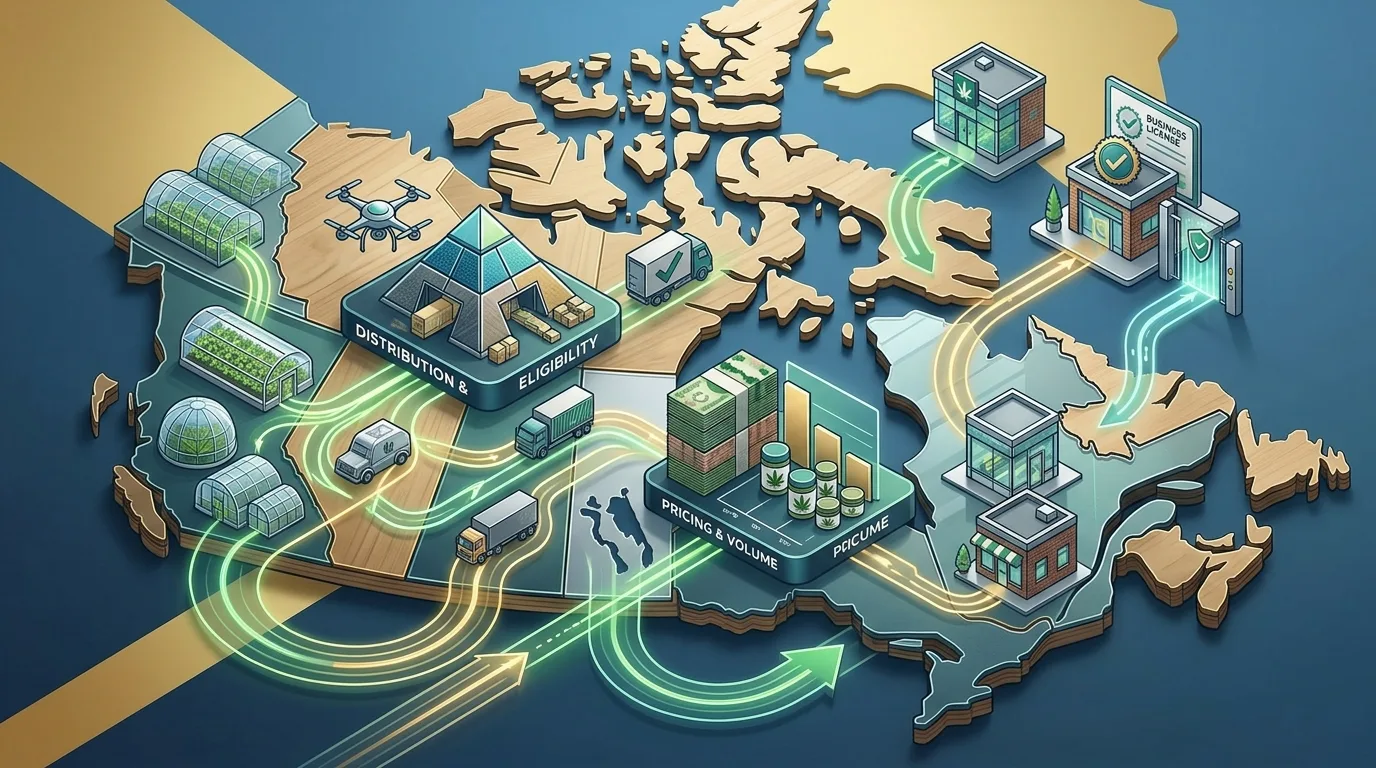
Canada's provincial distribution models create significant variation in how wholesale purchasing actually works. In monopoly distribution provinces, retailers don't negotiate directly with licenced producers. Instead, they place orders through the provincial wholesaler, which handles all purchasing, inventory management, and distribution. This system standardizes minimums and removes direct producer-retailer relationships from the equation.
Ontario's OCS operates the largest provincial wholesale operation in Canada, supplying over 1,600 licenced private retailers. The OCS sets low order minimums, sometimes $100-200, because it wants to ensure even the smallest retailers can access inventory. However, the OCS also determines which products reach retail shelves, creating a gatekeeping function that limited product selection in the early years of legalization.
In Alberta and Saskatchewan, private retailers can purchase directly from licenced producers, creating a more open wholesale market. This model allows craft producers to build direct relationships with retail buyers, negotiate pricing and payment terms, and differentiate their products through direct sales support. However, it also requires retailers to manage multiple supplier relationships, coordinate separate deliveries, and meet each producer's distinct order minimums and payment requirements. Understanding Alberta cannabis dispensary operations reveals how these direct relationships function in practice.
Pricing Tiers and Volume Discount Structures
Wholesale cannabis pricing in Canada operates on tiered structures that reward larger purchase volumes with progressively lower per-unit costs. These tiers don't follow a single industry standard, each licenced producer and provincial distributor sets their own pricing schedules based on production costs, market positioning, and competitive pressures. However, certain patterns have emerged across the legal market that reveal how volume discounts actually function.
Entry-level wholesale pricing typically applies to orders meeting minimum thresholds. At this tier, buyers might pay $4-6 per gram for mid-tier flower that retails for $8-12 per gram. The 100% markup provides sufficient margin for retailers to cover overhead, staffing, and operational costs while remaining competitive with grey-market pricing. Premium flower at this entry tier might wholesale for $6-9 per gram, with retail prices reaching $12-18 per gram.
Mid-volume tiers kick in at order values between $25,000 and $100,000, depending on the producer. At this level, per-gram prices drop by $0.50-1.50 compared to entry-level wholesale, rewarding retailers who commit to larger inventory purchases. A strain that wholesales for $5 per gram at the entry tier might drop to $4 per gram for orders exceeding 50 pounds. This $1 per gram reduction on a 50-pound order saves the retailer $22,680, providing significant margin expansion or the ability to undercut competitors on retail pricing.
How High-Volume Buyers Negotiate Custom Pricing
Large retail chains and provincial distributors purchasing millions of dollars in cannabis annually negotiate pricing outside standard tier structures. These buyers leverage their volume to secure rates that can be 40-60% below retail prices, compared to the 50-100% discount that mid-tier wholesale buyers receive. A strain retailing for $10 per gram might wholesale at $4 per gram for standard wholesale buyers but drop to $3 per gram or lower for provincial distributors ordering by the metric ton.
These custom arrangements also involve payment terms that smaller buyers can't access. While entry-level wholesale buyers typically pay upfront or within 15 days, high-volume purchasers negotiate 30, 60, or even 90-day payment terms. This extended payment window provides significant cash flow advantages, allowing large retailers to sell product and collect revenue before paying their supplier. The working capital benefit effectively reduces their true cost of goods even further.
Exclusive arrangements represent another dimension of high-volume negotiations. A licenced producer might grant a large retailer exclusive access to a particular strain or limited-edition product in exchange for guaranteed minimum purchase volumes. These exclusivity deals help producers secure predictable revenue while giving large retailers differentiated inventory that smaller competitors can't offer.
The Role of Excise Taxes in Wholesale Pricing
Canada's federal excise tax on cannabis complicates wholesale pricing by adding a fixed cost that doesn't scale with volume discounts. The excise duty equals the greater of $1 per gram or 10% of the producer's selling price, whichever is higher. This tax is applied at the producer level, meaning it's baked into wholesale prices before product reaches retailers. For low-priced flower wholesaling at $3 per gram, the $1 excise tax represents 33% of the wholesale cost, severely compressing margins.
This tax structure disproportionately impacts budget and mid-tier cannabis, where wholesale prices hover near the $1 per gram excise threshold. Premium flower wholesaling at $8 per gram only pays 12.5% of its wholesale price in excise taxes (assuming 10% of $8 equals $0.80, which is less than $1, so the flat $1 rate applies). The result is that volume discounts on lower-priced cannabis provide less actual savings because the fixed excise component can't be discounted.
Provincial and territorial cannabis taxes add another layer to the pricing stack. These vary significantly, from 0% in Alberta to over 10% in some provinces, and they apply to retail prices rather than wholesale costs. However, because retailers price products to remain competitive after all taxes are included, provincial tax rates influence what wholesale prices retailers can afford to pay while maintaining viable margins.
Supply Chain Logistics and Payment Requirements
Wholesale cannabis transactions involve logistics complexities that don't exist in the consumer retail market. Licenced producers must comply with strict seed-to-sale tracking requirements, ensuring every gram of cannabis remains within the legal supply chain from cultivation through final retail sale. This tracking uses provincial and federal database systems that record every transfer of product between licenced entities, creating an audit trail that regulators use to prevent diversion to illegal markets.
When a licenced producer fulfills a wholesale order, they must generate a shipping manifest that details the products, quantities, THC and CBD percentages, lot numbers, and destination. The receiving retailer or distributor must verify the shipment against this manifest and update the tracking system to reflect that the product has entered their inventory. Any discrepancies between the manifest and actual shipment trigger compliance reviews that can delay future orders or result in regulatory sanctions.
Transportation regulations add another layer of complexity. Cannabis shipments must travel in locked, opaque containers using secure transportation methods that prevent theft and diversion. Most provinces require dedicated security personnel or specialized transportation companies to move wholesale cannabis, increasing logistics costs compared to standard freight. Some licenced producers maintain their own distribution fleets to control costs and ensure delivery reliability, while others contract with third-party logistics providers licenced to transport cannabis.
Payment Methods and Credit Terms in Wholesale Cannabis
Payment requirements represent a significant barrier for new retailers entering the wholesale market. Most licenced producers require payment before shipping orders, especially for first-time buyers without established payment histories. This upfront payment requirement, combined with order minimums of $5,000-25,000, means retailers need substantial working capital to stock initial inventory. Unlike traditional consumer goods wholesalers who routinely extend 30 or 60-day payment terms, cannabis producers remain cautious because of the industry's newness and the prevalence of business failures among undercapitalized retailers.
Bank transfers represent the dominant payment method for wholesale cannabis transactions in Canada. Credit cards rarely work because many payment processors still treat cannabis as high-risk despite federal legalization, imposing transaction limits or declining to serve the industry entirely. Checks are uncommon because they introduce payment delays and carry fraud risks that producers won't accept for high-value shipments of a controlled substance.
Established retailers with strong payment histories can negotiate net-30 or net-60 payment terms, allowing them to receive product, sell it at retail, and then pay their supplier from the proceeds. This credit arrangement provides significant cash flow advantages but requires proving financial stability and consistent ordering patterns. Producers extend these terms selectively, often requiring personal guarantees, security deposits, or liens on inventory to protect against non-payment.
Quality Assurance and Testing Requirements
Every wholesale cannabis batch in Canada's legal market undergoes mandatory testing for potency, contaminants, and microbial safety before it can be sold to retailers. Licenced producers must use accredited testing labouratories to analyze samples from each harvest lot, verifying THC and CBD content, checking for pesticides, heavy metals, mycotoxins, and microbial contamination, and confirming the product meets Health Canada's safety standards. These test results travel with the product through the supply chain, and retailers can request lab certificates before accepting delivery.
Testing costs add $500-1,500 per batch to production expenses, which producers pass on to wholesale buyers through higher per-gram prices. Large licenced producers amortize these costs across thousands of pounds of flower, while micro-cultivators producing 200-kilogram harvests face proportionally higher testing expenses per gram. This testing requirement creates a quality floor that separates the legal market from grey-market operations, which rarely test product and can undercut legal pricing by avoiding this expense. For context on how consumers experience product quality differences, exploring how to tell good weed quality, aroma and appearance provides useful benchmarks.
The Gap Between Wholesale and Retail Pricing
Understanding the markup between wholesale and retail cannabis prices reveals why some businesses thrive while others struggle with thin margins. The standard retail markup on cannabis in Canada ranges from 100% to 150%, meaning a product that wholesales for $5 per gram retails for $10-12.50 per gram. This markup must cover substantial operational costs that wholesale buyers incur beyond just the cost of goods.
Retail overhead consumes a significant portion of this markup. Storefront retailers pay rent, utilities, staff salaries, insurance, security systems, and regulatory compliance costs that can total $30,000-75,000 monthly for a typical retail location. Point-of-sale systems, inventory management software, and mandatory security infrastructure add thousands more in monthly expenses. When these fixed costs are spread across sales volume, they account for 25-40% of retail prices, leaving smaller margins than the gross markup suggests.
Provincial sales taxes, which range from 0% to over 10% depending on location, further compress net margins. In provinces with high cannabis taxes, retailers must either absorb a portion of the tax to remain price-competitive or pass it fully to consumers and risk losing sales to lower-priced competitors. The competitive pressure from grey-market mail-order services, which avoid most taxes and regulatory costs, forces legal retailers to sacrifice margin to match or approach unlicensed pricing.
How Different Retail Models Affect Margin Structures
Delivery-only retailers operate with different cost structures than storefront dispensaries, allowing them to maintain margins on lower absolute prices. Without rent, utilities, and staffing costs associated with physical locations, delivery services reduce overhead by 40-60% compared to brick-and-mortar stores. This efficiency allows them to wholesale products at $5 per gram and retail them at $8-9 per gram while maintaining viable 30-35% net margins. For regions where same-day service is available, understanding how fast same-day service works in your city shows how these streamlined operations function.
Online-only retailers in provinces that permit direct-to-consumer sales occupy a middle ground between delivery services and storefronts. They avoid storefront rent but must invest in e-commerce infrastructure, warehousing, and shipping logistics. Their margins typically fall between 50-80%, allowing competitive pricing while covering the costs of packaging, shipping materials, and courier services that physical retailers don't face.
Chain retailers with multiple locations achieve economies of scale that single-store operators can't match. By purchasing wholesale inventory in high volumes, chains negotiate better pricing tiers that provide 10-20% lower wholesale costs than independent retailers pay. They also spread administrative overhead, marketing costs, and technology investments across numerous locations, reducing per-store expenses and allowing more aggressive retail pricing while maintaining margins.
Why Grey Market MOMs Undercut Legal Wholesale Pricing
The persistent price gap between legal and grey-market cannabis stems from fundamentally different cost structures. Unlicensed mail-order services avoid federal excise taxes ($1 per gram or 10% of sale price), provincial cannabis taxes (0-10%), regulatory compliance costs (testing, tracking, reporting), and the overhead associated with legal business operations. This tax avoidance alone saves $2-4 per gram compared to legal wholesale costs.
Grey-market supply chains also source from unregulated growers who avoid the licensing fees, facility inspections, security requirements, and production limits that licenced producers face. An unlicensed cultivator growing in a residential property or undeclared warehouse operates with 50-70% lower production costs than a licenced facility meeting Health Canada's requirements for security, sanitation, and record-keeping. These savings cascade through the supply chain, allowing grey-market wholesalers to sell flower for $2-3 per gram that would cost $4-6 per gram through legal channels.
The quality trade-off varies significantly. Some grey-market products rival or exceed legal market quality because experienced legacy growers supply these channels, bringing decades of cultivation expertise. Others involve untested, poorly cured, or contaminated product that legal testing would disqualify. Without consistent quality controls, grey-market wholesale purchasing carries risks that legal channels eliminate through mandatory testing and compliance requirements.
Practical Considerations for Businesses Entering Wholesale
Retailers considering wholesale purchasing must evaluate whether their business model and capital position support the order minimums and payment requirements that wholesale suppliers impose. The $5,000-25,000 entry threshold represents a substantial cash commitment for new businesses, especially when combined with upfront payment requirements. Undercapitalized retailers who can't meet minimums remain dependent on provincial distributors in monopoly markets or simply can't access certain producers' products in open markets.
Inventory management becomes more complex when purchasing wholesale quantities. A retailer buying 10 pounds of a single strain must move that product before it loses freshness or falls out of favour with consumers. Cannabis flower has a practical shelf life of 6-12 months in proper storage conditions before terpene degradation and moisture loss diminish quality. Ordering large quantities of slow-moving strains ties up capital and warehouse space while risking inventory devaluation.
Diversification strategies help mitigate these risks. Rather than ordering 10 pounds of a single strain, experienced retailers distribute their minimum order across 4-6 strains, balancing popular options that move quickly with premium selections that justify higher margins. This approach maintains inventory freshness while providing customers with variety, but it requires accurate sales forecasting and understanding of consumer preferences that new retailers often lack.
Building Supplier Relationships in the Legal Market
Successful wholesale purchasing depends on cultivating reliable supplier relationships that extend beyond transactional order placement. Licenced producers value retail partners who provide consistent order volume, maintain good payment records, and communicate clearly about inventory needs and product feedback. These relationships unlock benefits like priority access to limited releases, flexibility on order minimums during slow periods, and advance notice of price changes or supply disruptions.
Trade shows and industry events provide networking opportunities where retailers can meet producer representatives, sample products, and negotiate wholesale accounts. Events like Lift & Co. Expo, O'Cannabiz Conference, and regional cannabis industry gatherings host hundreds of licenced producers seeking retail distribution. Attending these events allows retailers to compare product quality, pricing, and terms across multiple suppliers before committing to wholesale relationships.
Direct outreach to licenced producers also works, especially for craft cultivators seeking retail partners for niche products. Most licenced producers maintain business development teams that handle wholesale inquiries, provide product information, and explain ordering processes. Retailers with clear business plans, proof of licensing, and realistic order volume projections receive more responsive service than vague inquiries from unqualified buyers.
No. Only businesses holding valid provincial retail licences or federal cannabis licences can legally purchase wholesale cannabis in Canada. Unlicensed individuals and businesses cannot access legal wholesale channels and attempting to do so violates federal cannabis laws. Provincial distributors and licenced producers verify licence status before accepting wholesale orders.
Order minimums vary by supplier but typically range from $5,000 to $25,000 for licenced producers selling directly to retailers. Provincial distributors in monopoly markets often have lower minimums starting around $500-1,000. Craft producers may accept $2,000-3,000 minimums, while large commercial producers require higher thresholds. Minimums apply to total order value, not individual products, allowing buyers to mix strains and product categories to reach the threshold.