
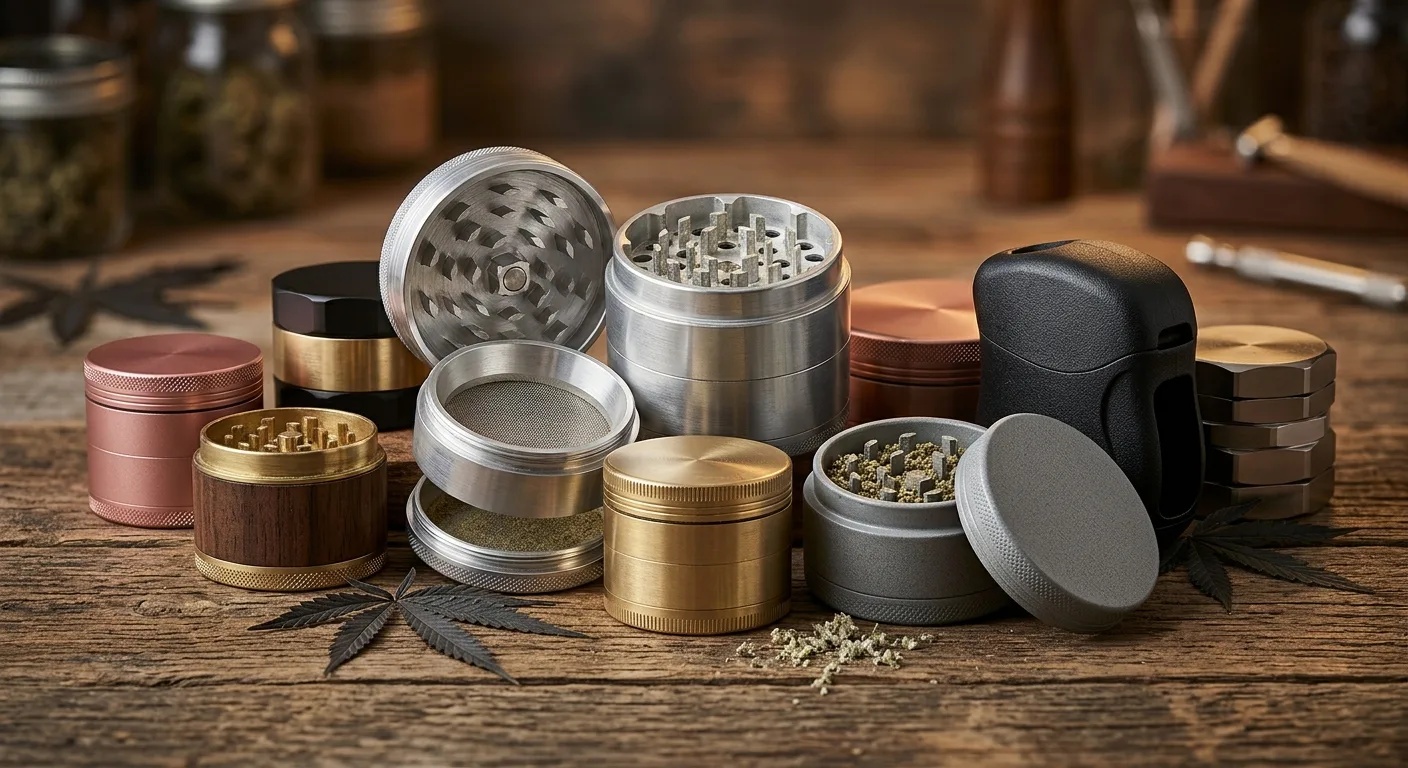
If you've been breaking up your cannabis by hand or using scissors and a shot glass, you're not just making things harder for yourself. You're litreally leaving potency on the table. The best grinder for weed transforms dense, sticky buds into a consistent texture that burns evenly, vapourizes efficiently, and maximizes surface area for extraction. But walk into any head shop or browse online, and you'll face dozens of options spanning $10 plastic cylinders to $200 aerospace-grade aluminum masterpieces. The difference isn't just marketing hype.
This guide breaks down the grinder decision into three core factors: piece count (two-piece versus four-piece designs), material quality (plastic, aluminum, titanium, wood), and the often-misunderstood kief chamber. Whether you're grinding for joints, bowls, vapourizers, or edible preparation, understanding these variables will save you money and frustration. We'll compare models across price points, explain why certain features actually matter, and help you match a grinder to your specific consumption method. Let's start with the most fundamental choice you'll make.
Two-Piece vs Four-Piece Grinders: Understanding the Core Design Difference
Every cannabis grinder on the market falls into one of three categories based on chamber count: two-piece, three-piece, or four-piece. The number refers to how many separate components stack together, and each design serves a different purpose. This isn't about one being universally better. It's about matching the tool to your consumption habits.
Two-Piece Grinders: The Minimalist Approach
A two-piece grinder consists of a top and bottom section, both fitted with interlocking teeth. You load flower into the top chamber, twist, and the ground material stays in the bottom section until you dump it out. That's it. No screens, no collection chambers, no moving parts beyond the basic twist mechanism. The entire design prioritizes simplicity and portability.
These work best for consumers who grind small amounts immediately before use. If you're rolling a single joint or packing one bowl, a two-piece gets you from whole bud to ready-to-smoke in thirty seconds with minimal cleanup. The compact form factor fits easily in a pocket or small kit. You'll find quality two-piece grinders in every material from acrylic to aircraft aluminum, typically ranging from $8 to $40 depending on build quality and brand.
The tradeoff? You lose every grain of kief that would otherwise accumulate in a collection chamber. For heavy consumers or medical patients who value cannabinoid conservation, that's a significant disadvantage. You're also stuck with whatever grind consistency the tooth design produces since there's no screen to filter particle size.
Four-Piece Grinders: The Collection System
Four-piece grinders add two critical components: a mesh screen and a bottom collection chamber. When you grind flower in the top section, it falls through holes into a middle storage chamber. As you handle the grinder, the finest trichome heads (kief) sift through a stainless steel or nylon screen into the isolated bottom chamber. Over weeks or months of regular use, you accumulate a potent reserve of pure kief for topping bowls or pressing into rosin.
This design appeals to efficiency-focused consumers who grind larger amounts at once and want to maximize every molecule of their purchase. The middle storage chamber holds enough ground flower for multiple sessions, while the kief chamber slowly builds a high-potency stockpile. Quality four-piece grinders range from $20 to $150, with the price reflecting materials, manufacturing precision, and screen quality.
The added complexity means more components to clean and more bulk to carry. Four-piece grinders typically measure 2 to 3 inches in diameter and stand 2 to 3 inches tall when assembled. They're home accessories, not pocket tools. But for anyone buying weed by the ounce or half-ounce, the kief accumulation alone justifies the investment within a few months of regular use.
Three-Piece Grinders: The Middle Ground Nobody Talks About
Three-piece grinders include a top grinding section, a bottom collection chamber, and the threaded connections between them, but no kief screen. You get the multi-session storage capacity of a four-piece without the trichome separation. These make sense for consumers who want convenient storage but don't care about kief collection, though they represent a small minority of the market. Most manufacturers focus on two-piece and four-piece models since three-piece designs satisfy neither the minimalist nor the collector.
Material Matters: Plastic, Aluminum, Titanium, and Wood Compared
The material your grinder is made from determines durability, grind consistency, cleaning ease, and whether it'll still function properly after three years of regular use. This is where price differences become meaningful. A $12 acrylic grinder and a $60 aluminum model might look similar in photos, but they perform like completely different tools.
Acrylic and Plastic Grinders: When Budget Is the Only Priority
Acrylic grinders dominate the under-$15 price range. They're lightweight, available in every colour imaginable, and perfectly functional for light, occasional use. The teeth are molded as part of the body rather than machined separately, which works fine for soft, properly cured flower. For travelers who worry about losing gear or consumers just exploring cannabis, plastic represents minimal financial risk.
The material's softness is both its advantage and fatal flaw. Acrylic won't damage delicate trichomes through aggressive grinding, but those same teeth wear down within months of daily use. Sticky, resinous strains gum up plastic threads quickly, making the grinder difficult to open. You can't clean acrylic with isopropyl alcohol without causing cloudiness and degradation. Most plastic grinders include mesh screens of such low quality that they clog or tear within weeks.
Consider acrylic grinders disposable tools with a six-month to one-year lifespan under regular use. They make sense as backups or festival gear, but not as your primary grinding solution if you consume cannabis more than occasionally.
Aluminum Grinders: The Industry Standard for Good Reason
Aerospace-grade aluminum (typically 6061 or 7075 alloy) dominates the mid-to-high-end grinder market because it solves most of plastic's problems while remaining affordable. CNC-machined aluminum teeth maintain their sharp diamond or pyramid shape through years of use. The material resists corrosion, tolerates isopropyl alcohol cleaning, and provides enough mass to grind dense flower without requiring excessive hand strength.
Quality aluminum grinders feature anodized finishes that prevent metal particles from contaminating your flower. The anodization process creates a hard, inert coating that won't chip or flake. This matters more than most consumers realize. Raw aluminum can oxidize and leave grey residue on flower, while anodized surfaces stay inert and clean. Colours in anodized aluminum come from dye trapped in microscopic pores during the coating process, not paint that can peel.
Thread quality separates budget aluminum from premium models. Cheap grinders use coarse threads that cross-thread easily and wear into a loose fit. Premium manufacturers like Space Case or Santa Cruz Shredder specify fine-pitch threads machined to tight tolerances. The grinder twists smoothly even when sticky with resin, and the sections stay aligned properly for decades. You're looking at $35 to $80 for quality aluminum grinders, with most landing around $50.
The aluminum standard works for 90% of consumers. It's tough enough for daily use, light enough for comfortable handling, and chemically inert enough for safe contact with cannabis. Unless you have specific needs that aluminum can't meet, this is where your search should focus.
Titanium Grinders: Overkill or Ultimate Investment?
Titanium grinders occupy the luxury tier, typically starting around $100 and climbing past $200 for premium models. The material offers legitimate advantages: it's lighter than aluminum with superior strength, naturally antimicrobial, and essentially indestructible under normal use. Titanium won't corrode, won't impart flavours, and maintains its finish without anodization. For medical patients concerned about material purity or travelers who need bombproof gear, titanium makes sense.
For most recreational consumers, it's expensive overkill. You're paying for material properties that exceed the demands of grinding cannabis. A quality aluminum grinder will outlast your interest in the hobby. Titanium represents the final 5% of performance improvement for 300% of the cost. But if you're the type who buys equipment once and never thinks about it again, titanium delivers that peace of mind.
Wood and Alternative Materials: Style Over Substance
Wooden grinders appeal to consumers who prioritize aesthetics and natural materials. They look beautiful on a coffee table and feel satisfying to handle. But wood absorbs moisture and odours, can't be cleaned with solvents, and requires regular maintenance to prevent warping. The teeth are typically metal pegs press-fit into drilled holes, a design that produces inconsistent grinds and eventually loosens.
Stone, ceramic, and other specialty materials occupy tiny market niches. They work, but they solve no problems that aluminum doesn't already handle better and cheaper. Treat these as artistic pieces rather than functional tools.
The Kief Chamber Explained: Why That Bottom Section Actually Matters
The kief chamber in four-piece grinders isn't a marketing gimmick. It's a passive extraction system that concentrates trichomes over time, giving you access to a significantly more potent product than the flower you started with. Understanding how this works, and what makes a good kief chamber versus a pointless one, changes how you evaluate grinders.
How Trichome Separation Actually Works
Cannabis trichomes consist of a stalk topped by a bulbous head containing cannabinoids and terpenes. When properly cured flower is ground, some of these heads break free from the stalks. They're heavier than the plant material but small enough to fall through a fine mesh screen. A quality kief screen typically measures between 75 and 125 microns, fine enough to catch plant matter while allowing trichome heads to pass through.
Every time you open your grinder or tap it on a surface, mechanical agitation encourages separated trichomes to sift downward. Over weeks of regular use, you accumulate kief in the bottom chamber. The concentration isn't pure. It includes some fine plant particles and broken stalks. But it's significantly more potent than whole flower, typically testing 40% to 60% THC compared to 15% to 30% in the original bud.
This passive collection means you're not losing potency from your regular consumption. The trichomes that end up in the kief chamber would have otherwise stuck to your fingers, rolling tray, or jar. You're simply capturing material that would be wasted through normal handling.
Screen Quality: The Variable That Makes or Breaks Collection
Not all kief screens perform equally. Cheap grinders use nylon or silk screens that stretch, tear, or develop holes within months. You'll notice the problem when plant material starts appearing in your kief chamber, contaminating what should be a purified product. These screens also clog quickly as resin and fine particles block the mesh openings.
Quality grinders specify stainless steel screens, either woven mesh or laser-cut perforated plates. Stainless steel maintains consistent micron size under tension, doesn't tear, and can be cleaned thoroughly with isopropyl alcohol and a soft brush. The material cost difference is maybe $2, but manufacturers cut this corner constantly on budget models.
Micron size matters too, though most manufacturers don't publish this specification. Screens below 75 microns produce very pure kief but collect slowly since fewer particles pass through. Screens above 150 microns collect quickly but include more plant contamination. The sweet spot lives between 90 and 120 microns, balancing purity with reasonable collection speed. A heavy weekly consumer should accumulate enough kief for a bowl-topping every two to three weeks with a properly sized screen.
When Kief Collection Isn't Worth the Complexity
If you consume less than a gram per week, you won't accumulate meaningful kief quantities even with an excellent screen. The chamber will take months to show visible accumulation, and the added bulk and cleaning requirements of a four-piece design outweigh the minimal benefit. Light consumers are better served by simpler two-piece grinders and accepting that trichome loss is negligible at their consumption rate.
Similarly, if you exclusively vapourize or make edibles, kief collection becomes less valuable. Vapourizers extract trichomes efficiently whether they're attached to plant material or separated, so there's no potency advantage. Edible makers already decarboxylate and extract whole flower. The separation work is redundant.
For those who make edibles with distillate or prefer more consistent dosing, kief can actually complicate the process by introducing a variable-potency ingredient into recipes that require precise measurements.
Tooth Patterns, Hole Size, and Grind Consistency: The Engineering Most People Ignore
Once you've settled on piece count and material, the internal design determines how your grinder actually performs. Two grinders with identical exteriors can produce completely different results based on tooth shape, tooth count, and the size and placement of drop-through holes. These variables affect grind texture, ease of use, and how well the grinder handles different flower densities.
Diamond vs Pyramid vs Peg Teeth: Shape Matters More Than Count
Diamond-shaped teeth feature four cutting edges arranged in a pointed diamond profile. They're the most common design in quality grinders because they shear flower efficiently while self-cleaning to some degree. As you twist the grinder, material slides off the diamond points rather than building up on them. This design works well across different moisture levels and flower densities.
Pyramid teeth arrange three or four cutting edges into a sharper, more aggressive pyramid shape. They excel at grinding dense, sticky flower but require more frequent cleaning since material tends to compact in the corners where edges meet. You'll find pyramid teeth in premium grinders marketed toward heavy users who prioritize grind speed over cleaning convenience.
Peg or pin teeth consist of simple cylindrical or slightly tapered posts. They're cheaper to manufacture and appear in most budget grinders. Pegs tear flower rather than shearing it, which works fine for dry, crumbly bud but struggles with properly cured, resinous strains. The tearing action also damages more trichomes compared to shearing designs, reducing the potency of both your ground flower and kief collection.
How Drop-Through Holes Control Your Final Grind
The holes in your grinder's grinding chamber floor determine the maximum particle size that falls into the collection area. Small holes (2-3mm diameter) force flower to be ground more finely before dropping through, producing a powdery, consistent grind ideal for vapourizers. Large holes (4-6mm) allow bigger pieces through, creating a coarser grind that works better for joints and pipes where airflow matters more than uniformity.
Hole placement affects how quickly material drops through. Grinders with holes concentrated near the centre require more twisting to work material toward the middle, while designs with holes extending to the outer edge finish faster but may produce less consistent grinds. Neither approach is objectively better. It depends whether you prioritize speed or consistency.
Some premium grinders feature no holes at all. Instead, they use a pass-through gap between the grinding chamber walls and the collection chamber below. This design, popularized by brands like Santa Cruz Shredder, creates an extremely consistent grind and prevents material from getting stuck in holes. The tradeoff is slower operation since you must consciously rotate the grinder body to allow ground material to fall through the gap.
Matching Grind Texture to Consumption Method
Vapourizers demand finely ground, fluffy material that provides maximum surface area for hot air extraction. Too coarse and you'll leave active compounds trapped in the centre of larger pieces. A grinder with small holes or a pass-through gap design works best. Many vapourizer enthusiasts prefer turning their grinders upside down (so ground flower can't fall through holes immediately) and grinding extra-fine before dumping the collection.
Joints and blunts roll more easily with medium-coarse grinds that maintain some structure. Too fine and the material becomes dense, restricting airflow and causing runs. If you primarily roll Backwoods or other leaf wraps, look for grinders with 4-5mm holes that preserve some texture while breaking up dense chunks.
Bowls and pipes accommodate the widest range of grind textures, but most consumers prefer medium grinds that pack easily without falling through the bowl hole. Standard grinders with 3-4mm holes hit this sweet spot naturally.
For consumers preparing flower for edible production or long-term storage, grind consistency matters less than thorough breakdown. Any quality grinder works fine, though models with more teeth (40+) process material faster when working with larger quantities. Those looking to buy bulk amounts will appreciate faster processing for ounce-plus quantities.
Size, Portability, and Capacity: Finding the Right Diameter for Your Use Case
Grinder diameter directly impacts capacity, ease of use, and portability. A 1.5-inch mini grinder fits in a pocket but requires multiple loads for a single large joint. A 3-inch model processes an eighth at once but won't fit in most bags discreetly. Matching size to your consumption patterns prevents daily frustration.
Small Grinders (1.5 to 2 inches): The EDC Option
Small-diameter grinders prioritize portability over capacity. They slip into a pocket, small kit, or dugout pouch without bulk. Two-piece designs in this size range work perfectly as on-the-go tools for consumers who grind single servings at the point of use. You can grind enough for one bowl or a half-gram joint, but anything larger requires multiple loads.
The small diameter makes grinding more challenging with sticky flower since you can't get much leverage on the shorter twist radius. Your fingers travel a smaller circle, meaning each rotation does less work. This forces more rotations to achieve the same result, which becomes tedious if you're processing material daily. Small grinders also fill more quickly, leaving less room for material to tumble and break down efficiently.
These work best as secondary grinders for travel or situations where discretion matters more than convenience. If you're visiting a friend or attending an outdoor event, a mini grinder makes sense. As your primary home grinder, you'll regret the size limitation quickly.
Medium Grinders (2 to 2.5 inches): The Goldilocks Range
Most quality grinders cluster around 2 to 2.5 inches in diameter because this size balances capacity with manageable bulk. You can grind 2 to 3 grams at once, enough for multiple bowls or several joints without requiring multiple loads. The larger diameter provides better leverage for grinding dense flower, and there's enough chamber space for material to tumble and break down evenly.
A 2.25-inch grinder fits comfortably in a cargo pocket or small bag but doesn't disappear into a jeans pocket. For home use and occasional portability, this size handles most needs without compromise. If you're only buying one grinder, this is the range to focus on.
Large Grinders (2.75 to 3.5 inches): For Heavy Users Only
Large-diameter grinders target heavy consumers who process multiple grams daily. You can load an eighth, grind it thoroughly, and store the result in the collection chamber for use over several days. The increased capacity means less frequent loading and more efficient grinding since there's ample room for material to circulate.
The size becomes a hindrance for anyone with small hands or limited grip strength. A 3-inch grinder requires significant rotational force when filled with sticky flower. They're also impractical for travel or discreet use. Consider large grinders home accessories rather than portable tools. They shine in group settings or for consumers who maintain high tolerance levels and process material in bulk.
Premium Brands vs Budget Models: When the Price Premium Actually Matters
Walk into any head shop and you'll see grinders ranging from $10 to $200. The expensive models tout features like "aircraft-grade aluminum" and "ultrasonic cleaning," while budget options claim to perform identically for a fraction of the cost. The truth lives somewhere in the middle. Premium grinders deliver real advantages, but the value proposition depends heavily on your consumption patterns.
What You Actually Get with Premium Grinders
Brands like Santa Cruz Shredder, Space Case, and Phoenician engineer grinders as precision tools rather than disposable accessories. They start with 6061 or 7075 aluminum billets, CNC-machine every component to tight tolerances, and finish with medical-grade anodization. The result is a grinder where threads engage smoothly even when caked with resin, teeth maintain sharp edges after years of use, and the screen stays taut without tearing or stretching.
Premium manufacturers typically offer lifetime warranties against defects and will replace damaged components. This matters more than most consumers realize. A $120 grinder with a true lifetime warranty costs less over five years than three $40 replacements. The warranty only holds value if the company remains in business and honours it, so stick with established brands with multi-year track records.
The engineering shows in daily use. Premium grinders require less force to twist through dense material because the tooth geometry is optimized for shearing rather than crushing. The threads are fine-pitch and precisely machined, so the sections stay aligned without wobbling or binding. Magnets (in four-piece designs with magnetic lids) are strong enough to keep the lid secured during vigourous grinding but not so strong that you struggle to open the grinder one-handed.
Where Budget Models Fall Short (And Where They Don't)
Budget grinders from generic manufacturers or white-label brands cut costs through material quality and manufacturing precision. They use softer aluminum alloys that dent more easily, skip anodization or use thin coatings that wear through quickly, and machine components to looser tolerances that feel acceptable when new but degrade rapidly with use.
The teeth are the most obvious compromise. Budget grinders often use fewer, larger teeth with blunt edges. They tear flower more than they shear it, requiring extra effort and producing inconsistent particle sizes. After a few months of regular use, the teeth litreally round off from impact with dense nugs, making the grinder progressively less effective. You'll notice this when the same strain that ground easily when the grinder was new now requires twice as much twisting.