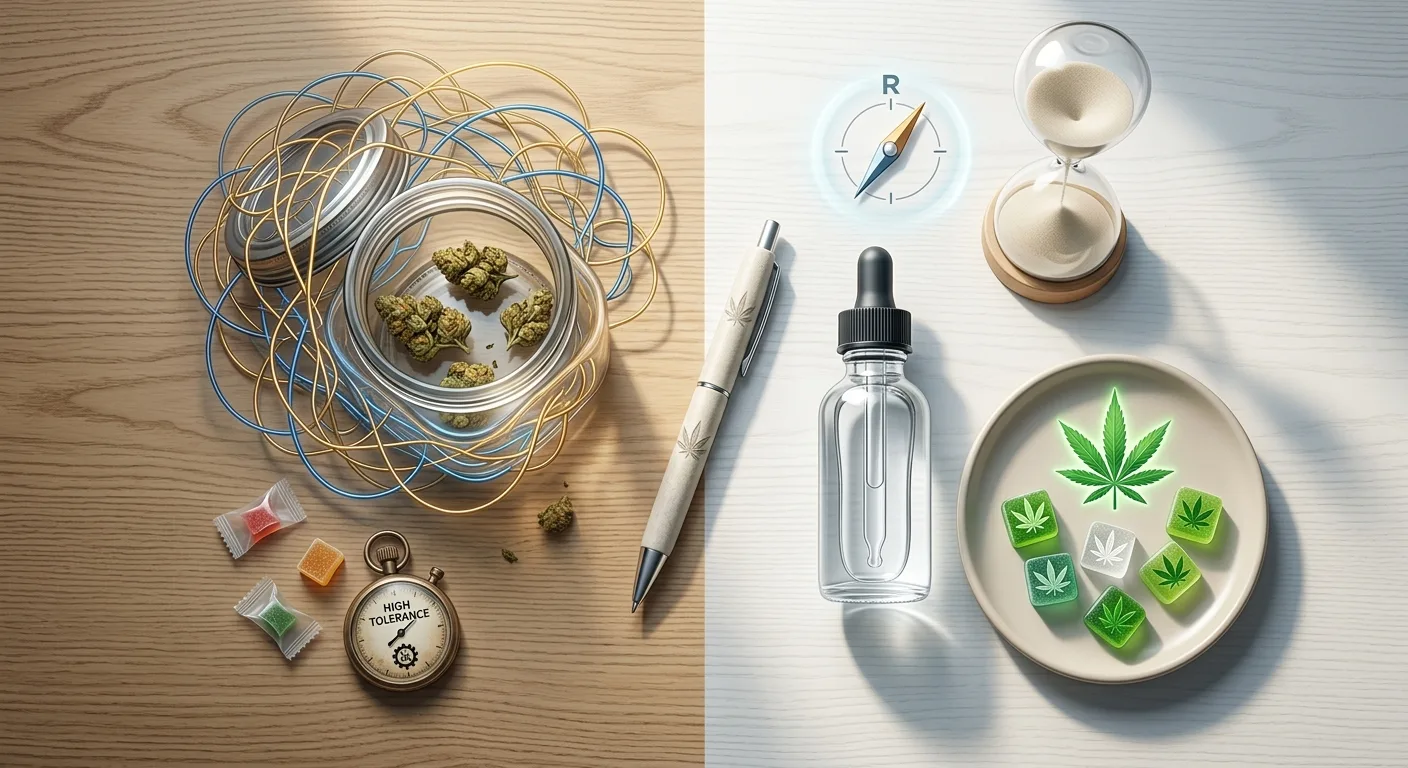
If your usual dose isn't hitting like it used to, or if you've noticed you're consuming more cannabis to achieve the same effects, you're experiencing tolerance. It's not a sign you're doing anything wrong,it's basic biology. Your endocannabinoid system adapts to regular THC exposure by downregulating CB1 receptors, the primary binding sites for cannabinoids in your brain. The solution? A tolerance break, or "T-break" in cannabis community parlance. This guide explains how tolerance builds, how long a reset actually takes, and what to expect when you step away from cannabis for a while.
Before we dive into the mechanics, let's address the elephant in the room: as a cannabis retailer, we're telling you to buy less from us temporarily. That might seem counterintuitive, but we'd rather have you as a satisfied long-term customer than push you toward higher doses and diminishing returns. A strategic tolerance break can restore your cannabis experience to its former glory, reduce your consumption costs, and keep your relationship with cannabis sustainable for years to come.
How Cannabis Tolerance Actually Builds in Your Brain
Cannabis tolerance develops through a process called receptor downregulation. When you consume THC regularly, your brain responds by reducing the number of available CB1 receptors and making existing receptors less sensitive to cannabinoid binding. Think of it like turning down the volume on a speaker system,your brain is trying to maintain equilibrium despite the constant THC signal.
This adaptation happens faster than you might expect. Studies on daily cannabis users show measurable CB1 receptor downregulation within just 48 hours of consistent use. Within two weeks of daily consumption, receptor availability can drop by as much as 20% in certain brain regions, particularly the cortex and limbic system where THC exerts many of its psychoactive effects.
The Dose-Frequency Relationship
Not all cannabis use patterns build tolerance at the same rate. Someone consuming 10mg of THC edibles once per week will maintain receptor sensitivity far longer than someone vaping multiple times daily. The key variables are dose size, frequency of use, and total THC exposure over time. High-potency products accelerate tolerance development,a 1000mg edible or a concentrate with 90% THC will downregulate receptors more aggressively than lower-potency flower.
Interestingly, occasional users who consume once every few weeks may never develop significant tolerance. Their CB1 receptors fully reset between sessions, preserving sensitivity. Daily users, conversely, keep their receptors in a constant state of adaptation, which is why experienced consumers often report needing dramatically higher doses than when they first started.
Why Your Favourite Strain Stops Working
There's a common misconception that you develop tolerance to specific strains and can reset by switching varieties. While there's some truth to the idea that cannabinoid and terpene profiles vary between strains, the fundamental issue remains THC binding to CB1 receptors. If those receptors are downregulated, no strain,regardless of its unique chemical fingerprint,will produce the effects you're chasing. Strain rotation may provide subtle differences, but it won't reverse systemic tolerance.
How Long Does a Tolerance Break Need to Be?
The research on CB1 receptor recovery offers surprisingly specific timelines. For moderate daily users, receptor density begins returning to baseline within 48 hours of cessation. However, full receptor upregulation,where your brain has restored both the number and sensitivity of CB1 receptors,takes considerably longer.
A frequently cited study on chronic daily users found that CB1 receptor availability returned to near-normal levels after 28 days of abstinence. However, you don't need a full month to experience meaningful benefits. Most users report noticeable improvements in cannabis effects after just 7-14 days without THC. The timeline depends on your previous consumption pattern: heavier users typically need longer breaks for equivalent results.
The Diminishing Returns Timeline
Here's what receptor recovery typically looks like for a daily cannabis user taking a tolerance break:
Days 1-3: No significant receptor changes yet. You may experience mild withdrawal symptoms like sleep disruption, irritability, or vivid dreams as your brain adjusts to the absence of THC.
Days 4-7: CB1 receptors begin upregulating. Some users report improved mood and mental clarity as their endocannabinoid system recalibrates. Sleep patterns often normalize during this window.
Days 8-14: Substantial receptor recovery. Most users who resume consumption at this point notice dramatically improved effects from their usual dose. A two-week break is often sufficient for recreational users seeking a meaningful reset.
Days 15-28: Continued receptor normalization approaching baseline levels. Heavy daily consumers benefit most from extending breaks into this range. By day 28, research suggests receptor density is largely restored.
Do You Need a Full Month?
The honest answer is: probably not, unless you've been consuming very high doses multiple times daily for months or years. For most cannabis users, a 14-day break produces substantial benefits. Even a 7-day break can meaningfully improve receptor sensitivity if you're a moderate user. The key is finding a break length that fits your lifestyle while delivering noticeable results when you resume.
What to Expect During Your Tolerance Break
Cannabis withdrawal exists, though it's far milder than withdrawal from alcohol, opioids, or even caffeine. The experience varies dramatically based on your consumption history. Someone who vapes nightly before bed will have a different experience than someone consuming concentrates throughout the day.
The most commonly reported symptoms during the first week include sleep disturbances, particularly difficulty falling asleep and unusually vivid or intense dreams. This happens because THC suppresses REM sleep; when you stop consuming, your brain experiences a REM rebound effect. You're not dreaming more,you're finally experiencing normal sleep architecture again, which can feel disorienting if you've been a long-term daily user.
Physical and Psychological Symptoms
Mild irritability or mood changes are common in the first 3-5 days as your brain's reward pathways adjust. Some users report increased anxiety during this window, though paradoxically, many others report decreased anxiety as their endocannabinoid system recalibrates. Changes in appetite are typical,you might feel less hungry than usual, particularly if cannabis was part of your eating routine. Mild headaches can occur, though they're less common than sleep or mood symptoms.
Most physical symptoms resolve within a week. The psychological adjustment,the habitual urge to consume at your usual times,often persists longer. If you typically vaped while watching evening TV or consumed edibles before social events, you'll need to consciously replace those rituals with alternatives. This is behavioural conditioning, not physical dependence.
Strategies to Make the Break Easier
Exercise is remarkably effective for easing tolerance break symptoms. Physical activity releases endocannabinoids,your brain's naturally produced cannabinoids,which can help smooth the transition. You're essentially stimulating your endocannabinoid system without external THC. Many users report that workouts during a T-break feel unusually rewarding, likely due to this endocannabinoid release.
Establishing new evening routines helps address the behavioural component. If you always consumed before bed, replace that ritual with herbal tea, meditation, reading, or whatever non-cannabis activity signals relaxation to your brain. The goal is to break the association between specific times or activities and cannabis consumption. Some users find it helpful to remove all cannabis products and paraphernalia from sight during their break to reduce subconscious triggers.
Resuming Cannabis After Your Tolerance Break
This is where many people make a critical mistake: they take a tolerance break, reset their receptors, then immediately return to their previous high-dose consumption pattern. Within days, they're right back where they started. The entire point of a tolerance break is to leverage your restored sensitivity, consume less, and maintain that lower baseline moving forward.
When you resume after a successful break, start with approximately half your previous dose. If you were consuming 50mg edibles, try 25mg. If you were taking multiple vape hits, try one or two. You'll likely find that this reduced dose produces effects equal to or stronger than your pre-break consumption. This is your window to establish a more sustainable consumption pattern.
Maintaining Lower Tolerance Long-Term
The key to preserving your tolerance reset is reducing consumption frequency. If you were using daily, consider dropping to 4-5 days per week with complete abstinence on off days. This intermittent pattern allows partial receptor recovery between sessions, preventing the aggressive downregulation that occurs with daily use. Some users adopt a "weekends only" approach, which maintains receptor sensitivity remarkably well over months or years.
Dose control matters equally. Resist the temptation to chase increasingly intense highs. Cannabis effects aren't linear,doubling your dose doesn't double the experience. There's a ceiling effect where additional THC produces diminishing returns and accelerated tolerance. Find your minimum effective dose and stick to it. You'll save money, maintain sensitivity, and enjoy more consistent effects.
If you're interested in exploring lower-dose options after your tolerance break, our selection of cannabis products includes everything from mild flower strains perfect for moderate consumption to precisely-dosed edibles that let you dial in your ideal amount without overconsumption.
Alternatives to Complete Abstinence
Not everyone needs a full tolerance break to restore sensitivity. Some users successfully manage tolerance through strategic reduction rather than complete cessation. This approach involves cutting your dose by 50-70% for several weeks while maintaining your usual consumption schedule. You're still providing some THC signal, but the reduced input allows partial receptor upregulation.
The "microdosing break" is another variation: switching to very low doses (2-5mg THC) for two weeks. This maintains your consumption ritual while dramatically reducing total cannabinoid exposure. It's less effective than complete abstinence but more sustainable for people who use cannabis for symptom management or have difficulty with abrupt cessation. Some users report that this gradual taper approach produces fewer withdrawal symptoms than going cold turkey.
CBD-Only Periods
Switching to CBD-dominant products during your break is a popular strategy. CBD doesn't produce intoxication and doesn't significantly downregulate CB1 receptors, making it an ideal placeholder while your THC tolerance resets. Some evidence suggests CBD may even facilitate receptor recovery, though the research is preliminary. If you use cannabis partially for its non-intoxicating benefits,anxiety reduction, sleep support, or inflammation management,CBD products let you maintain those benefits during your THC break.
Keep in mind that full-spectrum CBD products contain trace THC (under 0.3% in legal products), which could theoretically slow receptor recovery if consumed in large amounts. For the strictest tolerance break, consider CBD isolate products with zero THC content. However, for most users, the tiny THC content in full-spectrum CBD is negligible and won't meaningfully impact tolerance reset.
The Business Case for Tolerance Breaks
Here's where we address the unusual position of a cannabis retailer actively encouraging customers to buy less. The logic is straightforward: sustainable, satisfied customers are more valuable than high-volume consumers spiraling toward diminishing returns. When you're consuming excessively just to feel baseline effects, you're not enjoying cannabis,you're chasing a response that's increasingly elusive. That's neither financially nor experientially sustainable.
A tolerance break restores the relationship to one where cannabis enhances your life rather than requiring ever-escalating doses to maintain normalcy. From a business perspective, we'd rather you consume moderately for decades than burn out on expensive high-dose products within a few years. The long-term value of a customer who uses our mail order service sustainably far exceeds short-term sales volume.
There's also an educational component. The more informed our customers are about tolerance mechanics, dosing strategies, and sustainable consumption patterns, the better their outcomes. That knowledge translates into positive word-of-mouth, customer retention, and a healthier cannabis community overall. We'd rather be known as the retailer that helped you use cannabis intelligently than the one that pushed you toward unsustainable consumption.
Building a Smarter Cannabis Routine
Post-tolerance-break, consider implementing consumption tracking. Note your doses, effects, and timing in a simple journal or phone app. This data reveals patterns,times when you're consuming out of habit rather than intention, doses that produce optimal effects, and early warning signs that tolerance is creeping back up. Most users discover they were consuming more than necessary once they see their patterns objectively.
Intentionality is the difference between cannabis use and cannabis misuse. Ask yourself before each session: What am I hoping to achieve? Am I consuming because I want to, or because it's my usual time? Would a lower dose accomplish my goals? These brief check-ins help maintain the mindful consumption pattern you establish after your tolerance break. For practical guidance on different consumption methods and their effects, our article on edibles vs smoking offers detailed comparisons that can help you optimize your approach.
Special Considerations for Different User Types
Medical cannabis users face unique challenges with tolerance breaks. If you're using cannabis to manage chronic symptoms, complete abstinence may not be feasible without symptom return. Work with your healthcare provider to develop a modified approach,perhaps a dose reduction rather than complete cessation, or strategically timed breaks during periods when symptoms are naturally less severe.
Concentrate users typically develop tolerance more rapidly than flower users due to the higher THC concentrations. If you primarily use shatter, wax, or high-potency vape cartridges, consider a longer break (21-28 days) for optimal results. Post-break, think about whether you want to return to concentrates or transition to lower-potency options. Some users discover that flower or moderate-dose edibles provide perfectly adequate effects after a tolerance reset, at a fraction of the cost.
Edible Users and Tolerance
Edible tolerance follows the same CB1 receptor downregulation patterns, but the oral route produces different subjective experiences. Some users report that edible tolerance develops more slowly than inhalation tolerance, possibly because the liver converts THC to 11-hydroxy-THC, a distinct metabolite. However, once established, edible tolerance can be particularly stubborn. If you've been taking high-dose edibles (200mg+) regularly, expect to need a longer break for meaningful reset,closer to 21-28 days. Our guide on edibles dosage can help you find your optimal post-break dose.
When resuming edibles after a break, exercise extra caution. The delayed onset (60-90 minutes) makes it easy to redose prematurely, and your restored sensitivity means you'll feel effects much more intensely than before your break. Start low,perhaps 5-10mg if you were previously consuming 50-100mg,and wait a full two hours before considering additional doses. Many users find that their "sweet spot" dose drops by 50-75% after a successful tolerance break.
Frequently Asked Questions About Tolerance Breaks
Yes, CBD doesn't significantly affect CB1 receptor density and won't interfere with THC tolerance recovery. Many users switch to CBD-only products during their break to maintain certain benefits while allowing THC receptors to reset. Just ensure your CBD products are THC-free or contain only trace amounts if you want the fastest tolerance reset.
If you return to heavy daily consumption, yes,tolerance will rebuild quickly, sometimes within days. However, if you moderate your post-break consumption (lower doses, less frequent use), you can maintain improved sensitivity for months. The key is using your tolerance break as a reset point for more sustainable consumption patterns, not just a temporary measure before returning to previous habits.
It depends entirely on your consumption pattern after the break. Users who moderate their intake after a tolerance break may never need another one. Daily heavy users will likely need periodic breaks,some implement them quarterly or semi-annually as routine maintenance. Think of it like resetting your relationship with cannabis rather than a one-time fix.
Complete prevention isn't possible with regular use, but you can slow tolerance development significantly. Use the minimum effective dose, take at least 1-2 days off per week, avoid multiple sessions per day, and choose lower-potency products. Intermittent consumption patterns preserve sensitivity far better than daily use at any dose level.
This is rare but can happen if the break was too short for your consumption level, or if you immediately returned to high doses. Extend your break another 7-14 days and ensure you're starting with a significantly reduced dose when you resume. Also verify that your cannabis products are from reliable sources with accurate potency labelling,inconsistent products can mask the benefits of a tolerance break.
From a purely physiological perspective, alcohol doesn't interfere with CB1 receptor recovery. However, many people find that substituting one substance for another during a break defeats the purpose of resetting consumption patterns. The goal is often to break habitual use and prove to yourself that you can function well without cannabis, which is harder to achieve if you're relying on alternative substances.
Conclusion: The Reset That Keeps Cannabis Sustainable
A tolerance break isn't a punishment or admission of problematic use,it's intelligent maintenance of your endocannabinoid system. Whether you take a week, two weeks, or a full month away from THC, the result is the same: restored receptor sensitivity, improved effects from lower doses, and a more sustainable long-term relationship with cannabis. Most users discover they were consuming far more than necessary once they experience how powerfully cannabis works with a fresh receptor profile.
The week or two of mild discomfort during your break is a small price for months of improved effects and reduced consumption. More importantly, a successful tolerance break gives you perspective on your consumption patterns and an opportunity to reset them intentionally. When you resume, you're starting fresh with the knowledge that less can accomplish more,a lesson that serves you far beyond cannabis use.
If you're ready to implement a smarter approach to cannabis consumption after your tolerance break, explore our delivery service across Canada for sustainably-sourced products that support moderate, intentional use. Your reset tolerance,and your wallet,will thank you.
Questions About Sustainable Cannabis Use?
Our team can help you select products that match your consumption goals and support long-term satisfaction without escalating tolerance. Whether you're planning your first tolerance break or looking to maintain your reset, we're here to support your journey.
Get in Touch