You can legally buy cannabis in Canada, but getting behind the wheel after consuming it is a different story entirely. Unlike alcohol, where everyone knows the 0.08% blood alcohol concentration limit, cannabis impairment laws remain confusing for most Canadian drivers. The federal Cannabis Act established national impairment thresholds in 2018, but provinces have layered their own penalties, testing protocols, and administrative sanctions on top. The result? A patchwork of rules that vary significantly depending on where you're driving.
Understanding these laws isn't just about avoiding tickets. Cannabis DUI convictions carry criminal records, immediate roadside suspensions, and penalties that can cost thousands of dollars. Whether you're a medical cannabis patient who needs to drive daily or a recreational user planning a weekend road trip, knowing the specific rules in your province could be the difference between a normal commute and a criminal charge. This guide breaks down the impairment limits, testing methods, and penalties province by province so you understand exactly what's legal where you live and drive.
Federal Cannabis Impairment Laws: The National Baseline
Before diving into provincial differences, you need to understand the federal framework that applies everywhere in Canada. The Criminal Code sets three blood THC concentration thresholds that define impaired driving offences. These are national standards enforced through criminal law, meaning they carry the same weight whether you're in Vancouver or St. John's.
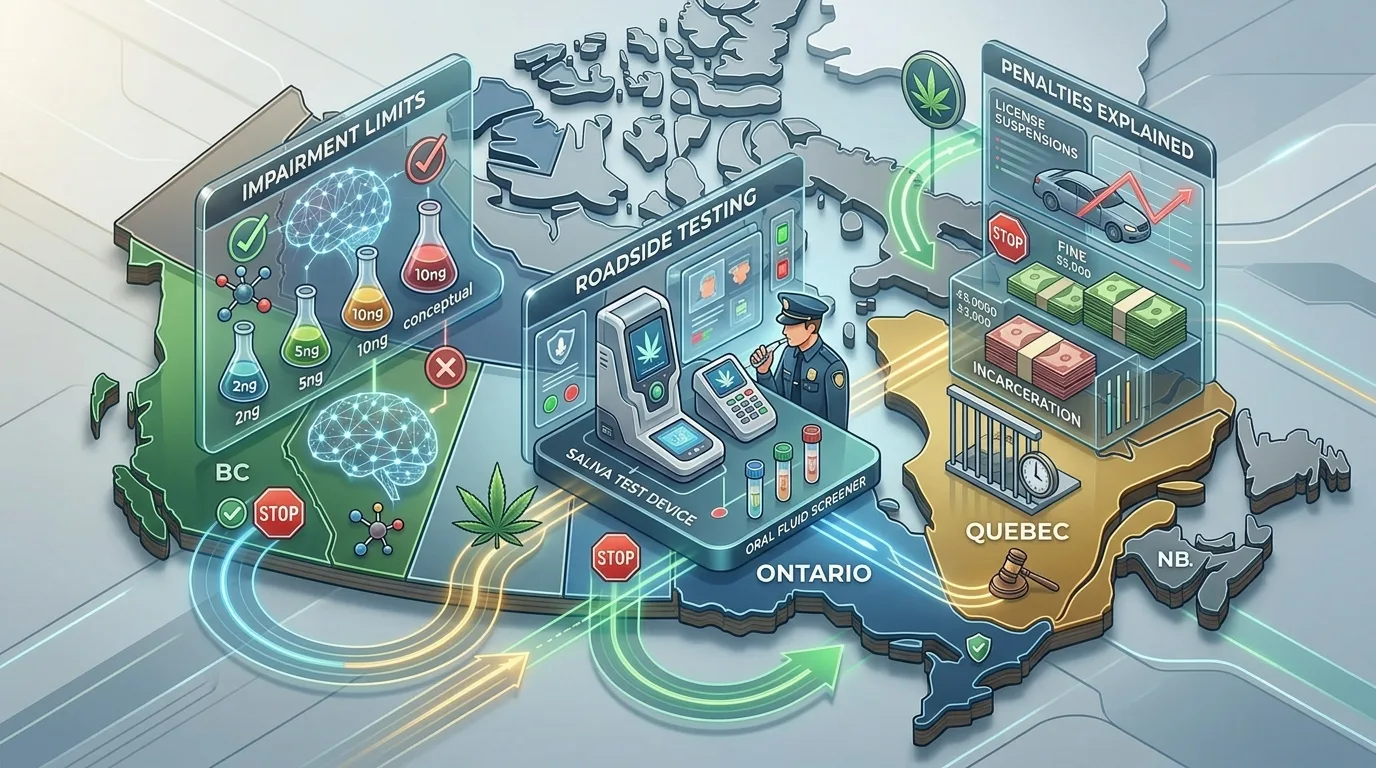
The three federal impairment levels are: 2 to 5 nanograms of THC per milliliter of blood (ng/mL) within two hours of driving, which is a summary conviction offence; 5 ng/mL or more of THC, which is a hybrid offence with harsher penalties; and any detectable amount of THC combined with 50 milligrams or more of alcohol per 100 milliliters of blood, which is also a hybrid offence. The combined THC and alcohol threshold recognizes that even small amounts of both substances together significantly impair driving ability.
How Blood THC Levels Are Measured
Police use a two-stage testing process. First comes the roadside screening with a saliva test or standardized field sobriety test. If you fail the roadside screening, officers will demand a blood sample at the station or hospital. The blood test is what determines your actual THC concentration for criminal charges. Saliva tests at the roadside are screening tools only, not the basis for criminal charges.
Here's the critical issue: blood THC levels don't correlate neatly with impairment the way blood alcohol does. THC can remain detectable in blood for hours or even days after the impairing effects have worn off, particularly in regular users. A tolerance break can affect how long THC stays in your system, but the law doesn't account for individual metabolism or usage patterns.
The federal mandatory minimum penalties start at a $1,000 fine for a first offence at the 2-5 ng/mL level. For 5 ng/mL or higher, you're looking at a $1,000 fine for the first offence, 30 days imprisonment for a second offence, and 120 days imprisonment for subsequent offences. These are just the starting points. Judges can impose much harsher sentences, and provinces add their own administrative penalties on top.
Provincial Penalties and Administrative Sanctions: Where the Real Costs Add Up
While federal law handles the criminal charges, provinces control driver's licensing and vehicle registration. This is where the immediate, expensive consequences kick in, often before you're convicted of anything. Provincial administrative penalties can include immediate roadside suspensions, vehicle impoundment, mandatory education programs, and ignition interlock requirements.
Ontario's Cannabis DUI Approach
Ontario takes an aggressive stance with its Administrative Driver's Licence Suspension (ADLS) program. If you register a "warn" on a roadside screening device (indicating any presence of drugs), you face an immediate three-day licence suspension and a three-day vehicle impoundment, even if you're not criminally charged. First offence warn-range penalties also include a $180 administrative monetary penalty.
If you're charged criminally (the "fail" range), Ontario issues an immediate 90-day licence suspension before any trial. Upon conviction, first-time offenders face a minimum one-year driving prohibition, a mandatory education program costing around $634, and potential ignition interlock requirements. Second offences trigger three-year prohibitions, and third offences result in lifetime driving bans with possible reinstatement after 10 years. Ontario cannabis consumers need to take these administrative penalties seriously, as they hit your wallet immediately, whether or not you're ultimately convicted.
Quebec's Zero-Tolerance Zones
Quebec maintains zero-tolerance policies for all drivers under 22 and any driver with a learner's permit or probationary licence, regardless of age. Any detectable THC triggers an immediate 90-day licence suspension and 30-day vehicle impoundment. For fully licenced drivers over 22, Quebec follows the federal thresholds but adds immediate licence suspensions of 90 days for a first offence.
The province also requires convicted drivers to complete a substance abuse evaluation before licence reinstatement. The evaluation costs between $150 and $300, and if the evaluator recommends treatment, you'll pay for that too before getting your licence back. Vehicle impoundment fees in Quebec run approximately $150 per day, making a 30-day impound a $4,500 expense before you even address the criminal charges.
British Columbia's Immediate Roadside Prohibition
British Columbia uses an Immediate Roadside Prohibition (IRP) system that runs parallel to criminal charges. If you fail a roadside drug screening, you receive an immediate 90-day driving prohibition and a 30-day vehicle impoundment. The administrative penalties alone include a $500 IRP driver penalty and towing and impound fees that typically exceed $1,000.
BC also requires an 8-month ignition interlock period after the prohibition ends for first offences. The interlock device costs around $1,500 to install and monitor. Second offences within 10 years trigger 12-month prohibitions, third offences result in 36-month prohibitions, and fourth offences lead to lifetime driving bans. British Columbia's approach means you're dealing with severe consequences immediately, long before any criminal trial concludes.
Alberta's Progressive Sanctions
Alberta implemented its cannabis impaired driving laws under the Traffic Safety Act. First-time offenders caught in the warn range face immediate three-day licence suspensions and three-day vehicle seizures. The fail range triggers 90-day suspensions and 30-day vehicle seizures, plus a $1,000 administrative penalty.
What sets Alberta apart is the mandatory Ignition Interlock Program for all drug-impaired drivers, even first offenders. You'll pay approximately $1,400 for a one-year interlock period, which doesn't start until after your licence suspension ends. Second offences result in three-year suspensions, and third offences lead to five-year suspensions with possible lifetime bans. Alberta cannabis users face some of Canada's longest suspension periods for repeat offences.
Atlantic Canada's Varied Approaches
Nova Scotia, New Brunswick, Prince Edward Island, and Newfoundland and Labrador each implement their own administrative frameworks on top of federal criminal law. Nova Scotia issues immediate seven-day suspensions for warn-range results and 30-day suspensions for fail results, with vehicle impoundments matching the suspension length. New Brunswick uses similar timelines but adds a $300 administrative penalty for fail-range results.
PEI takes a slightly softer approach with 24-hour roadside suspensions for warn-range results and seven-day suspensions for fail results on first offences. Newfoundland issues immediate 90-day suspensions for any drug-impaired driving charge, along with 30-day vehicle impoundments. All four Atlantic provinces require substance abuse evaluations before licence reinstatement.
Roadside Testing Methods and Legal Challenges
Police use two primary roadside screening methods for cannabis impairment: approved drug screening equipment (saliva tests) and Standardized Field Sobriety Tests (SFST). Understanding how these tests work and their limitations is crucial, as they're the first step in the legal process that can lead to criminal charges.
Saliva Testing Devices
As of 2024, the only approved oral fluid screening device in Canada is the Dräger DrugTest 5000. This device analyzes saliva for THC and other drugs, providing results in approximately 5 to 10 minutes. The device indicates "fail," "warn," or "pass" results based on THC concentration in saliva. However, saliva THC levels don't correlate reliably with blood THC levels or actual impairment.
The Dräger device has documented issues in cold weather, requiring officers to warm the device before testing. Defence lawyers have successfully challenged the reliability of saliva tests, particularly regarding the correlation between oral THC concentration and blood concentration. The device also cannot distinguish between recent use (within two hours) and use from earlier in the day or even the previous day for regular users.
Standardized Field Sobriety Tests
When saliva testing isn't available or practical, officers may conduct a SFST. This includes three components: horizontal gaze nystagmus (following a stimulus with your eyes), walk-and-turn (nine heel-to-toe steps on a line), and one-leg stand (balancing on one foot for 30 seconds). Officers trained as Drug Recognition Experts (DRE) may conduct more extensive 12-step evaluations.
The problem? These tests were originally developed for alcohol impairment and may not reliably detect cannabis impairment. Physical conditions, injuries, anxiety about the police interaction itself, and even footwear can affect test performance. Unlike breathalyzer results, SFST results are subjective, based on the officer's interpretation of your performance.
Your Legal Rights During Roadside Testing
You have specific rights when stopped for impaired driving suspicion. You must comply with screening tests when demanded by police, as refusal carries the same penalties as a fail result. However, you have the right to speak with a lawyer before providing a blood sample at the station (not for roadside screening). You also have the right to remain silent beyond providing identification and vehicle documents.
If arrested, the police must inform you of your right to counsel "without delay." This means as soon as practicable, which typically happens at the police station after roadside screening. You cannot refuse the blood test demand, but you can request to speak with a lawyer first. Anything you say about when you consumed cannabis or how much can be used as evidence, so politely declining to answer questions beyond basic identification is your right.
Special Circumstances: Medical Cannabis Patients, CBD Users, and Passengers
Several groups face unique concerns regarding cannabis DUI laws. Medical cannabis patients, CBD users, passengers in vehicles, and commercial drivers all navigate different aspects of these regulations. Understanding how the law applies to your specific situation is essential for staying compliant.
Medical Cannabis Authorization Doesn't Provide Exemptions
Having a medical cannabis prescription does not exempt you from impaired driving laws. If your blood THC concentration exceeds the federal thresholds, you can be charged and convicted regardless of whether your cannabis use is medical or recreational. This creates a significant challenge for medical patients who may need to maintain consistent THC levels for symptom management.
Medical patients can present their authorization as context during sentencing, potentially affecting the penalties imposed by a judge. However, it's not a defence to the charge itself. Some provinces, like Ontario, allow medical patients to apply for exemptions from zero-tolerance provisions if they can prove their therapeutic cannabis use doesn't impair their driving ability. These exemptions are rare and require extensive medical documentation.
The practical advice for medical cannabis patients: understand how long THC stays in your system based on your usage patterns and dosing schedule. Regular medical users maintain higher baseline THC levels, which means you could test above the 2 ng/mL threshold even when not actively impaired. Arrange alternative transportation whenever possible, especially within the first few hours after dosing.
CBD Products and Drug Testing
Pure CBD products that contain no THC shouldn't trigger positive results on cannabis drug tests. However, many CBD products contain trace amounts of THC (under 0.3% as allowed by federal regulations). If you consume high doses of CBD products with trace THC regularly, you could theoretically accumulate enough THC to register on screening devices, though this is uncommon.
The more significant risk involves mislabeled or inaccurate CBD products. Some products claiming to be CBD-only actually contain more THC than advertised. If you're using CBD products and driving regularly, purchase from reputable sources that provide third-party lab testing certificates confirming THC content. The burden of proof is on you to show what you consumed and why it wouldn't impair you.
Passengers and Open Cannabis
Most provinces prohibit open cannabis in vehicles, similar to open alcohol container laws. In Ontario, cannabis must be in its original, unopened package or stored in a closed container. Quebec requires all cannabis to be in the trunk or another area not readily accessible to passengers. British Columbia and Alberta have similar trunk-storage requirements.
Passengers cannot consume cannabis in a vehicle in any province, even if the driver is sober. This applies to all forms of cannabis including smoking, vaping, and edibles. The driver can be charged with allowing cannabis consumption in the vehicle, which carries separate penalties from impaired driving charges. If you're transporting cannabis, keep it sealed and stored according to your province's specific requirements to avoid unnecessary legal complications.
Commercial Drivers and Zero-Tolerance Policies
Commercial drivers holding Class 1, 2, or 3 licences face stricter standards in most provinces. Many provinces implement zero-tolerance policies for commercial drivers, meaning any detectable THC can result in licence suspension regardless of impairment. Federal regulations for federally-regulated commercial drivers also include fitness-for-duty standards that prohibit cannabis use within specified periods before operating commercial vehicles.
Commercial motor vehicle operators should understand that even off-duty cannabis use can affect their employment and licensing. Many trucking companies and transportation employers implement their own drug testing policies as a condition of employment, which may be more stringent than provincial law requires. If you hold a commercial licence, the practical answer is: cannabis and commercial driving are incompatible under current regulations.
Legal Defences and What to Do If Charged
If you're charged with cannabis-impaired driving, you face serious criminal allegations that require proper legal defence. While you should consult a criminal defence lawyer experienced in impaired driving cases, understanding common defences and procedural protections helps you make informed decisions about your case.
Common Legal Defences
The most frequently successful defence challenges the reliability of the testing process. This includes arguing the roadside screening device wasn't properly maintained or calibrated, the officer didn't follow proper testing procedures, or the blood sample wasn't collected or stored according to regulations. Any break in the chain of custody or procedural violation can potentially exclude evidence.
Another defence challenges the correlation between blood THC levels and actual impairment at the time of driving. Scientific evidence shows THC can remain in blood long after impairing effects end, particularly for regular users. Expert witnesses can testify about your consumption patterns, metabolism, and whether the measured THC level actually indicated impairment when you were driving.
Charter rights violations provide another avenue for defence. If police didn't have reasonable grounds to demand screening, didn't inform you of your right to counsel promptly, or otherwise violated your constitutional rights, evidence obtained may be excluded. These procedural protections exist precisely to prevent wrongful convictions and ensure police follow proper protocols.
The Importance of Documentation
If you consume cannabis and drive (not simultaneously, but as part of your regular life), maintaining documentation of your consumption patterns can be valuable if you're ever charged. Keep records of what products you use, when you typically consume them, and how much. This information helps expert witnesses analyze whether the THC levels found in your blood could have resulted from non-impairing residual THC rather than recent use.
After being charged, document everything about the stop, testing, and arrest. Write down the time of day, weather conditions, what you were doing before being stopped, when you last consumed cannabis, and exactly what the officer said and did. Memory fades quickly, and these details can be crucial for your defence. If you took any edibles versus smoking, note that too, as different consumption methods affect detection windows differently.
What to Expect in the Legal Process
After being charged, you'll receive a court date for your first appearance. This is typically an arraignment where you hear the charges formally and enter a plea. You should have retained a lawyer by this point who can speak on your behalf. The Crown prosecutor must disclose all evidence against you, including test results, officer notes, and any video footage from the traffic stop.
Your lawyer will review the disclosure to identify weaknesses in the Crown's case. Many cannabis DUI charges are resolved through plea negotiations rather than trial. If the evidence is strong, your lawyer may negotiate reduced charges or penalties in exchange for a guilty plea. If there are procedural issues or scientific problems with the evidence, your case may proceed to trial.
The entire process typically takes 6 to 18 months from charge to resolution, depending on whether you plead guilty or go to trial. During this time, you're dealing with provincial licence suspensions and vehicle impoundments regardless of the criminal case outcome. This is why the administrative penalties are often more immediately consequential than the criminal charges themselves.
Practical Prevention: Time Guidelines and Risk Reduction
The most straightforward way to avoid cannabis DUI charges is simple: don't drive after consuming cannabis. But many people want specific timelines, and the reality is more nuanced than "wait X hours." Prevention requires understanding how different consumption methods affect you, how long impairing effects last, and how long THC remains detectable in your system.
Consumption Method Matters
Smoking or vaping cannabis produces peak impairment within 30 minutes to an hour, with noticeable effects lasting 3 to 4 hours for occasional users. The impairing effects diminish significantly after 4 to 6 hours, though THC remains detectable in blood much longer. For regular users, baseline tolerance means shorter impairment durations but longer detection windows.
Edibles are an entirely different story. Peak impairment occurs 2 to 4 hours after consumption, and effects can last 8 to 12 hours or longer depending on dose. This is why edibles affect people differently, and why edible users need to plan even more conservative timelines before driving. A strong edible dose at 8 PM could still be actively impairing you the next morning.
Concentrates, including vaping THC distillate, can produce higher blood THC concentrations faster than flower. This means both stronger immediate impairment and potentially higher readings on blood tests if you're stopped. If you're consuming concentrates or high-potency products, you need longer waiting periods before driving safely and legally.
The 24-Hour Rule for Maximum Safety
While there's no universal "safe" timeline that guarantees you'll be under the 2 ng/mL threshold, many experts recommend a minimum 24-hour period between consuming cannabis and driving for regular users. This is especially true if you consume daily or multiple times per week. Your baseline THC levels remain elevated, and adding any new consumption could push you over the legal threshold even a full day later.
Occasional users (once per week or less) may be safe to drive after 12 to 24 hours for smoked cannabis, but this still depends on individual metabolism and the amount consumed. The conservative approach for occasional users is: if you smoke or vape cannabis, don't drive until you've slept a full night and feel completely back to baseline. For edibles, add another 12 to 24 hours to that timeline.
Alternative Transportation Options
The best risk reduction strategy is eliminating the need to drive after consuming cannabis. Urban areas increasingly offer cannabis-friendly ride services and delivery options. Rideshare apps, traditional taxis, designated drivers, and public transit all remove the risk entirely. If you're planning to consume cannabis at a social event, arrange transportation before you consume, just as you would with alcohol.
For medical cannabis patients who need to drive regularly, consider timing your dosing to avoid driving during peak impairment windows. If you dose in the evening, your driving the next morning carries less risk than driving within hours of consumption. Some medical patients find lower-dose, more-frequent scheduling helps maintain therapeutic benefits while minimizing impairment. Always discuss driving concerns with your prescribing healthcare provider.
Provincial Comparison Table: Key Differences at a Glance
Each province applies the federal criminal thresholds but adds its own administrative framework. Here's how the most significant penalties compare across Canada's largest provinces for first-time offenders in the fail range (5 ng/mL or higher blood THC):
Ontario issues immediate 90-day administrative suspensions, 90-day vehicle impoundments, and requires completion of an education program costing approximately $634 before reinstatement. British Columbia implements 90-day immediate roadside prohibitions, 30-day vehicle impoundments, and mandatory 8-month ignition interlock periods costing around $1,500. Alberta enforces 90-day suspensions, 30-day vehicle seizures, $1,000 administrative penalties, and mandatory ignition interlock programs for one year.
Quebec applies 90-day suspensions, 30-day vehicle impoundments, and mandatory substance abuse evaluations costing $150 to $300 before reinstatement. The pattern is clear: expect three-month licence suspensions and one-month vehicle impounds as the baseline across Canada, with additional financial penalties and program requirements varying by province.
For repeat offenders, penalties escalate dramatically. Second offences typically trigger one to three-year suspensions across most provinces, while third offences result in multi-year or lifetime bans in Ontario, BC, and Alberta. The administrative penalties alone for a second offence can exceed $10,000 when you factor in suspension lengths, impound fees, legal costs, and mandatory program fees.
Frequently Asked Questions About Cannabis DUI Laws in Canada
Yes, technically. The federal law sets blood THC concentration thresholds rather than measuring actual impairment. Regular cannabis users can maintain detectable THC levels for days or even weeks after last use. If your blood test shows 2 ng/mL or higher within two hours of driving, you can be charged regardless of when you actually consumed the cannabis or whether you felt impaired. This is one of the most controversial aspects of Canada's cannabis DUI laws, as THC detection doesn't correlate with impairment the same way alcohol does.