
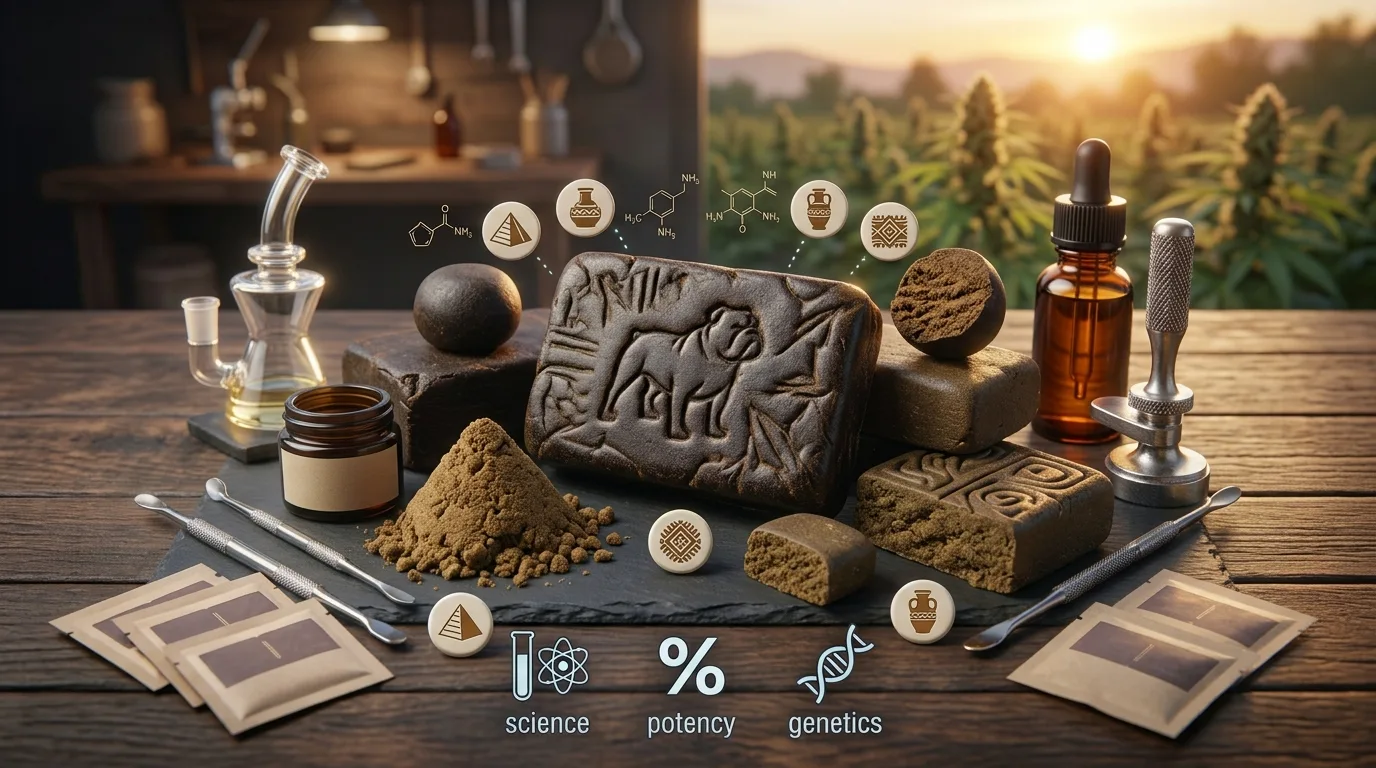
Long before vape pens and live resin, before shatter and distillate, there was hash. For more than three millennia, humans have been collecting cannabis resin and pressing it into concentrated blocks. It's the world's oldest cannabis extract, mentioned in ancient texts, carried along the Silk Road, and refined by mountain communities from the Hindu Kush to the Rif Valley.
Hash,short for hashish,is concentrated cannabis resin separated from the plant material and compressed into a solid form. Unlike flower, which you grind and smoke as is, hash isolates the trichomes (the tiny resin glands on cannabis that contain cannabinoids and terpenes) and consolidates them into a product that's typically two to four times stronger than traditional bud. The result is a dense, aromatic concentrate that delivers potent effects and complex flavours in a format that's remained largely unchanged for centuries.
This isn't a new trend or a lab innovation. Hash is the original concentrate, with production methods still practiced in Afghanistan, Morocco, Lebanon, and parts of India exactly as they were generations ago. Understanding hash means understanding the deep roots of cannabis culture itself.
The Mechanics: How Hash Is Made
Hash production starts with a simple principle: separate the resin from the plant matter. Cannabis trichomes,those crystalline, mushroom-shaped glands visible on quality flower,contain the vast majority of the plant's THC, CBD, terpenes, and other active compounds. Fresh or dried cannabis is covered in these glands. The challenge is harvesting them without bringing along excess leaf and stem.
Traditional methods accomplish this through mechanical separation. In hand-rubbing (the oldest technique, still used in parts of India and Nepal), fresh cannabis flowers are rolled between the palms until resin accumulates on the skin. This sticky black residue is scraped off and pressed into balls or blocks. It's labour-intensive and yields small amounts, but produces some of the most aromatic, full-spectrum hash available.
Dry sifting, common in Morocco and Afghanistan, involves rubbing dried cannabis over fine mesh screens. The trichome heads break off and fall through the screen, leaving plant material behind. The resulting powder,called kief,is then pressed using heat and pressure to form cohesive blocks. Screen size and the number of sifting passes determine purity: fewer passes through finer screens yield higher grades.
Ice water extraction (sometimes called bubble hash) is a modern refinement of ancient principles. Cannabis is submerged in ice water and agitated, causing trichomes to freeze and break away. The mixture is then filtered through progressively finer mesh bags. Different micron sizes capture different grades of resin, with the finest screens yielding the purest concentrate. This method produces a cleaner product than traditional techniques, though purists argue it sacrifices some of the complex flavour profile that comes with small amounts of plant waxes and lipids.
The Role of Heat and Pressure
Once resin is collected, it needs to be pressed. This isn't just about shaping,heat and pressure cause the trichomes to rupture slightly and their contents to bind together. Traditional hash makers in Afghanistan press kief in cloth bags, kneading and applying body heat until the powder transforms into a pliable, dark mass. Moroccan producers often use wooden presses or simple mechanical leverage.
The degree of heat and pressure affects the final product's texture and colour. Light pressure yields a crumbly, sandy hash that retains a lighter colour. Heavy pressure and more heat produce a dark, oily, almost plastic-like consistency. Both are "correct",it's a matter of regional tradition and desired characteristics.
A 3,000-Year Timeline: Hash Through History
The earliest references to hashish appear in ancient texts from the Middle East and Central Asia. While cannabis flower has been consumed for at least 5,000 years, concentrated resin preparations emerge in written records around 900-1000 CE, though archaeological evidence and oral traditions suggest use dating back much further. The word "assassin" is sometimes etymologically linked (though disputed by scholars) to "hashishin," referring to a medieval sect rumoured to use hash, illustrating how deeply the substance was woven into regional lore.
By the medieval period, hash production had spread across the Islamic world, where it was consumed in social settings and mentioned in medical texts as an analgesic and sedative. The technique moved along trade routes, with each region developing distinct production methods based on local climate, cannabis genetics, and cultural preferences.
Morocco's Rif Mountains became a hash production centre in the 20th century, exporting blonde and brown Moroccan hash throughout Europe. Afghanistan and Pakistan's border regions cultivated varieties specifically for resin production, creating the legendary Afghani and Pakistani black hash that set the standard for potency and aroma. Lebanon's Bekaa Valley produced red and blonde Lebanese hash, prized for its cerebral effects and spicy profile.
In the 1960s and 70s, Western travellers on the "hippie trail" encountered hash in Nepal, India, Afghanistan, and Morocco, bringing techniques and appreciation back to Europe and North America. This cultural exchange transformed hash from an exotic import to a sought-after product, eventually spurring domestic production using traditional methods adapted to new climates.
Hash in the Modern Era
Today's hash landscape is split between tradition and innovation. Countries like Morocco still produce thousands of tonnes annually using centuries-old methods. Meanwhile, Canadian and American craft producers apply ice water extraction and rosin pressing (a solventless technique using heat and pressure on flower or kief) to create ultra-pure concentrates that honour hash's heritage while pushing quality to new levels.
The legal Canadian market has embraced hash, with products ranging from imported traditional presses to domestically produced bubble hash and rosin. This diversity allows consumers to choose between old-world authenticity and modern refinement.
Hash Formats and What They Tell You
Not all hash is created equal, and its physical form often reveals its origin and production method. Understanding these formats helps you select the right product for your preferences.
Moroccan and Mediterranean Styles
Moroccan hash typically appears as a firm, sandy block ranging from light blonde to dark brown. It crumbles easily and has a spicy, earthy aroma with hints of incense. This style comes from dry sifting local landrace strains over silk screens, then pressing the kief lightly. Quality varies widely: premium Moroccan hash (sometimes called "zero zero" or double zero, referring to the finest screen grade) is light in colour, aromatic, and produces a clear, uplifting high. Lower grades incorporate more plant material and press darker.
Lebanese hash shares production methods with Moroccan but tends to be redder and slightly oilier, reflecting different cannabis genetics and regional pressing techniques. It's become rarer in recent decades due to political instability in the region, making authentic Lebanese hash a collector's item.
Afghan and Pakistani Black Hash
Afghan hash is dark, almost black, with a shiny surface and a pliable, sometimes sticky texture. It's made by hand-rubbing dried plants or dry sifting, then applying significant heat and pressure. The result is a potent, narcotic-leaning product with heavy body effects. The aroma is complex,earthy, spicy, with notes of wood and incense. When heated, quality Afghan hash bubbles and melts rather than burning harshly, a sign of purity.
Pakistani hash follows similar methods but often includes slight variations in genetics and curing. Both are beloved for their sedating, pain-relieving properties and rich flavour profiles that reflect the terroir of the Hindu Kush region.
Charas and Hand-Rubbed Hash
Charas, produced in the Indian Himalayas and parts of Nepal, is made exclusively by hand-rubbing live, flowering plants. Workers spend hours gently rolling buds between their palms, accumulating a thick layer of resin that's scraped off and formed into balls or sticks. This method captures terpenes at their peak freshness, yielding an intensely aromatic product with a full-spectrum effect profile. Authentic charas is rare and expensive, reflecting the labour investment and limited production regions.
Modern Ice Water Hash and Rosin
Ice water hash (bubble hash) is graded by micron size, with 73-90 micron "full melt" considered the highest quality. It appears as a light-coloured, granular or slightly pressed material that fully melts when dabbed, leaving minimal residue. This represents the modern pinnacle of solventless hash,pure trichome heads with virtually no contamination.
Rosin, made by pressing flower or hash with heat, produces a sappy, translucent extract. While technically a newer format, it's philosophically aligned with traditional hash: mechanical separation using only heat and pressure, no solvents, no chemicals. It's become popular among Canadian consumers seeking potency and purity without sacrificing the craft ethos.
How to Use Hash: Traditional and Modern Methods
Hash's versatility is part of its enduring appeal. Unlike some concentrates that require specialized equipment, hash adapts to nearly any consumption method with minimal modification.
The most traditional approach is smoking hash in a pipe or bong. Break off a small piece, warm it slightly with a lighter to soften it (don't burn it yet), and crumble it over a bed of tobacco or cannabis flower. Hash alone doesn't stay lit well, so mixing it ensures even burning. The resulting smoke is thick, flavourful, and potent,start with less than you think you need.
In joints or spliffs, hash works best when crumbled finely and distributed evenly. Some users roll thin "snakes" of softened hash and place them inside the joint for a concentrated core. This creates a slow, intense burn that extends the session. If you're used to flower's effects, remember that hash concentrates cannabinoids significantly,your typical dose should be smaller.
Vapourizing hash requires temperatures between 175-200°C (347-392°F). Many dry herb vapourizers accept hash when sandwiched between flower or placed on a concentrate pad. The flavour is cleaner than combustion, highlighting the terpene profile without the harshness of smoke. High-quality hash that fully melts can be dabbed on a nail or e-rig, though most traditional pressed hash leaves some residue.
Hash also works in edibles, though it requires decarboxylation (heating to activate THC). Crumble hash into melted butter or oil, simmer gently for 30-45 minutes, then strain and use in any recipe. The dosing is tricky,hash potency varies widely, so start conservatively and wait at least two hours before considering more.
Storage and Longevity
Properly stored hash outlasts flower by years. Keep it in an airtight container in a cool, dark place. Some traditionalists wrap it in parchment, then foil, then plastic, protecting it from air and light. Hash doesn't dry out like flower,in fact, it can improve with age as terpenes meld and the cannabinoid profile shifts slightly. Avoid refrigeration, which can introduce moisture and promote mould.
Why Hash Still Matters in the Age of Modern Extracts
With today's market offering distillates, live resin, and lab-tested isolates, you might wonder why anyone still chooses hash. The answer lies in what hash represents: a full-spectrum, minimally processed product that preserves the plant's complete chemical signature.
Unlike distillate (which isolates THC and strips away most other compounds) or many solvent-based extracts, quality hash retains the full range of cannabinoids, terpenes, and flavonoids present in the source material. This creates an entourage effect,the synergistic interaction of multiple compounds,that many users find more balanced and therapeutic than isolated THC. The high tends to be rounder, less racy, with a gradual onset and a fuller body sensation.
Hash also connects users to cannabis history in a tangible way. Smoking traditional Afghan hash is experiencing a product virtually identical to what was consumed centuries ago. There's a ritualistic quality to it,the warming, crumbling, the dense smoke, the complex flavour,that's been lost in some modern consumption methods. For many, this isn't nostalgia; it's about respecting the plant's heritage and the human knowledge refined over millennia.
From a practical standpoint, hash offers potency and portability. A small piece of hash contains the concentrated essence of several grams of flower, making it ideal for travel (where legal) or situations where discretion is valued. It doesn't produce the overwhelming smell of fresh flower, and it doesn't dry out or degrade as quickly.
The Canadian market has embraced this balance of old and new. Consumers can choose imported traditional hash for an authentic experience or modern ice water extracts for maximum purity. Both honour the same fundamental principle: concentrating cannabis resin through mechanical means, without solvents or extensive processing.
Choosing Quality Hash: What to Look For
Quality assessment in hash requires different criteria than flower. Appearance, aroma, texture, and burn characteristics all provide clues about production method, purity, and potency.
First, examine colour and texture. Blonde or light brown hash typically indicates minimal plant material and gentle processing. Dark hash isn't necessarily lower quality,Afghan black hash is prized specifically for its colour,but in Moroccan styles, very dark hash sometimes signals contamination with leaf matter. The texture should be appropriate to type: Moroccan hash should be firm but crumbly, Afghan hash pliable and slightly sticky, bubble hash granular or lightly pressed.
Smell is critical. Quality hash has a complex, layered aroma,earthy, spicy, sometimes fruity or floral, depending on the source strain. It should smell like concentrated cannabis, not like hay, grass, or nothing at all. Harsh chemical smells suggest contamination or improper curing. When warmed slightly in your hands, the aroma should intensify.
The Bubble Test
One traditional quality indicator is how hash behaves when heated. Touch a flame to a small piece and watch what happens. High-quality hash bubbles and melts, producing light grey ash. Lower-quality product flames up, crackles (indicating plant material), or leaves black, hard residue. This isn't perfect,some excellent traditional hash doesn't bubble extensively,but it's a useful baseline, especially for water-extracted products that should fully melt.
Pricing offers another clue. Authentic imported hash from traditional production regions, or high-grade domestic bubble hash, commands premium prices reflecting labour, rarity, and quality. Extremely cheap hash often incorporates significant plant material or comes from lower-grade sift. As with flower and concentrates, you generally get what you pay for.
The Future of an Ancient Tradition
Hash sits at an interesting crossroads in the cannabis industry. Legal markets have created opportunities for craft producers to elevate traditional techniques while maintaining solventless, full-spectrum principles. At the same time, global demand has strained traditional production regions, sometimes leading to quality compromises or unsustainable practices.
In Canada, the trend is toward premium, small-batch hash made from high-quality source material. Producers are using ice water extraction and rosin pressing to create products that meet modern expectations for purity while honouring hash's artisanal roots. These products often cost more than imported hash but offer transparency about source genetics, production methods, and cannabinoid content that traditional imports can't match.
Simultaneously, imported traditional hash maintains a loyal following among connoisseurs who value authenticity and regional character. Moroccan blonde, Afghan black, and Pakistani hash each offer flavour profiles and effects shaped by specific genetics and production traditions that can't be exactly replicated elsewhere.
The challenge for the industry is preserving traditional knowledge while ensuring product safety and quality. Unlike flower, hash production involves human handling and processing that can introduce contamination if not done carefully. Regulations and testing help address this, though they sometimes conflict with traditional methods that have worked for centuries.
Ultimately, hash's future likely includes both paths: premium domestic production using modern refinements, and continued importation of traditional products from established regions. Both serve the market, offering consumers choice between cutting-edge purity and time-honoured authenticity.
Explore Premium Hash Products
Experience the full range of traditional and modern hash formats, from imported classics to Canadian craft concentrates.
Shop Hash SelectionGenerally yes. Hash concentrates trichomes, which contain most of the plant's THC and other cannabinoids. While flower typically ranges from 15-25% THC, quality hash often tests between 40-60%, though potency varies significantly by production method and source material. Start with smaller amounts than you'd use with flower.
Kief is the powder of separated trichomes before pressing. Hash is kief that's been compressed using heat and pressure into a solid block or ball. The pressing process changes the texture, appearance, and sometimes the flavour profile, but both are concentrated cannabis resin. You can make hash from kief using simple hand pressure and warmth.
When stored properly in an airtight container, hash produces less ambient smell than flower because it's more compact and doesn't release terpenes as readily. However, when heated or crumbled, quality hash can be quite aromatic. It's more discreet for storage but not odourless during use.
Yes, the simplest method is collecting kief from a grinder's bottom chamber and pressing it with your thumbs or between parchment paper with a warm iron. For better results, you can buy bubble hash bags and use ice water extraction with just a bucket, ice, and mesh bags. Rosin pressing requires a press or hair straightener but produces high-quality results.
Imported hash from traditional production regions benefits from decades of established infrastructure, lower labour costs, and purpose-grown landrace strains. Canadian craft hash uses premium genetics, modern facilities, testing, and higher labour costs. You're paying for different things: traditional authenticity versus documented purity and domestic production standards.
Hash is remarkably stable. Stored in an airtight container away from light, heat, and moisture, it can maintain potency for several years. Some users report hash actually improving with age as terpenes meld. It doesn't dry out like flower, and the concentrated form protects cannabinoids from degradation better than loose plant material.
Conclusion: The Original Concentrate, Still Relevant
Hash isn't a relic or a curiosity,it's the foundation of cannabis concentration, a 3,000-year-old tradition that still produces some of the most nuanced, full-spectrum products available. From the hand-rubbed charas of the Himalayas to the precisely micron-graded bubble hash of Canadian craft producers, hash represents a continuous line of human ingenuity applied to capturing cannabis's essence.
Understanding hash means understanding cannabis history, production methods, and the differences between mechanical and solvent-based extraction. It means recognizing that older doesn't mean inferior, and that traditional techniques refined over centuries sometimes produce results modern technology can't quite replicate. Whether you choose traditional Afghan black hash for its complex, sedating effects or premium ice water hash for its purity and clarity, you're participating in one of humanity's oldest relationships with the cannabis plant.
As the Canadian market matures, hash offers both authenticity and innovation,a bridge between cannabis's ancient past and its modern possibilities. It remains what it's always been: concentrated resin, thoughtfully produced, connecting users across time and geography through shared technique and appreciation. That's why hash still matters, and why it will continue to matter as long as people value craftsmanship, history, and the full spectrum of what cannabis can offer.


