When you order cannabis online or visit a local dispensary, the rules governing that transaction depend entirely on where you live. Canada legalized cannabis federally in 2018, but each province and territory built its own regulatory framework on top of that baseline. The result? Thirteen distinct sets of rules covering everything from purchase age to possession limits to where you can legally consume.
This comprehensive reference guide breaks down the cannabis regulations across all Canadian provinces and territories, updated for 2025. Whether you're travelling, relocating, or simply curious about how your home jurisdiction compares, this is your definitive resource for understanding the patchwork of cannabis laws that govern the country.
Understanding the Federal-Provincial Split in Cannabis Regulation
The Cannabis Act of 2018 established federal baseline rules that apply everywhere in Canada. These include the legalization of possession up to 30 grams in public, cultivation of up to four plants per household, and a minimum purchase age of 18. However, the Act explicitly granted provinces and territories the authority to set stricter rules within their borders.
This federal-provincial arrangement mirrors how Canada regulates alcohol. The federal government handles production standards, import-export rules, and criminal penalties, while provinces control retail models, taxation rates, consumption spaces, and local enforcement. Some provinces embraced a government-run retail monopoly. Others opened the market to private retailers. A few did both.
The key areas where provinces differ include minimum purchase age, public possession limits, public consumption rules, home cultivation permissions, and retail structure. No province can make rules more permissive than federal law, but they can add restrictions. Alberta, for example, allows 18-year-olds to purchase cannabis, matching the federal minimum. Quebec raised its age to 21, exercising its right to be stricter.
This regulatory diversity means that cannabis delivery services operate under dramatically different frameworks depending on where they ship. A behavior that's perfectly legal in one province might carry fines in another. Understanding these differences isn't just academic curiosity, it's practical knowledge for anyone who consumes cannabis in Canada.
The Complete Province-by-Province Cannabis Rules Table
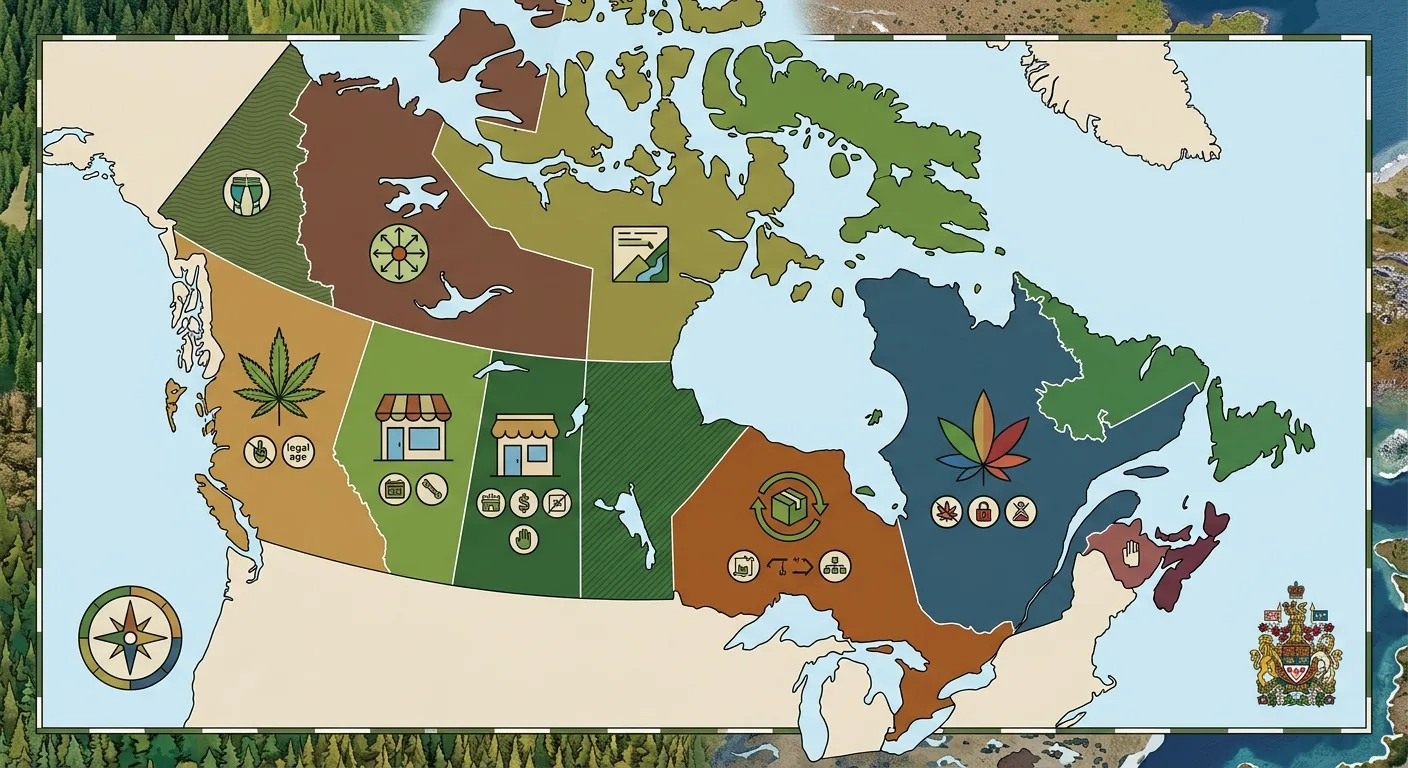
The table below represents the most comprehensive snapshot of cannabis regulations across Canada's thirteen jurisdictions. Each row captures the essential rules that affect daily cannabis use: minimum age, public possession limits, home cultivation allowances, public consumption restrictions, and the retail model governing legal purchases.
| Province/Territory | Min. Age | Public Possession Limit | Home Cultivation | Public Consumption | Retail Model |
|---|---|---|---|---|---|
| Alberta | 18 | 30g | 4 plants | Where tobacco smoking permitted | Private retail |
| British Columbia | 19 | 30g | 4 plants | Where tobacco smoking permitted, plus parks | Mixed (BC Cannabis Stores + private) |
| Manitoba | 19 | 30g | Prohibited | Private property only | Private retail |
| New Brunswick | 19 | 30g | 4 plants | Where tobacco smoking permitted | Government retail (Cannabis NB) |
| Newfoundland & Labrador | 19 | 30g | 4 plants | Where tobacco smoking permitted | Private retail |
| Northwest Territories | 19 | 30g | 4 plants | Where tobacco smoking permitted | Government retail (NWT Liquor & Cannabis) |
| Nova Scotia | 19 | 30g | 4 plants | Where tobacco smoking permitted | Government retail (NSLC Cannabis) |
| Nunavut | 19 | 30g | 4 plants | Where tobacco smoking permitted | Government retail (Nunavut Liquor & Cannabis) |
| Ontario | 19 | 30g | 4 plants | Where tobacco smoking permitted | Private retail |
| Prince Edward Island | 19 | 30g | 4 plants | Where tobacco smoking permitted | Government retail (Cannabis PEI) |
| Quebec | 21 | 30g | Prohibited | Private property only, strict public bans | Government retail (SQDC) |
| Saskatchewan | 19 | 30g | 4 plants | Where tobacco smoking permitted | Private retail |
| Yukon | 19 | 30g | 4 plants | Where tobacco smoking permitted | Private retail |
This table serves as a quick reference, but the rules contain nuances that deserve deeper exploration. The sections below unpack the key regulatory categories and highlight the meaningful differences that affect how Canadians interact with legal cannabis.
Purchase Age: Why Two Provinces Chose 21
Most provinces set their minimum cannabis purchase age at 19, aligning with alcohol regulations. Alberta stands alone at 18, matching both its alcohol age and the federal minimum. Quebec raised its age to 21 in 2020, making it the strictest jurisdiction in Canada and one of only two that deviates from the 19-year standard.
The rationale for age restrictions centres on brain development research. Studies suggest the prefrontal cortex continues developing into the mid-twenties, and regular cannabis use during adolescence may affect cognitive function. Quebec's government cited this research when raising its age limit, arguing that 21 provides additional protection during critical developmental years.
Critics of the 21-year threshold point out that it may push young adults toward illegal markets. If a 20-year-old in Montreal can't purchase legally, they're more likely to buy from unlicensed sources that don't verify age, check product safety, or pay taxes. Alberta's decision to maintain 18 reflects a different philosophy: that legal access with proper regulation is safer than prohibition, and that 18-year-olds are legal adults capable of making informed decisions.
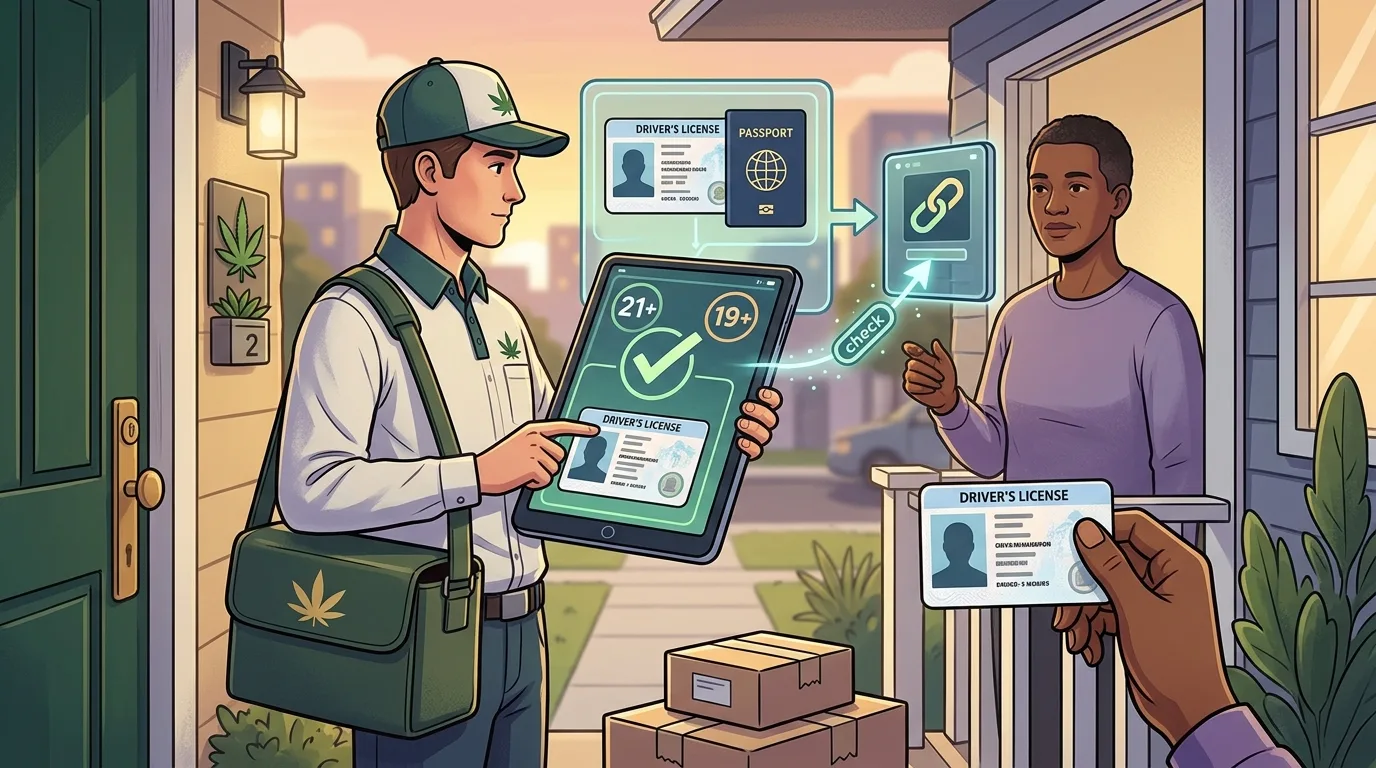
For cannabis retailers and delivery services, age verification protocols must match the strictest standard. Online orders require government-issued ID verification at the point of delivery, and any uncertainty results in a refused sale. The penalties for selling to minors are severe across all jurisdictions, ranging from thousands of dollars in fines to licence suspension for retailers.
Special Considerations for Border Provinces
The age difference creates practical complications in border regions. Someone who's 19 and lives in Gatineau, Quebec cannot legally purchase cannabis in their home province, but they could theoretically cross the river to Ottawa, Ontario where 19 is the legal age. However, transporting cannabis across provincial borders is legal under federal law, so the purchase would be valid. The complexity illustrates how Canada's patchwork approach creates navigational challenges for consumers near provincial boundaries.
Home Cultivation: The Two Provinces That Banned Growing
Federal law permits households to cultivate up to four cannabis plants, provided they're from licenced seeds or seedlings and not visible from public spaces. Most provinces adopted this federal standard without modification. Manitoba and Quebec took a different path, implementing outright bans on home cultivation within their borders.
Both provinces justified their bans on public safety grounds. Quebec argued that home cultivation posed risks related to fire, electrical hazards, and organized crime infiltration. Manitoba echoed these concerns and added that enforcing plant limits would prove difficult for law enforcement. Neither ban survived legal challenges intact, though implementation has been messy.
In 2019, a Quebec Superior Court struck down the province's cultivation ban as unconstitutional, ruling it infringed on federal jurisdiction over criminal law. Quebec appealed, but the ruling stands pending further legal proceedings. Manitoba's ban faced similar legal challenges. The practical effect is that home cultivation occupies a grey zone in both provinces where residents can technically grow plants under federal law, but provincial authorities haven't officially sanctioned it and may still issue tickets.
For residents of the other eleven jurisdictions, home cultivation follows consistent rules. Four plants maximum per household, not per person. Plants must be kept out of public view. Landlords can prohibit growing in rental properties. Some municipalities added restrictions like requiring plants to be grown indoors only, but these local bylaws vary widely.
The cultivation conversation matters because home growing represents a significant segment of cannabis consumption. Health Canada estimates that hundreds of thousands of Canadian households grow at least some of their own supply. The prohibition in Manitoba and Quebec affects millions of residents who might otherwise cultivate, pushing them toward retail purchases or, potentially, illegal growing operations.
Public Consumption Rules: From Permissive to Prohibitive
Where you can legally consume cannabis varies more than any other category. The baseline rule across most provinces is simple: cannabis can be consumed anywhere tobacco smoking is permitted. This typically means outdoors in most public spaces, but not in enclosed areas like restaurants, bars, or workplaces. It also means restrictions near schools, playgrounds, and other youth-focused locations.
British Columbia goes further than most, explicitly allowing cannabis consumption in provincial parks where smoking is otherwise permitted. The province's approach reflects its longstanding cannabis culture and recognition that outdoor recreation and cannabis use often intersect for residents and tourists alike.
At the other end of the spectrum, Quebec and Manitoba enforce much stricter rules. Quebec prohibits consumption in all public spaces, limiting use to private property only. This means no smoking in parks, on sidewalks, or anywhere the public has access. Manitoba takes a similarly restrictive approach, though with slightly more flexibility in designated areas.
The public consumption debate touches on competing interests. Permissive rules acknowledge that cannabis is legal and adults should be able to use it in appropriate outdoor settings without criminal penalties. Restrictive rules prioritize concerns about secondhand exposure, particularly for children, and aim to prevent normalization of cannabis use in public life.
For practical purposes, most cannabis consumers need to understand three layers of rules. Federal law sets the outer boundary. Provincial law adds restrictions. Municipal bylaws add further limitations. A park in downtown Toronto might allow cannabis consumption under Ontario's provincial rules, but a local bylaw might prohibit it within that specific park's boundaries. Checking local regulations prevents unwanted tickets and conflicts.
Consumption in Vehicles
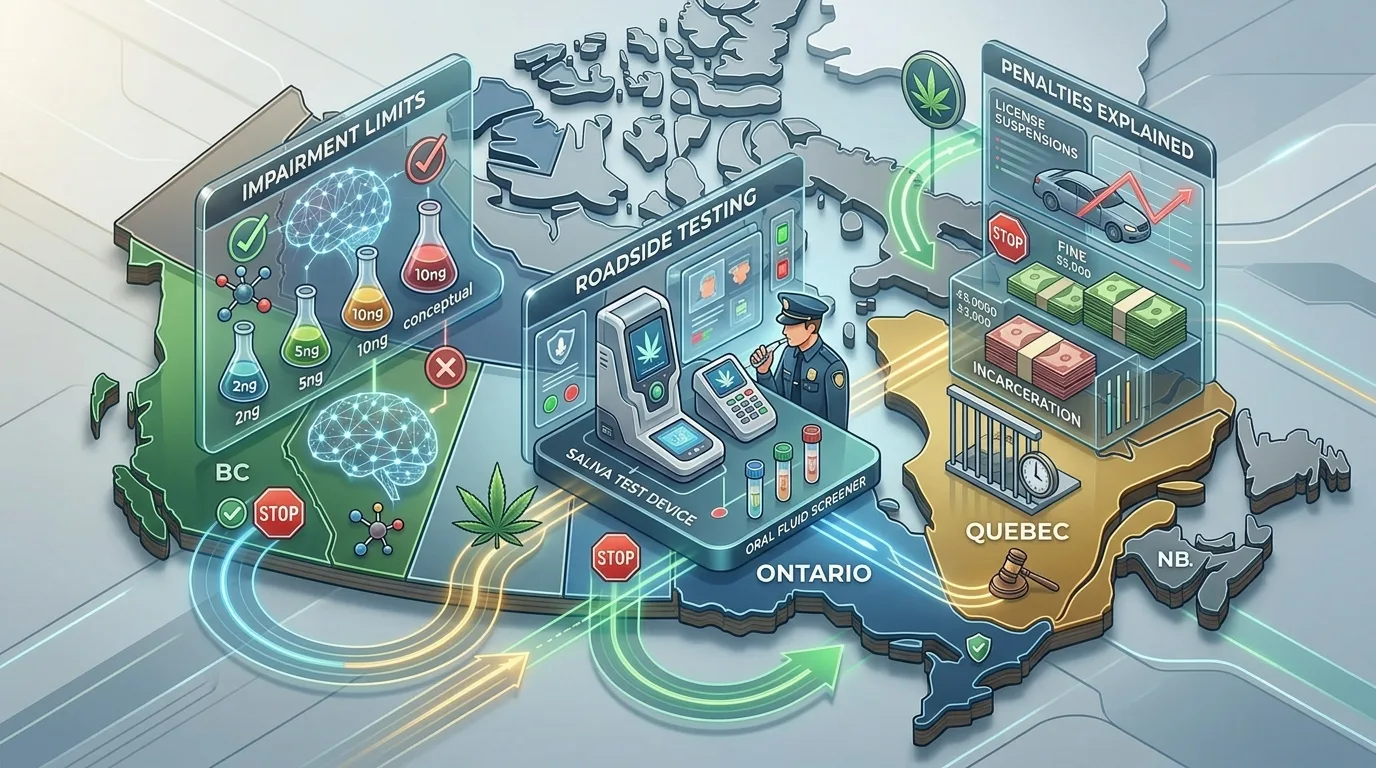
Every province prohibits cannabis consumption in vehicles, whether the vehicle is moving or parked. This applies to drivers and passengers alike. The rule extends to boats, RVs, and any motorized vehicle. Even if you're a passenger in a parked car with the engine off, consuming cannabis may violate provincial traffic laws. The penalties mirror impaired driving rules, with fines and potential licence suspensions.
Retail Models: Government Monopoly vs Private Competition
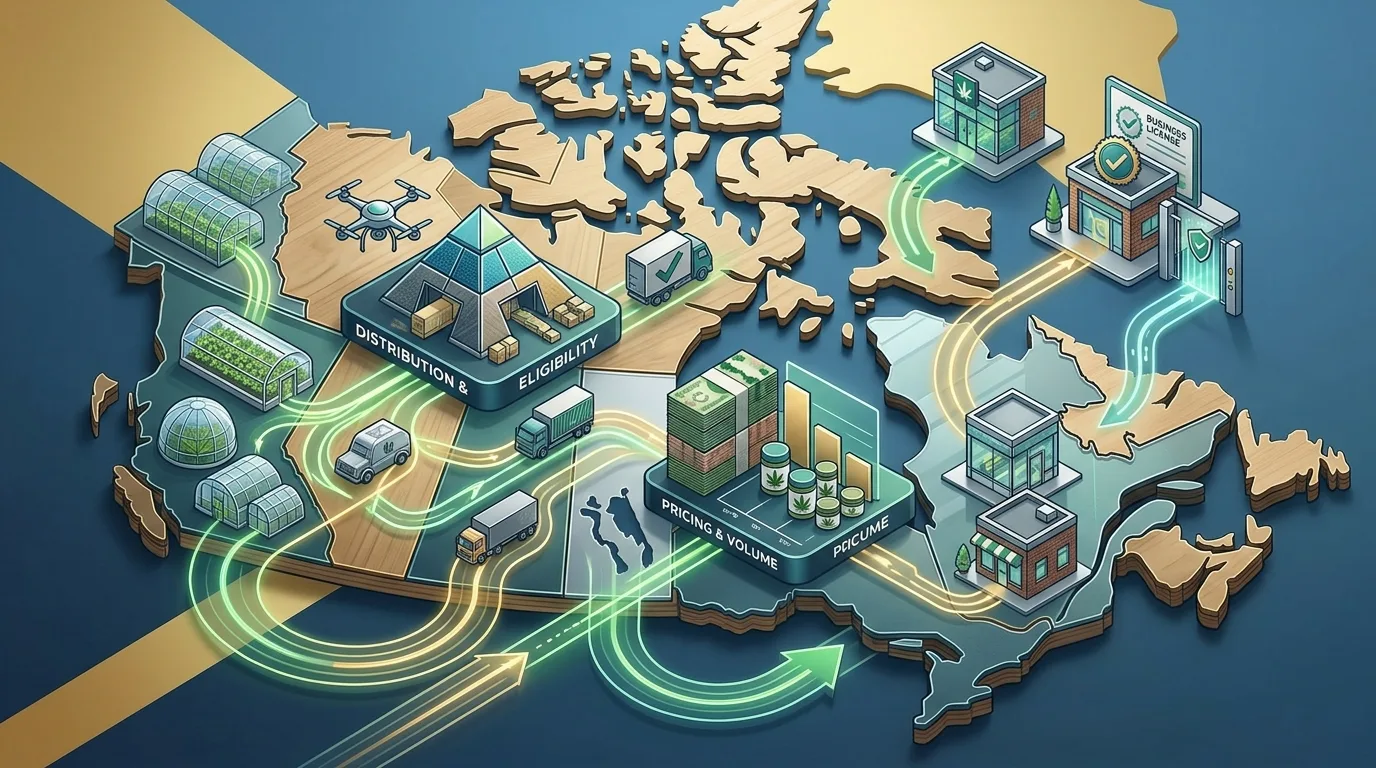
The structure of legal cannabis retail splits Canadian provinces into three categories: government-run monopolies, fully private retail systems, and hybrid models that combine both. These differences affect everything from product selection to pricing to convenience.
Government Monopoly Provinces
New Brunswick, Nova Scotia, Prince Edward Island, Northwest Territories, Nunavut, and Quebec operate government-controlled retail systems. In these jurisdictions, a crown corporation manages all legal cannabis sales through physical stores and online platforms. New Brunswick's Cannabis NB, Quebec's SQDC (Société québécoise du cannabis), and Nova Scotia's NSLC Cannabis stores exemplify this model.
The monopoly approach offers certain advantages. Centralized control ensures consistent quality standards, predictable pricing, and clear accountability. Revenue flows directly to provincial coffers, funding public services. The downside is limited competition, potentially higher prices, and fewer retail locations compared to private markets. Quebec's SQDC, despite operating the country's strictest rules, manages one of the most successful retail operations by sales volume, demonstrating that monopolies can succeed if well-executed.
Private Retail Provinces
Alberta, Manitoba, Ontario, Saskatchewan, Newfoundland and Labrador, and Yukon opened their markets to private retailers. These provinces issue licences to independent businesses that compete for customers through location, selection, pricing, and service. Ontario alone has licenced over 1,400 retail stores since 2019, creating one of the world's most competitive cannabis markets.
Private retail creates market diversity. Stores differentiate through branding, customer experience, and product curation. Competition theoretically drives prices down and service quality up. The model also shifts regulatory burden to licence management rather than direct retail operation. The tradeoff is less government control over where stores locate and how they operate, leading to concerns about oversaturation in some urban areas.
For consumers looking to buy cannabis online in Canada, private retail provinces often feature more delivery options and competitive pricing due to the market dynamics at play.
Hybrid Models
British Columbia operates a hybrid system where government-run BC Cannabis Stores compete with licenced private retailers. The approach attempts to capture benefits from both models, providing government revenue through crown corporation sales while allowing market innovation through private competition. The model has worked reasonably well, though government stores sometimes struggle to compete with private retailers on convenience and selection.
Possession Limits and Equivalency Rules
Every province maintains the federal 30-gram public possession limit for dried cannabis. However, the Cannabis Act establishes equivalency rules for other product formats because edibles, concentrates, and other forms contain different THC concentrations than dried flower. Understanding these equivalencies matters for staying within legal limits when carrying multiple product types.
The federal equivalency formula treats one gram of dried cannabis as the baseline. Five grams of fresh cannabis equals one gram dried. One gram of concentrates equals five grams dried. Fifteen grams of edibles equals one gram dried. One seed or seedling equals zero grams. These ratios allow calculation of mixed possession limits.
For example, if you're carrying 15 grams of dried flower, 2.5 grams of shatter, and 30 grams of edibles in Manitoba, your total equivalent is 15g (flower) + 12.5g (2.5g concentrate × 5) + 2g (30g edibles ÷ 15) = 29.5 grams equivalent, just under the 30-gram limit.
In practice, most consumers never approach these limits during normal activity. The rules matter most when travelling with cannabis or making large purchases. Some provinces require retailers to track cumulative daily purchases per customer to prevent individuals from exceeding legal limits through multiple transactions, though enforcement varies.
Provincial Cannabis Taxes and Pricing
Beyond regulatory differences, provinces impose varying tax structures on cannabis sales. The federal excise tax applies everywhere: $1 per gram or 10 percent of producer price, whichever is higher. Provinces then add their own retail taxes through either excise markups or sales tax applications.
Quebec and other monopoly provinces typically build provincial tax into retail prices through crown corporation markups. Private retail provinces apply provincial sales taxes at the point of sale. The combined federal-provincial tax burden ranges from roughly 20 percent to over 30 percent depending on jurisdiction and product category. These taxes fund regulatory operations, public education campaigns, and general revenues.
Price competition varies dramatically by retail model. Ontario's saturated private market has driven average dried flower prices down significantly through competitive pressure. Quebec's SQDC maintains relatively stable pricing due to its monopoly position. For consumers, the lesson is simple: where you live affects what you pay, and shopping across provincial lines (which is legal for personal use) can yield savings if you're near a border.