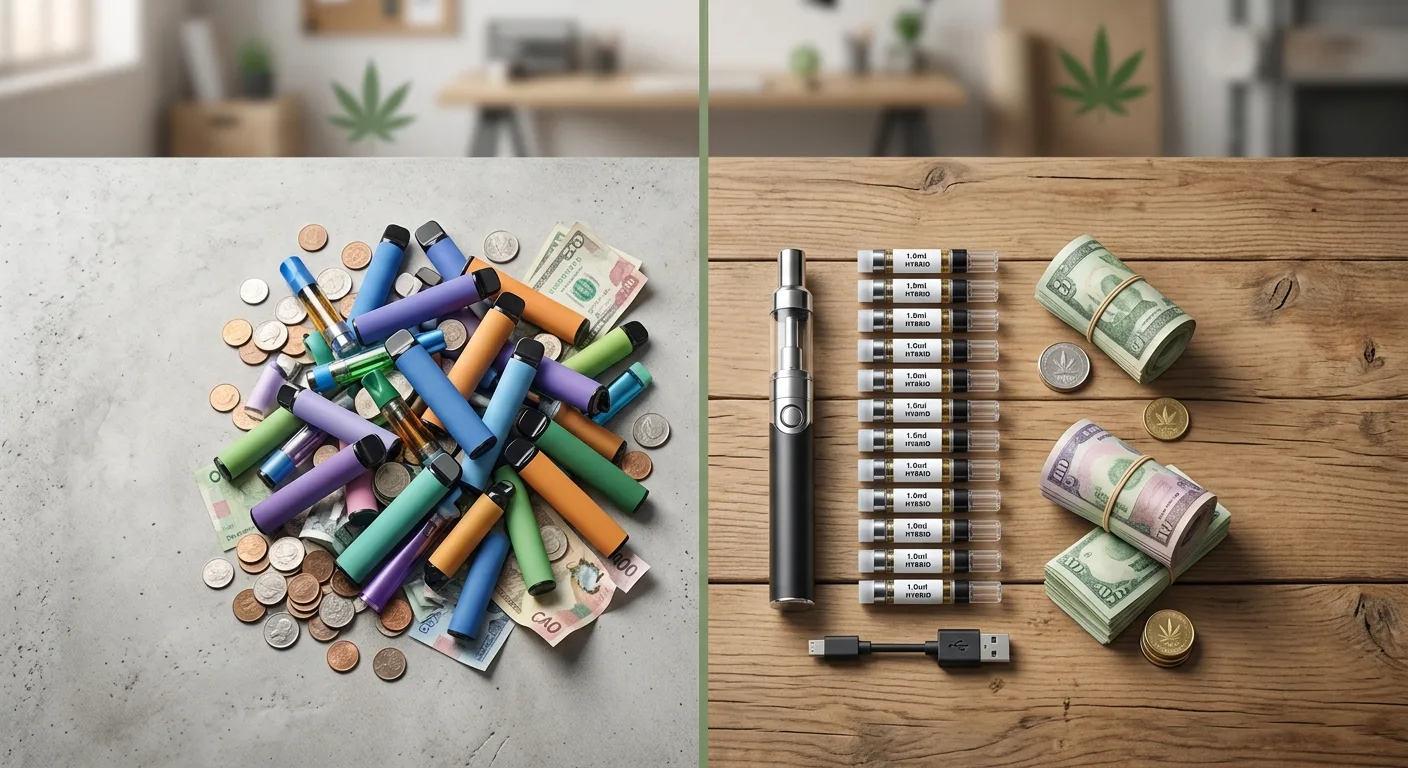
Walk into any cannabis dispensary in Canada and you'll face a choice that seems simple on the surface: grab a disposable vape pen for $35, or invest in a rechargeable battery and buy cartridges separately. Most articles on this topic will give you vague advice about "convenience versus savings." This one won't. We're running the actual numbers,cost per gram of distillate, monthly consumption patterns, and twelve-month projections,to show you exactly what each format costs over time.
The difference isn't trivial. For a moderate user vaping 2 grams per month, the format you choose will either cost you $420 or $720 annually. That's a $300 swing, and it comes down to understanding cost-per-gram math that most budtenders won't calculate for you at the counter.
Understanding the Two Vape Formats
Before we dive into spreadsheets, let's clarify what we're comparing. A disposable vape pen is an all-in-one unit: battery, heating element, and pre-filled THC distillate in a single sealed device. You use it until the oil runs out (typically 0.5g to 1g of distillate), then discard the entire unit. No charging cables, no button presses,just inhale and go.
A cartridge system separates these components. You buy a rechargeable 510-thread battery once (usually $15-$25), then purchase individual cartridges (commonly 0.5g or 1g) that screw onto that battery. When a cart runs dry, you unscrew it, toss it, and attach a new one. The battery lasts hundreds of charge cycles.
What's Actually Inside
Both formats contain the same core ingredient: cannabis distillate, a highly refined THC oil typically ranging from 80-95% potency. Most brands add strain-specific terpenes for flavour and effect. The oil itself is chemically identical whether it's in a disposable or a cartridge,the difference lies entirely in the hardware delivery system and the business model behind it.
The hardware quality varies significantly. Disposables use the cheapest possible heating elements because manufacturers know you'll throw them away. Cartridge systems allow you to invest in better atomizer technology once, then benefit from consistent vapour quality across dozens of carts.
The Base Cost Breakdown: Price Per Gram
Here's where most consumers make their mistake: they compare sticker prices instead of calculating cost per gram of distillate. Let's establish benchmark prices based on typical Canadian dispensary rates in 2025.
Disposable Vape Pens
A standard 1g disposable at a mid-tier dispensary runs $35-$45. Premium brands like Drizzle Factory charge $40-$50 for their 2g units. Budget options drop to $25-$30 for 0.5g. Let's use realistic averages:
- 0.5g disposable: $28 = $56/gram
- 1g disposable: $40 = $40/gram
- 2g disposable: $80 = $40/gram
Notice that 2g disposables offer no per-gram savings over 1g units,you're paying the same rate, just buying in bulk. The hardware cost is embedded in every purchase.
Cartridge System
A quality 510 battery costs $20 (one-time purchase). Cartridge prices follow this pattern:
- 0.5g cartridge: $25 = $50/gram + distillate
- 1g cartridge: $35 = $35/gram + distillate
- 2g cartridge: $60 = $30/gram + distillate
Add the $20 battery to your first purchase, and the first cartridge effectively costs more. But that battery never needs replacing,it's a sunk cost that amortizes over dozens of carts.
The 12-Month Cost Projection: Four User Profiles
Abstract per-gram rates mean nothing without context. Let's model four realistic consumption patterns and calculate annual costs for each format. These projections assume consistent product quality and stable pricing.
Light User: 1 Gram Per Month
This user takes a few hits most evenings, making a single gram last 30 days. That's 12 grams annually.
Disposable route (1g units):
12 units × $40 = $480/year
Cartridge route (1g carts):
Initial: $20 battery + $35 cart = $55
Months 2-12: 11 carts × $35 = $385
Total: $440/year
Savings: $40 annually
At light consumption, the formats are nearly identical in cost. The $40 annual difference barely justifies thinking about it,choose based on convenience preference.
Moderate User: 2 Grams Per Month
Daily evening use or weekend sessions. This is the most common consumption pattern among regular cannabis users. That's 24 grams annually.
Disposable route (1g units):
24 units × $40 = $960/year
Cartridge route (1g carts):
Initial: $20 battery + $35 cart = $55
Months 2-12: 23 carts × $35 = $805
Total: $860/year
Savings: $100 annually
Now we're seeing meaningful separation. A hundred dollars covers two free grams of distillate,or more importantly, it's a 10% reduction in annual cannabis spending. The math shifts further if you buy 2g cartridges instead of 1g units.
Cartridge route (2g carts):
Initial: $20 battery + $60 cart = $80
Months 2-12: 11 carts × $60 = $660
Total: $740/year
Savings vs disposables: $220 annually
By purchasing larger cartridges, the moderate user cuts costs by nearly 25%. That $220 is real money,equivalent to 5.5 grams of free distillate just by changing hardware format.
Heavy User: 4 Grams Per Month
All-day micro-dosing or sharing with a partner. This user goes through 48 grams annually.
Disposable route (2g units):
24 units × $80 = $1,920/year
Cartridge route (2g carts):
Initial: $20 battery + $60 cart = $80
Months 2-12: 23 carts × $60 = $1,380
Total: $1,460/year
Savings: $460 annually
We've crossed into serious money territory. That $460 savings represents 11.5 grams of distillate,nearly three months of free consumption just by switching formats. For heavy users, disposables are financially indefensible unless convenience has extraordinary value to you.
Medical User: 6 Grams Per Month
Chronic pain management or severe anxiety treatment. This user consumes 72 grams annually, often through scheduled micro-doses throughout the day.
Disposable route (2g units):
36 units × $80 = $2,880/year
Cartridge route (2g carts):
Initial: $20 battery + $60 cart = $80
Months 2-12: 35 carts × $60 = $2,100
Total: $2,180/year
Savings: $700 annually
At medical-level consumption, disposables become absurdly expensive. That $700 annual premium buys you... what, exactly? The privilege of not unscrewing a cartridge? For patients on fixed incomes, this math isn't academic,it's the difference between affording treatment and rationing medicine.
The Hidden Costs Nobody Calculates
Our projections above assume perfect conditions: every disposable works flawlessly, every cartridge empties completely, prices remain stable. Real-world usage introduces variables that skew costs in unexpected directions.
Disposable Failure Rate
Industry estimates suggest 5-10% of disposable vapes fail before empty,clogged airways, dead batteries, or manufacturing defects. Most retailers won't exchange a partially used disposable. At 10% failure rate, our moderate user (24 disposables/year) loses 2.4 units worth $96 to defects. That's an additional hidden cost disposable advocates never mention.
Cartridge systems isolate failure points. A bad cart costs $35 to replace; a dead battery (rare) costs $20. You're never throwing away both simultaneously.
Incomplete Consumption
Disposables often retain 10-15% of their oil when the battery dies. That's distillate you paid for but can't access. On a 1g disposable, you're losing 0.1-0.15g per unit. For our moderate user, that's 2.4-3.6g of wasted distillate annually, worth $96-$144 at retail rates.
Cartridges on manual batteries let you adjust voltage to extract every last drop. Many users report getting 5-10% more consumption from carts versus disposables purely through hardware control.
Impulse Purchase Premium
Disposables encourage grab-and-go buying. You're at a dispensary for flower, you spot a new disposable flavour, you add it to the order. This behaviour pattern increases consumption through availability. It's not a direct cost, but it's worth acknowledging: cartridge users who buy in bulk (4-6 carts at once) tend to budget more consciously than disposable users making frequent small purchases.
When Disposables Actually Make Financial Sense
After 1,300 words of math showing cartridges win, let's be fair: there are scenarios where disposables justify their premium.
Experimental Purchases
Trying a new brand or flavour profile? A $40 disposable is cheaper than committing to a $60 2g cartridge you might hate. Think of disposables as sample sizes. Once you've identified strains you love, switch to cartridges for regular consumption.
Travel and Discretion
Airport security and hotel rooms create complications. Disposables are self-contained and more easily concealed than battery-plus-cart systems. The premium you pay for disposables might be worth it for 5-6 travel days per year, while cartridges handle your home consumption more economically.
Infrequent Use
If you vape once every 2-3 months at parties, the math changes. A light user consuming 4 grams annually saves only $15-$20 with cartridges,hardly worth the mental energy of tracking batteries and carts. Disposables offer appropriate simplicity.
Avoiding Cross-Contamination
Some users rotate between sativa daytime strains and indica nighttime formulas. Running two separate cartridges on one battery risks flavour bleed between strains (though minimal). Dedicated disposables ensure pure strain expression. Whether this matters enough to justify doubling your annual costs is a personal judgment call.
If you're curious about maximizing your cannabis value across all product categories, understanding quality grades in flower purchases applies similar cost-benefit logic to your overall cannabis budget.
Battery Technology: The Variable Nobody Talks About
The $20 battery assumption in our calculations deserves scrutiny. Battery quality varies enormously, and cheap units create false economy.
Budget Batteries ($10-$15)
These work, barely. Fixed voltage (usually 3.7V), no preheat function, inconsistent connection threads. They'll last 50-100 charge cycles before voltage sag makes them useless. At heavy use, that's 6-9 months. You'll replace them 1-2 times per year, adding $20-$30 to your annual cartridge costs and narrowing the savings gap.
Mid-Range Batteries ($20-$35)
Variable voltage (3.0-4.2V), preheat modes, better build quality. These last 200+ cycles,18-24 months of heavy use. This tier offers the best cost-per-cycle value. You're buying once and forgetting about it.
Premium Batteries ($40-$60)
Digital displays, precise temperature control, warranty coverage. These batteries outlast your interest in vaping. For enthusiasts who care about vapour flavour profiles, the investment makes sense. For cost-conscious users, the mid-range tier suffices.
Our projections used a $20 battery (mid-range entry level) as baseline. If you cheap out on a $10 battery and replace it twice yearly, add $20 to the annual cartridge costs,disposables start looking more competitive for moderate users.
Environmental Cost: The Externality You're Paying For
This article focuses on financial math, but disposables carry an environmental cost that eventually becomes economic through regulatory pressure. Each disposable contains a lithium battery that Canadian municipalities struggle to recycle. As of 2025, British Columbia is considering a $2 per-unit extended producer responsibility fee on disposable vapes to fund battery recycling programs. If this passes and spreads nationally, our cost projections shift dramatically.
A $2 EPR fee turns a $40 disposable into a $42 purchase. For our heavy user buying 24 units annually, that's an additional $48,closing the savings gap by 10%. Some provinces may go further, following the EU model of $5+ sustainability levies on single-use electronics.
Cartridge systems generate less waste (just the glass and metal cart, no battery each time), likely exempting them from future disposal fees. This isn't speculation,it's the documented policy direction in multiple provinces. The financial math we've run may be conservative; disposables could become 15-20% more expensive within 24 months through regulatory action.
The Verdict: A Framework for Decision-Making
After running the numbers across four user profiles and accounting for hidden costs, here's the decision framework:
Choose disposables if:
- You consume less than 1 gram monthly (savings under $40/year aren't meaningful)
- You're experimenting with new strains and don't want commitment
- You travel frequently and need maximum portability
- Simplicity has extraordinary value to you personally
Choose cartridges if:
- You consume 2+ grams monthly (savings exceed $100/year)
- You've identified preferred strains and buy consistently
- You're willing to manage charging cables and hardware
- Environmental impact concerns you (even slightly)
For the moderate-to-heavy user,which describes most regular cannabis consumers,cartridges offer 15-30% annual savings with minimal inconvenience. That's not lifestyle optimization advice, it's arithmetic. You're either paying $860 or $960 for the same 24 grams of distillate. Choose accordingly.
Understanding terpene profiles in your vape oil matters as much as the hardware format,both factors combined determine your actual experience and cost efficiency.
Premium Vape Selection
Browse our curated selection of disposables and cartridges with transparent per-gram pricing. We carry multiple formats so you can choose what makes financial sense for your consumption pattern.
Shop VapesReal-World Hybrid Strategy: The Best of Both
Few articles acknowledge that optimal strategy often combines formats. Here's what experienced users actually do:
Maintain a cartridge system for home use with your preferred strains. Buy 2g carts in bulk (4-6 at once) when dispensaries run sales. This covers 80-90% of your consumption at minimum cost-per-gram. Then keep one disposable for travel, social situations, or trying new strains. You're still saving 70-80% compared to disposable-only consumption, while retaining convenience where it genuinely matters.
This hybrid approach runs roughly $600-$700 annually for a moderate user (2g/month), splitting the difference between pure disposable ($960) and pure cartridge ($860) costs while maximizing situational appropriateness. The financial math still heavily favours cartridges for bulk consumption,you're just acknowledging that life includes edge cases.
Frequently Asked Questions
Technically possible but practically inadvisable. Disposables use sealed systems not designed for refilling. Attempting to pry them open often damages the heating element, and you void any recourse if it fails. The cost of buying distillate to refill plus the failure rate makes this false economy,just buy cartridges if you want refillable systems.
A quality mid-range battery (twenty to thirty-five dollars) lasts 200-300 charge cycles, typically 18-24 months of heavy use or 3-4 years of light use. Battery degradation shows as shorter charge life and weaker vapour production. Budget batteries under fifteen dollars often fail within 6-9 months, requiring replacement that erodes your savings.
Generally yes, assuming you're comparing equivalent price tiers. A forty-dollar disposable and a thirty-five-dollar cartridge from the same brand contain nearly identical distillate. Quality differences arise between brands and price points, not between hardware formats. Read COA lab reports rather than assuming disposables are premium.
You're paying for integrated battery hardware and the manufacturer's convenience premium. Disposable batteries cost three to five dollars in bulk manufacturing. Brands price disposables higher because consumers perceive them as premium and accept the markup. It's not better oil,it's more expensive packaging.
Yes, assuming both use 510-thread standard (99% of the Canadian market does). Cartridges and batteries are universally compatible within the 510 ecosystem. Rare exceptions include proprietary systems from some legacy brands, but these represent under 1% of current market.
Lithium batteries in disposables pose fire risks in waste management systems. Most municipalities lack infrastructure to recycle vape hardware. Batteries leach heavy metals as they degrade. This environmental burden is driving provincial legislation toward extended producer responsibility fees and potential phase-outs of disposable formats.
For deeper context on how mail-order cannabis delivery works across Canada, including bulk purchasing strategies that maximize savings beyond hardware choices, our ordering guide breaks down the logistics.
Conclusion: Let the Math Decide
The disposable versus cartridge debate isn't about convenience versus savings in abstract terms,it's about whether you're willing to unscrew a cartridge every two weeks to keep $100-$700 in your pocket annually. We've run the numbers across four consumption levels, accounted for failure rates and hidden waste, and shown our work with transparent calculations.
For light users under 1 gram monthly, the formats cost roughly the same,choose based on preference. For everyone else, cartridges deliver 15-30% savings with minimal friction, and those savings compound year after year. A moderate user switching from disposables to cartridges saves $1,200 over five years. That's not a rounding error; it's twenty-four grams of free distillate or two months of cannabis budget redirected elsewhere.
The math doesn't lie, and now you have it in front of you. Calculate your monthly consumption, multiply by twelve, and see which column you land in. The cheapest gram of cannabis you'll ever buy is the one you don't overpay for in the first place.
Ready to shop smarter? Whether you choose disposables or cartridges, understanding the true cost-per-gram helps you make informed decisions across all cannabis purchases. Our selection includes both formats with transparent pricing, so you can apply this math to your actual consumption pattern and see real savings. And if you're exploring other concentrate formats beyond vapes, the same cost-conscious approach applies,always calculate per-gram rates, not sticker prices.