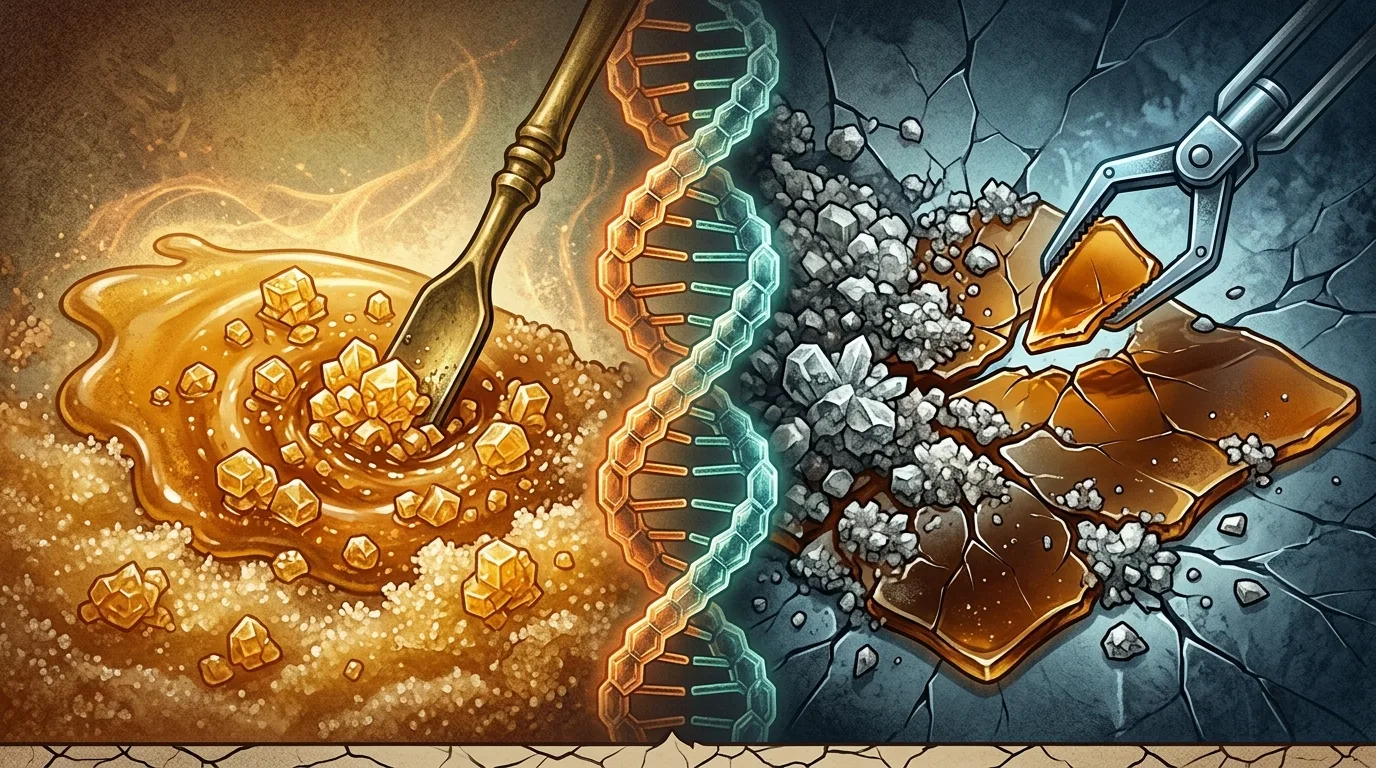
Ask any concentrate collector what ruins a perfect sheet of shatter, and they'll tell you: crystallization. Those cloudy patches that spread through amber glass, turning transparency into opacity. Yet here's the counterintuitive truth that changes how you see both products,sugar wax is deliberately crystallized shatter. The same molecular process that makes shatter "go bad" is precisely what manufacturers control to create sugar wax's granular texture. Understanding this single phenomenon explains two of Canada's most popular concentrates and why your shatter eventually transforms in the jar.
This isn't about which concentrate is "better." It's about recognizing that sugar wax and shatter represent opposite ends of the same crystallization spectrum, with identical starting material taking different paths based entirely on post-extraction handling. One prioritizes visual clarity and snap-ability. The other embraces the natural tendency of cannabinoids to form crystals, producing a texture that's easier to handle and often richer in terpenes. Both deliver potent THC, but the journey from extraction to your dab tool couldn't be more different.
What Actually Makes Shatter Shatter (And Why It Won't Stay That Way)
Shatter earns its name from physical structure, not potency. When you snap a piece of quality shatter, it breaks cleanly like glass because the molecules are locked in an amorphous solid state,think frozen honey rather than crystallized sugar. No crystal lattice has formed. THC-A molecules remain randomly distributed throughout the extract, held in place by viscosity rather than organized bonding patterns.
This clarity requires specific conditions during and after extraction. Manufacturers pull this off through rapid cooling and minimal agitation during the purging process. As butane or propane evaporates from the crude extract, temperature control prevents THC-A molecules from organizing into crystal structures. The goal is to remove solvent so efficiently that cannabinoids don't have time to nucleate,the initial clustering that triggers crystallization.
But here's the problem: shatter's clarity is thermodynamically unstable. Given enough time or the wrong storage conditions, those randomly distributed THC-A molecules will eventually find each other and form crystals. This is why shatter "sugars up" over weeks or months, especially if exposed to temperature fluctuations or humidity. The product isn't degrading,it's simply completing the crystallization process that was artificially paused during production.
The Molecular Instability That's Built In
Every sheet of shatter contains the seeds of its own transformation. THC-A molecules naturally want to bond with other THC-A molecules, forming the stable crystal lattices we see in sugar wax. Keeping them separated requires maintaining the exact conditions that prevented crystallization in the first place: consistent cool temperatures, sealed containers, and zero agitation.
Open your shatter container daily? You're introducing micro-temperature changes. Store it somewhere that swings from 18°C to 24°C? You're accelerating nucleation. Even the mechanical stress of breaking off dabs creates tiny fracture points where crystallization can begin. Shatter's glass-like structure is always working against entropy, which is why concentrate veterans know that absolute clarity won't last forever.
Sugar Wax: Controlled Crystallization as the Entire Point
Sugar wax starts with the exact same crude extract as shatter,the difference is what happens during purging. Instead of preventing crystallization, manufacturers deliberately trigger and control it. This typically involves introducing heat cycles, physical agitation, or both during the solvent removal phase. The goal is to create nucleation sites throughout the material, allowing THC-A molecules to form the crystal structures they naturally prefer.
The result is a concentrate with a granular, wet-sand texture that ranges from fine sugar to coarse crystals depending on technique. Some sugar wax looks like beach sand with a slight sheen. Others resemble crystallized honey with visible faceted structures. All of it represents the same cannabinoid content as shatter, just organized differently at the molecular level.
This crystalline structure offers practical advantages that shatter can't match. Sugar wax is exponentially easier to handle,it doesn't stick to tools, doesn't require warming to portion, and won't shatter into dust if you drop the container. The crystals provide built-in texture that makes scooping a consistent dab almost foolproof, even for beginners who struggle with shatter's sticky-when-warm, brittle-when-cold properties.
Why Sugar Wax Often Preserves More Terpenes
Here's where sugar wax gains a chemical advantage: the crystallization process that creates its texture also tends to preserve volatile terpenes more effectively than shatter production. When THC-A molecules form crystals, they create a matrix with spaces between them. Terpenes pool in these gaps rather than evaporating during extended vacuum purging.
You can often see this visually in high-quality sugar wax,the crystals sit in a slightly wet, sauce-like layer of concentrated terpenes. This separation doesn't happen in shatter because the amorphous structure traps terpenes throughout the material, where they're more vulnerable to degradation from light and heat. Sugar wax's crystalline structure essentially protects terpenes in micro-reservoirs between THC-A structures, which is why it frequently delivers more pronounced flavour profiles than shatter from identical starting material.
The Crystallization Process: How Shatter Becomes Sugar Wax in Your Drawer
Every piece of shatter that "sugared up" in your stash box went through the same phase transition that manufacturers control deliberately. Nucleation started at a microscopic level,maybe a particle of dust, a microscopic temperature gradient, or simply random molecular collision that allowed a few THC-A molecules to bond in crystalline formation.
Once that initial crystal seed forms, it acts as a template. Adjacent THC-A molecules align with the existing structure, and the crystal grows outward. Multiple nucleation sites mean multiple growing crystals, which is why sugaring often appears as cloudy patches that spread through clear shatter. You're watching crystal formation in real time, just slowed down enough to observe over days rather than seconds.
Temperature is the primary accelerant. Every time shatter warms and cools, molecular motion increases and decreases, giving THC-A molecules more opportunities to find bonding partners. This is why shatter stored in fluctuating environments sugars faster than concentrate kept at stable cool temperatures. Humidity plays a secondary role by introducing moisture that can provide additional nucleation sites, though sealed containers mostly prevent this factor.
The transformation is one-way and irreversible through normal means. Once crystals form, you cannot "melt" shatter back to clarity. The molecular organization has fundamentally changed. What you can do is embrace it,your sugared-up shatter is now functionally identical to deliberately produced sugar wax, with the same potency and often improved ease of handling.
Why Some Shatter Sugars in Weeks While Other Lasts Months
Starting material quality determines crystallization resistance more than any other factor. Shatter made from highly refined, single-strain extract with minimal plant lipids resists sugaring longer than mixed-strain or lower-purity concentrates. Those additional compounds,waxes, lipids, residual plant matter,act as nucleation sites that accelerate crystal formation.
Terpene content creates another variable. High-terpene shatter (often labelled "terp sauce" or "HTFSE") remains softer and more pliable because terpenes disrupt crystal lattice formation. These concentrates may never achieve hard glass-like snap, but they also resist the brittleness and sudden sugaring that plague overly refined, low-terpene shatter. It's a trade-off between shelf stability and flavour preservation.
Practical Differences: Handling, Dabbing, and Storage
The texture difference between sugar wax and shatter creates distinct use-case scenarios. Shatter excels when you need precise dosing and clean breaks. The rigid structure lets you snap off exact portions without scales, and its transparency allows visual inspection for contaminants or residual solvent. For users who dab at lower temperatures or use portable devices, shatter's stability at room temperature prevents messy melting during transport.
Sugar wax dominates for ease of handling and consistent loading. The granular texture scoops cleanly onto dab tools without the sticky-tool-syndrome that plagues warm shatter. You can portion dabs with a simple scooping motion, and the texture naturally breaks apart without requiring warming or careful snapping. For electric dab rigs or devices with ceramic chambers, sugar wax's non-stick properties make cleaning significantly easier than dealing with shatter residue.
Storage requirements flip based on your priority. Shatter demands stable, cool conditions in airtight containers away from light,essentially, you're fighting natural crystallization at every turn. Sugar wax tolerates wider temperature ranges because it's already crystallized; there's no glass-like structure to preserve. Both concentrates degrade with heat and light exposure, but sugar wax's worst-case scenario is terpene loss rather than texture transformation.
For users exploring different concentrate textures, our selection includes both formats in various potency ranges. The complete guide to cannabis concentrate textures breaks down how each format is produced and what to expect from the experience.
Temperature Sensitivity During Dabbing
Vapourization temperature affects these concentrates differently due to their structural organization. Shatter's amorphous structure melts relatively evenly, transitioning from solid to liquid to vapour in a smooth progression. This makes it forgiving for beginners still dialing in their nail temperature,you have a wider window between "not hot enough" and "combustion."
Sugar wax's crystalline structure creates a two-phase vapourization. The THC-A crystals melt at a slightly different rate than the terpene-rich sauce between them, which means you get an initial burst of flavour (the terpenes) followed by cannabinoid vapour (the crystals). This staged release is why experienced dabbers often prefer sugar wax at lower temperatures,around 315-370°C rather than the 370-430°C range common for shatter. The goal is to preserve that terpene fraction that vapourizes first.
Potency, Purity, and Price: The Numbers That Actually Matter
Here's the truth that cuts through concentrate marketing: texture tells you nothing about THC content. Lab-tested shatter typically ranges from 70-90% THC, with premium examples pushing into the low 90s. Sugar wax occupies the exact same range. A 75% THC shatter and 75% THC sugar wax deliver identical cannabinoid content,the only difference is molecular organization and terpene preservation.
What texture does indicate is processing technique and, by extension, terpene survival. Shatter's production prioritizes purity and clarity, often at the expense of volatile compounds that don't survive extended purging. Sugar wax's controlled crystallization tends to retain more of the terpene fraction because the process completes faster. If you see lab reports showing 8-15% terpenes in sugar wax versus 3-6% in shatter from the same strain, that's the crystallization process preserving volatiles.
Price variation usually reflects terpene content rather than texture. Budget shatter runs $20-30/gram because it prioritizes THC extraction over flavour preservation. Premium sugar wax commands $40-60/gram when it's produced from fresh-frozen material with deliberate terpene conservation. You're not paying extra for the granular texture,you're paying for the additional volatile compounds that texture helps preserve.
For bulk concentrate users, understanding this price-to-value ratio matters. If you're chasing maximum THC per dollar and don't prioritize flavour, budget shatter offers unbeatable value. If terpene profiles and dabbing experience rank higher than raw potency, sugar wax's premium pricing delivers compounds that simply aren't present in equivalently priced shatter.
How to Read Lab Reports for Both Formats
Concentrate lab reports reveal what texture can't: actual chemical composition. For both shatter and sugar wax, look beyond the headline THC percentage. The terpene section tells you whether you're getting a full-spectrum extract or a refined THC-dominant concentrate. Total terpene percentages above 5% indicate significant flavour and entourage-effect potential. Below 2% suggests heavy refinement that stripped most aromatic compounds.
The cannabinoid breakdown matters more than many users realize. Look for the THC-A versus THC ratio,higher THC-A means less decarboxylation during processing, which often correlates with better terpene preservation. Sugar wax frequently shows higher THC-A percentages than shatter because the faster crystallization process exposes the material to less heat overall. For a detailed walkthrough of what every line means, check out our line-by-line guide to reading cannabis lab reports.
Which Concentrate Fits Your Use Case
Choose shatter when portability, precise dosing, and room-temperature stability matter most. It travels better than any other concentrate format,no special cooling, no risk of sauce leaking, no texture changes from a few hours in a warm car. For users who dose throughout the day or need concentrates that tolerate less-than-ideal storage conditions, shatter's structural rigidity provides practical advantages that outweigh its handling quirks.
Choose sugar wax when flavour, ease of loading, and immediate usability take priority. The granular texture eliminates the learning curve that makes shatter frustrating for beginners. You don't need to warm your tool, you don't need to master the snap technique, and you don't need to worry about texture changes over time because it's already in its final crystalline form. For home users with controlled storage and quality dab rigs, sugar wax delivers the best overall dabbing experience if you're willing to pay the premium.
Consider your consumption device as well. Portable vape pens and cartridges work better with shatter-consistency concentrates because they flow predictably when heated. Sugar wax's crystalline structure doesn't always melt smoothly in restricted chambers, leading to clogging or uneven heating. Conversely, large-format e-nails and temperature-controlled rigs excel with sugar wax because you can optimize temperature for the terpene-then-cannabinoid release pattern.
For users exploring different concentrate formats, understanding dabbing equipment matters as much as choosing between textures. Our guide on dabbing without a full rig setup covers alternative consumption methods that work with both concentrate types.
The Budget Calculation: Cost Per Dose vs Cost Per Gram
Raw price per gram misleads when concentrates have different potencies and you waste different amounts during use. A $25 gram of 75% shatter that you waste 10% of due to sticky tools costs more per actual dose than a $35 gram of 78% sugar wax that loads cleanly every time. Factor in the product that stays stuck to parchment paper, the dabs that fall off tools, and the residue that burns onto nails at wrong temperatures.
Sugar wax's handling efficiency often closes the price gap in real-world use. Users report 5-15% less waste compared to shatter, simply because the texture cooperates with tools and doesn't require heating to portion. Over an ounce of concentrate use, that waste reduction can offset $50-100 in additional upfront cost. Budget-conscious dabbers should calculate cost per clean dab delivered, not just sticker price per container.
Frequently Asked Questions
No. Both concentrates typically contain 70-90% THC depending on starting material and refinement level. Texture doesn't determine potency,lab testing does. The main difference is terpene content, where sugar wax often preserves 2-3x more aromatic compounds than shatter due to faster processing that protects volatile molecules.
Yes, through controlled heat cycling and agitation. Place shatter in a sealed silicone container and apply gentle heat (30-40°C) for several hours while periodically stirring. This triggers nucleation and accelerates crystallization. However, you cannot reverse the process,once crystals form, you cannot return shatter to its original amorphous state.
No. The crystallization process is physical structure change, not chemical degradation. THC-A content remains identical whether organized in an amorphous solid or crystalline matrix. What you may notice is reduced terpene aroma if sugaring occurred due to poor storage with heat and air exposure, but the cannabinoid potency stays constant.
The 'wet' appearance in sugar wax is concentrated terpenes pooling between THC-A crystals. During controlled crystallization, cannabinoids form solid structures while terpenes remain liquid, creating visible separation. This sauce layer contains the majority of flavour compounds and indicates high-quality, terpene-rich starting material.
Sugar wax. The granular texture eliminates most handling difficulties that frustrate new dabbers,no sticky tools, no warming required, no precision breaking technique needed. You simply scoop and dab. Shatter's learning curve around temperature-dependent handling and brittle-when-cold properties makes it better suited for users with some concentrate experience.
Highly variable, from weeks to months depending on purity, storage conditions, and terpene content. Refined, low-terpene shatter stored at stable cool temperatures in airtight containers may last 6+ months before significant crystallization. High-terpene shatter in fluctuating environments may sugar within 2-3 weeks. Once started, the process accelerates as existing crystals template new growth.
The Same Molecules, Different Arrangements
Understanding that sugar wax and shatter represent controlled versus prevented crystallization reframes how you evaluate both concentrates. Neither texture is inherently superior,they're optimization for different priorities. Shatter maximizes visual purity and structural stability. Sugar wax maximizes terpene preservation and handling ease. Both deliver potent THC. Both come from identical extraction processes. The only difference is what happens during those final hours of solvent purging.
This knowledge empowers better purchasing decisions based on actual use case rather than concentrate mythology. If you're a mobile user who needs portable stability, shatter's glass-like structure serves you better than any granular alternative. If you're a home dabber with temperature control who prioritizes flavour, sugar wax's terpene-rich crystals deliver an experience shatter can't match. And when your shatter inevitably sugars up in storage, you'll recognize it as transformation rather than degradation,the crystallization that was always coming, just arriving on its own schedule.
Premium Concentrates Delivered
Explore our selection of lab-tested shatter and sugar wax, all available for discreet same-day delivery across Canada.
Shop ConcentratesFor concentrate users building comprehensive knowledge, texture is just one variable in a complex equation. Our detailed breakdown of all cannabis concentrate formats covers the full spectrum from shatter to live resin, helping you match product to preference. Whether you chase clarity or embrace crystallization, understanding the science behind texture transforms concentrate selection from guesswork into informed choice.