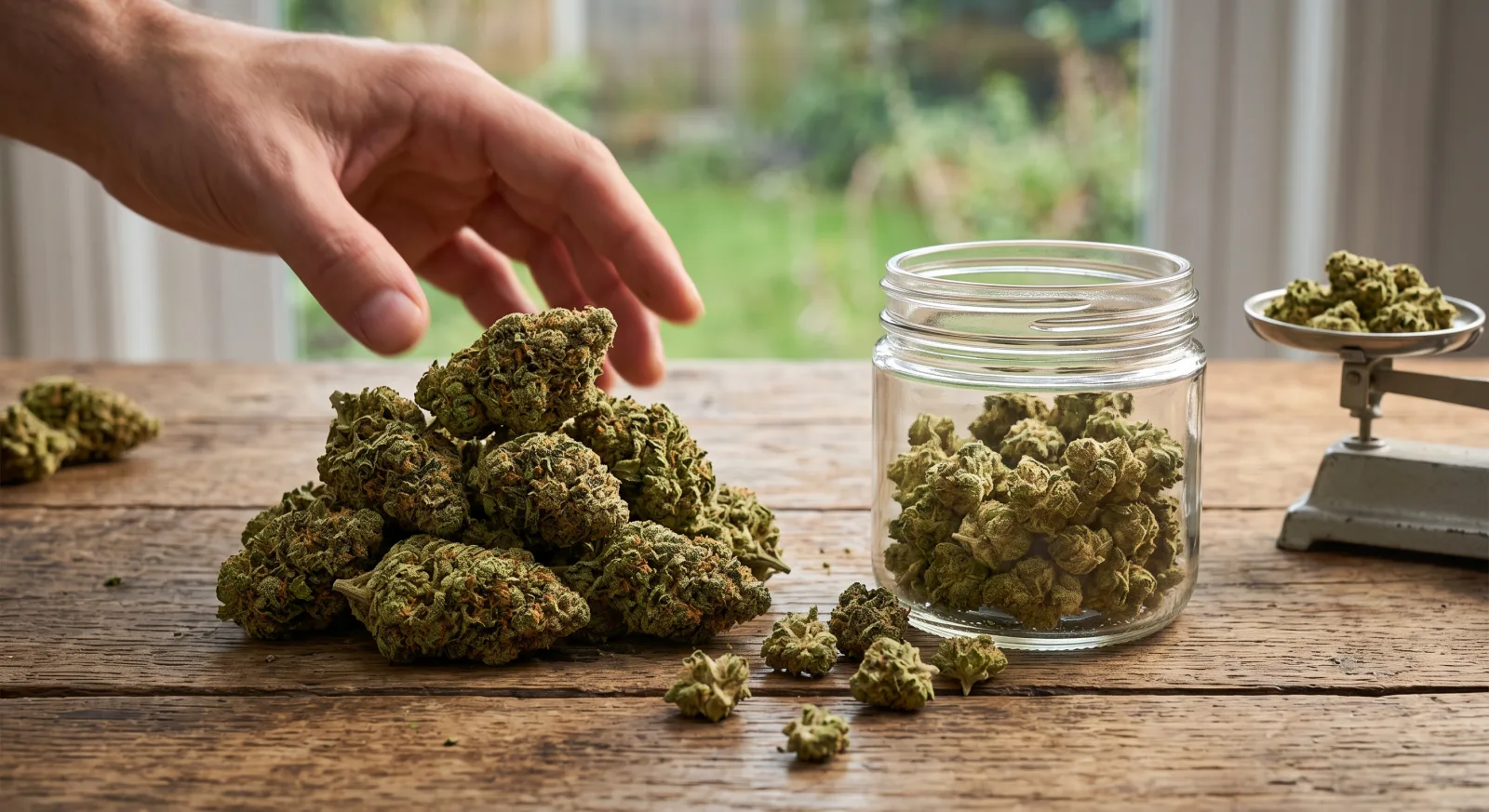
Walk into any cannabis dispensary or browse an online menu, and you'll see two price points for what looks like the same strain: "premium flower" at $10 per gram, and "popcorn buds" at $6. The difference? Size. The smaller nugs, roughly the diameter of actual popcorn kernels, come from the lower branches of the cannabis plant where light penetration is weaker. But here's the part most budtenders won't tell you: once you grind that flower for a joint or vapourizer, the size difference disappears completely. You're smoking the same genetics, the same trichomes, the same cannabinoid profile. The only real question is whether you're paying for Instagram-worthy bag appeal or actual value per session.
This guide breaks down the science of why popcorn buds form, how they differ from true larf (a term sellers often use interchangeably but shouldn't), and the exact scenarios where buying smaller nugs makes financial sense. We'll compare cost-per-gram math, storage considerations, and the one situation where premium colas actually justify the markup. If you've ever wondered whether those discounted popcorn listings are a steal or a compromise, the answer depends entirely on how you consume your cannabis.
The Plant Science Behind Popcorn Buds
Cannabis plants grow in a hierarchical structure dictated by light exposure. The main cola at the top of each branch receives the most intense light, which drives photosynthesis and, consequently, bud development. As you move down the plant toward the base, light intensity drops exponentially. This phenomenon, called the inverse square law of light, means that buds on lower branches receive significantly less energy to fuel growth. The result is smaller, less dense flowers that finish with the same trichome coverage and cannabinoid content as their upper-canopy siblings, just in a more compact package.
Commercial growers face a choice when harvesting: sell the entire plant as mixed-grade flower, or separate the top-shelf colas from the popcorn nugs and price them accordingly. The separation isn't about quality in the traditional sense,labouratory testing often shows minimal THC variance between sizes from the same plant. It's purely about visual appeal and perceived value. Consumers have been conditioned to associate large, dense buds with premium cannabis, so cultivators charge more for them. The popcorn buds, meanwhile, get relegated to "value" or "budget" tiers, despite being genetically identical to the flowers growing six inches above them on the same stalk.
Light Penetration and Canopy Management
Indoor growers use various training techniques,topping, super cropping, screen of green (SCROG),to maximize light exposure across the canopy and minimize popcorn bud formation. These methods redistribute growth hormones and encourage lateral branching, creating a flatter canopy where more bud sites receive equal light. Even with aggressive training, however, some lower growth inevitably produces smaller flowers. Outdoor growers contend with natural sunlight angles that change throughout the season, making it nearly impossible to eliminate popcorn buds entirely. The plants that produce your cannabis will always have some gradient of bud sizes, which is why popcorn offerings exist across all cultivation environments.
Popcorn vs Larf: A Critical Distinction Retailers Often Blur
Here's where terminology matters. Popcorn buds are fully mature, properly cured flowers that happen to be small. Larf, on the other hand, refers to airy, underdeveloped growth that never reached full maturity,usually scraggly material from the absolute lowest branches or shaded interior nodes. Larf has visibly fewer trichomes, feels loose and leafy rather than compact, and often carries a grassy or hay-like smell indicating incomplete curing. Some dispensaries label larf as "popcorn" to move inferior product at budget prices. The distinction is critical: true popcorn buds should look like miniature versions of premium flower, with visible crystal coverage and proper density for their size. Larf looks like the scraps left after trimming.
When evaluating a popcorn bud listing, ask to see the product or request detailed photos. Legitimate popcorn will have the same bag appeal as full-size nugs, just scaled down. If the listing shows wispy, stemmy material with minimal trichomes, you're looking at larf being misrepresented. This bait-and-switch is common enough that experienced consumers always verify quality before buying discounted "small buds." The price difference between popcorn and premium should reflect size alone, not a drop in potency or cure quality.
When Popcorn Buds Make Financial Sense
The economics of popcorn buds are straightforward: you're getting the same active compounds for 30-50% less money, with the only trade-off being visual aesthetics. For consumers who grind their flower before use,whether for joints, vapourizers, or edibles,this trade-off is functionally meaningless. A grinder reduces both premium colas and popcorn nugs to the same particle size, erasing any distinction. The trichomes that contain THC, CBD, and terpenes are distributed across the plant regardless of bud size, so your ground material will have equivalent potency whether it started as top-shelf or value-tier.
Let's run the numbers. If premium flower from a specific strain sells for $10 per gram and the popcorn version costs $6 per gram, you're saving $4 for every gram purchased. Over an ounce (28 grams), that's $112 in savings,enough to buy an additional 18 grams of the popcorn product. For consumers who prioritize effects over Instagram photos of their stash, popcorn buds represent one of the best value propositions in legal cannabis. The savings compound even further when buying in bulk, as many dispensaries offer popcorn quarters or half-ounces at aggressive per-gram rates.
The Cost-Per-Session Breakdown
Consider your consumption method. If you roll 0.5-gram joints, a gram of premium flower yields two sessions at $5 each. That same $5 buys you 0.83 grams of popcorn (at $6/g), which yields 1.66 joints,a 66% increase in sessions per dollar spent. Vapourizer users see similar math: if you load 0.2-gram bowls, premium flower gives you five bowls per $10 spent, while popcorn delivers eight bowls for the same price. The only scenario where premium flower justifies its cost is when you're smoking whole buds in a pipe or bong and aesthetics genuinely enhance your experience. Even then, you're paying a substantial markup for visual preference rather than chemical superiority.
The one legitimate concern with popcorn buds is stem-to-flower ratio. Smaller nugs have proportionally more stem material by weight, which means you're smoking slightly less actual bud per gram purchased. However, this difference is marginal,typically 5-10% at most with properly trimmed popcorn. When you factor in the 30-50% price reduction, you're still coming out ahead financially. A gram of premium flower might contain 0.95 grams of smokable material, while a gram of popcorn contains 0.88 grams. At $10 vs $6, you're paying $10.53 per gram of smokable premium vs $6.82 per gram of smokable popcorn,still a 35% savings.
Storage and Handling Considerations
Popcorn buds have a higher surface-area-to-volume ratio than large colas, which affects how they interact with their storage environment. This increased surface area means they can dry out faster if stored improperly, potentially leading to harsher smoke and terpene loss. Conversely, in overly humid conditions, smaller buds can absorb moisture more quickly, increasing mold risk. The solution is the same regardless of bud size: store your cannabis in airtight glass containers with humidity control packs (Boveda or Integra) to maintain 58-62% relative humidity. With proper storage, popcorn buds retain their quality just as long as premium flower.
Handling is another minor consideration. Smaller buds are more prone to breaking apart during transport, especially if shipped via mail order. This isn't a quality issue,broken buds smoke identically to intact ones,but it does affect presentation. If you're buying popcorn buds for personal use, this matters little. If you're purchasing for a gift or to impress friends with your stash, the visual factor might influence your decision. Most consumers find that the savings outweigh any cosmetic concerns, particularly when they're the only ones who'll see the product before it's ground and consumed.
Bulk Buying and Long-Term Value
Popcorn buds excel in bulk purchase scenarios. Because they're already discounted and often sold in larger quantities (quarters, halves, ounces), you can stock up at rates that make premium flower look overpriced. An ounce of popcorn at $140-$160 provides the same number of sessions as $220-$280 worth of premium flower,a savings that adds up over months of consumption. For regular users who go through an ounce or more per month, switching to popcorn buds can save $80-$140 monthly without sacrificing effects.
One strategy savvy consumers employ: buy popcorn buds of familiar strains where you already know the genetic quality is high. If you've tried the premium version of Blue Dream from a specific grower and loved it, their popcorn Blue Dream will deliver the same terpene profile and high at a fraction of the price. This approach removes the risk of buying an unknown product and lets you capitalize on proven genetics. It's the cannabis equivalent of buying store-brand products made by name-brand manufacturers,same quality, different packaging, better price.
The Premium Flower Argument: When Size Actually Matters
There are scenarios where premium colas justify their markup, though they're narrower than cannabis marketing would have you believe. If you smoke whole buds in a pipe or bong without grinding, larger flowers provide a better visual and handling experience. The ritual of breaking apart a dense, resinous cola by hand can be part of the enjoyment for some consumers. Premium buds also tend to have slightly better cure quality on average, as cultivators reserve their best drying and curing practices for top-shelf product. This can translate to smoother smoke and more pronounced terpene preservation, though the difference is subtle and strain-dependent.
Collectors and connoisseurs who treat cannabis as a craft product rather than a consumable commodity might also prefer premium flower for its aesthetic qualities. There's legitimate artistry in cultivating perfectly formed, trichome-encrusted colas, and some consumers are willing to pay for that craftsmanship the same way wine enthusiasts pay premiums for vintage bottles. If appreciating the visual and structural beauty of cannabis flowers enhances your experience, premium buds offer something popcorn cannot. Just recognize that you're paying for art and ritual, not superior chemical composition.
Gift-giving is another valid reason to choose premium over popcorn. Presenting someone with a jar of pristine, large-format buds makes a stronger impression than popcorn nugs, even if the effects will be identical. Social consumption scenarios where you're sharing with others who might judge your stash also favour premium presentation. These are psychological and social considerations rather than practical ones, but they're real factors in purchasing decisions. The key is being honest about whether you're buying for yourself or for others' perceptions.
Lab Testing and Potency: The Numbers Don't Lie
When growers send samples to licenced labouratories for cannabinoid and terpene testing, they typically submit material from the main colas,the premium flower that will command top dollar. This creates a perception that premium buds are more potent than popcorn from the same plant. In reality, cannabinoid distribution across a healthy cannabis plant is remarkably uniform. Studies on within-plant variation show that THC percentages typically vary by only 1-3% between top and bottom buds, a difference that's imperceptible to most consumers and well within the margin of error for lab testing equipment.
The reason for this uniformity is biological: cannabinoids are produced in the trichome heads that cover all flower surfaces, and trichome density is largely determined by genetics, not bud size. A small popcorn bud from a 25% THC strain will test very close to 25% THC, just like the main cola. Where you might see variation is in terpene concentration,larger buds sometimes retain aromatics better during curing due to lower surface-area-to-volume ratios,but even this difference is minimal with proper handling. The potency you experience is a function of the strain's genetics and the grower's skill, not whether you bought the biggest or smallest flowers from the harvest.
Some dispensaries conduct separate lab tests for their popcorn listings, which provides transparency but often confirms what we already know: the numbers are nearly identical. If you're a consumer who makes purchasing decisions based on lab results, compare the certificates of analysis (COA) for premium and popcorn versions of the same strain from the same batch. You'll typically find negligible differences that don't justify the price gap. This data-driven approach takes guesswork out of the equation and lets you make value-based decisions grounded in chemistry rather than marketing.
The Role of Trim and Processing
One area where premium and popcorn can diverge is trim quality. Large colas are often hand-trimmed with precision to remove all fan leaves and excess sugar leaves, creating that Instagram-ready appearance. Popcorn buds, being lower-margin products, sometimes receive less meticulous manicuring,you might see a few more sugar leaves left on the final product. This doesn't significantly impact quality (sugar leaves contain trichomes and are perfectly smokable), but it does affect aesthetics and can contribute to slightly harsher smoke if the leaves weren't properly cured.
When evaluating popcorn listings, look for "hand-trimmed" or "premium trim" descriptors. These indicate that the popcorn received the same post-harvest care as the top-shelf product, just in smaller form. Machine-trimmed popcorn isn't necessarily bad,modern trimming machines are highly effective,but hand-trimming generally preserves more trichomes and terpenes. If a dispensary doesn't specify trim method, ask before purchasing. Understanding the ordering process includes knowing what questions to ask about product preparation and handling.
Matching Popcorn Buds to Consumption Methods
Your preferred consumption method should heavily influence whether popcorn buds make sense for your needs. For joint and blunt smokers, popcorn is ideal,you're grinding everything anyway, so size is irrelevant. The same applies to dry-herb vapourizer users, who rely on ground material for optimal airflow and even heating. Edibles makers also benefit from popcorn pricing, as decarboxylation and extraction processes care only about total cannabinoid content, not bud appearance. In these use cases, choosing premium over popcorn is litreally paying extra for something you'll immediately destroy.
Bong and pipe users who don't grind their flower occupy a middle ground. Smaller popcorn nugs can actually be advantageous here,they fit bowl sizes more naturally without requiring you to break apart a large cola. However, if you enjoy the ritual of hand-breaking resinous buds and you notice trichome loss with smaller flowers that crumble easily, premium might be worth the premium. Pay attention to how you actually consume: if you're meticulously separating and handling your cannabis, aesthetics matter. If you're quickly packing bowls or rolling joints while watching TV, they don't.
For concentrate makers who press rosin or make hash, popcorn buds present an interesting value proposition. Your yield percentage is determined primarily by trichome density and moisture content, not bud size. If you can source high-quality popcorn from a strain known for good resin production, you'll get nearly identical returns as using premium flower while spending significantly less on starting material. The economics here are compelling: if you're pressing an ounce into 5-7 grams of rosin, saving $80 on popcorn buds while yielding the same concentrate amount substantially improves your cost per gram of final product.
Finding Quality Popcorn: What to Look For and Avoid
Not all popcorn listings are created equal. The market includes legitimately small but high-quality buds, mediocre mid-tier flower being sold as a value option, and outright larf being misrepresented as popcorn. Learning to distinguish between these requires examining a few key characteristics. First, trichome coverage should be abundant and visible to the naked eye,the buds should sparkle with resin, just in smaller packages. Second, density matters: popcorn buds should feel firm when gently squeezed, not airy or hollow. Third, the smell should match the strain profile, with pronounced terpene aromatics indicating proper curing.
Colour is another indicator. Vibrant greens, purples, or oranges (depending on the strain) signal healthy, well-grown cannabis. Dull browns, excessive yellowing, or overall lack of colour vibrancy suggest old, poorly stored, or low-quality flower. Check for signs of mold, particularly in the denser parts of the buds,any white, fuzzy growth is an immediate deal-breaker regardless of price. Reputable dispensaries won't sell moldy product, but the discount popcorn market can sometimes include inventory that's been sitting too long. Understanding quality indicators helps you evaluate whether a popcorn listing is a bargain or a compromise.
The best way to source reliable popcorn buds is to stick with growers and dispensaries you already trust for their premium flower. If their top-shelf products consistently deliver quality, their popcorn offerings will too,they're from the same plants, after all. Look for listings that specify the batch number or harvest date, which lets you verify that the popcorn is fresh and from a recent run. Avoid generic "budget buds" or "value flower" listings that don't disclose strain, grower, or harvest information,these are often grab-bags of mixed quality that may include actual larf.
Online Reviews and Community Feedback
Before purchasing popcorn buds from a new source, check reviews from other consumers. Online cannabis communities and dispensary review sections often discuss whether a vendor's popcorn products live up to their descriptions. Look for comments about trim quality, potency relative to premium versions, and whether the buds were actually popcorn-sized or smaller larf. Photos uploaded by customers can be more revealing than professional product shots, showing the actual size, structure, and trichome coverage you'll receive.
Pay attention to recurring complaints. If multiple reviewers mention that a dispensary's "popcorn" is mostly stems and sugar leaves, or that the product arrived bone-dry, take that feedback seriously. Conversely, consistent praise for value and quality indicates a reliable source. The cannabis market has enough transparency now that it's rare for truly poor products to maintain good ratings,consumers are vocal about disappointments. Use this collective knowledge to avoid bad deals and identify hidden gems in the popcorn category.
The Future of Popcorn Pricing in Cannabis Markets
As cannabis markets mature and consumers become more educated, the premium placed on visual aesthetics may diminish. In established markets like Colourado and California, savvy consumers have already shifted toward value-focused purchasing, creating strong demand for popcorn and smalls at aggressive price points. This trend pressures growers to price their products more rationally,when consumers understand that size doesn't equal potency, paying double for large nugs becomes harder to justify. The result is likely a compression of the price gap between premium and popcorn as market forces correct the aesthetic premium.
Automation in cultivation and processing could also affect popcorn availability and pricing. Training techniques that create flatter canopies produce fewer popcorn buds overall, as more of the plant receives optimal light. If growers perfect these methods, the supply of popcorn might decrease while quality increases,smaller harvests of high-quality smalls rather than larger harvests of mixed-quality popcorn and larf. This could actually increase prices for legitimate popcorn buds as they become scarcer, though premium prices would likely rise in tandem to maintain the market's pricing hierarchy.
Consumer preferences are shifting toward pre-ground flower and pre-rolls, particularly among newer cannabis users who view grinding and rolling as inconvenient. This trend could increase demand for popcorn buds as source material, since appearance becomes completely irrelevant when the end product is ground or rolled. Manufacturers of these products prioritize cost efficiency, making popcorn an ideal input. As this segment grows, we may see more of the popcorn harvest directed toward processed products rather than sold as whole buds, potentially creating scarcity in the consumer popcorn market while improving overall value across product categories.
Frequently Asked Questions About Popcorn Buds
No. Cannabinoid distribution across a healthy cannabis plant is remarkably uniform, with THC levels varying by only 1-3% between top and bottom buds. Popcorn buds are smaller due to reduced light exposure during growth, but they contain the same trichome density and cannabinoid concentration as larger colas from the same harvest. Lab testing confirms this: when dispensaries test both premium and popcorn versions of the same strain, the potency numbers are nearly identical.
Popcorn buds are fully mature, properly cured flowers that are simply small,miniature versions of premium nugs with the same trichome coverage and density. Larf refers to airy, underdeveloped growth from the lowest branches that never reached full maturity. Larf has visibly fewer trichomes, feels loose and leafy, and often smells grassy. Unfortunately, some retailers mislabel larf as popcorn to move inferior product at budget prices. True popcorn should have abundant crystal coverage and firm density despite its small size.
Popcorn buds have a higher surface-area-to-volume ratio, which means they can lose or gain moisture more quickly than large colas if stored improperly. However, this is only a concern with inadequate storage. When kept in airtight glass containers with humidity control packs maintaining 58-62% relative humidity, popcorn buds retain their quality just as long as premium flower. The storage method matters far more than the bud size,poorly stored premium buds will degrade faster than properly stored popcorn.
Yes, slightly. Smaller buds have proportionally more stem material by weight, typically 5-10% more than premium colas. However, when you factor in the 30-50% price reduction for popcorn buds, you're still getting a better value per gram of actual smokable flower. For example, if premium flower costs $10/gram with 95% smokable material and popcorn costs $6/gram with 88% smokable material, you're paying $10.53 vs $6.82 per gram of actual bud,still a 35% savings despite the higher stem ratio.
It depends on your priorities. If you smoke whole buds in a pipe or bong and the visual and tactile experience of handling large, resinous colas enhances your enjoyment, premium flower might be worth the extra cost to you. However, even when smoking whole buds, popcorn nugs deliver identical effects,the experience difference is purely aesthetic and ritualistic, not chemical. If you prioritize value and effects over appearance, popcorn makes sense regardless of consumption method. The one exception is if the popcorn buds are so small they crumble excessively when handled, creating wasteful trichome loss.