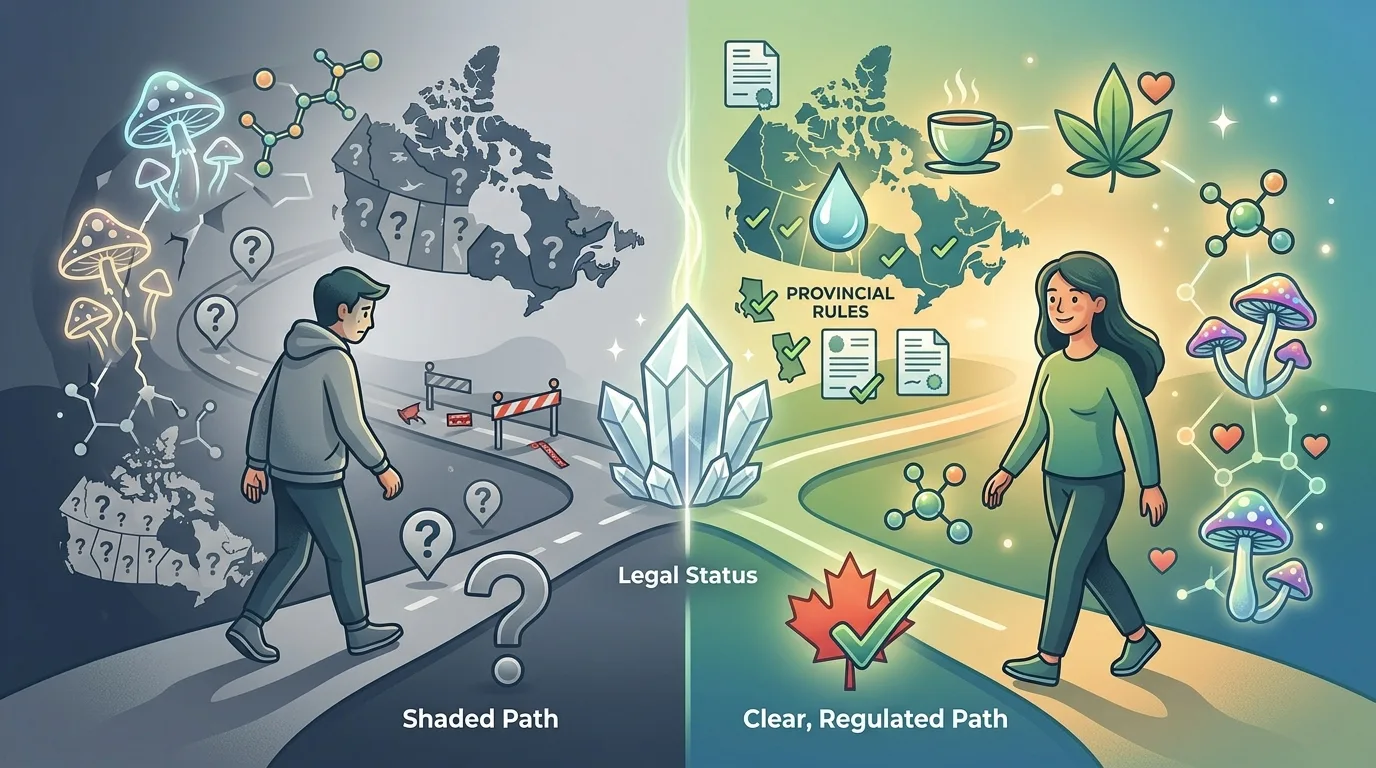
If you've been following the cannabis industry in Canada since legalization in 2018, you've probably noticed something confusing: magic mushroom dispensaries operating openly in major cities, mail-order psilocybin sites shipping across provinces, and storefronts advertising shroom products right alongside legal cannabis. So what's actually going on? Is psilocybin legal in Canada, or are these businesses operating in a legal grey zone similar to what cannabis dispensaries did before 2018?
The short answer is that psilocybin remains illegal in Canada under the Controlled Drugs and Substances Act, but enforcement is inconsistent, creating a grey market that looks eerily similar to pre-legalization cannabis. Unlike cannabis, which went through federal legalization and provincial regulation, psilocybin has no legal recreational framework. What you're seeing isn't legalization but rather a combination of lax enforcement, growing public acceptance, and businesses willing to operate in legal limbo. This article breaks down exactly what "legal" means when it comes to psilocybin, how it differs from regulated cannabis, and what the rules actually look like province by province.
The Legal Status of Psilocybin: What Federal Law Actually Says
Under the Controlled Drugs and Substances Act (CDSA), psilocybin and psilocin (the active compounds in magic mushrooms) are classified as Schedule III substances. This places them in the same legal category as LSD and mescaline, making possession, production, and distribution criminal offences. Unlike cannabis, which was removed from the CDSA entirely in 2018, psilocybin has no legal recreational pathway in Canada.
The maximum penalties are serious on paper. Possession can result in up to three years imprisonment for an indictable offence, while trafficking or production carries a maximum penalty of ten years. However, enforcement reality tells a different story. Most police forces across Canada have deprioritized simple possession cases, and prosecutions for personal amounts are rare unless connected to other criminal activity.
There is one legal exception: Health Canada can grant exemptions under Section 56 of the CDSA for medical or scientific purposes. Since 2020, terminally ill patients have successfully applied for legal access to psilocybin-assisted therapy. As of early 2024, Health Canada has approved over 80 individual exemptions for end-of-life care and treatment-resistant mental health conditions. However, these exemptions are individual, case-by-case approvals that require physician support and extensive documentation.
How Psilocybin's Legal Status Differs from Cannabis
The confusion around psilocybin legality stems from people drawing parallels to cannabis without understanding the fundamental legal differences. When cannabis was legalized in 2018, Parliament passed the Cannabis Act, which created an entirely new regulatory framework. This federal law established production licences, quality standards, THC limits, packaging rules, and distribution models. Provinces then built their own retail and delivery systems within that federal framework.
Psilocybin has none of this infrastructure. There is no Psilocybin Act, no licenced producers, no regulated retail system, and no provincial distribution networks. Every magic mushroom product sold in Canada right now exists outside legal commerce. When you buy from a psilocybin dispensary or mail-order service, you're participating in an unregulated grey market with no quality controls, no product testing, and no legal consumer protections.
The Grey Market Explained: Why Psilocybin Businesses Operate Openly Despite Illegality
Walk through Vancouver's Downtown Eastside or Toronto's Kensington Market, and you'll find storefronts openly selling psilocybin products with names like "Fun Guyz" and "Shroom Room." These aren't underground operations. They have business hours, Instagram accounts, and debit terminals. So how are they operating if psilocybin is illegal?
The answer lies in enforcement discretion and political will. Police departments in major Canadian cities have largely chosen not to prioritize psilocybin dispensaries, similar to how they treated cannabis cafes in the years before legalization. This creates a grey market: technically illegal, but functionally tolerated. Several factors contribute to this situation.
Public Opinion and Decriminalization Advocacy
Public attitudes toward psychedelics have shifted dramatically in recent years. A 2023 Abacus Data poll found that 35% of Canadians support legalizing psilocybin for recreational use, while 64% support access for medical purposes. This is remarkably similar to cannabis support levels in the years leading up to legalization. Cities like Vancouver and Toronto have seen organized advocacy for decriminalization, and some city councils have passed symbolic motions requesting federal action.
This political climate influences enforcement priorities. When the public doesn't view something as a serious crime, police resources get redirected to issues with more public support. The result is that psilocybin possession and small-scale distribution rarely result in charges unless part of larger criminal operations.
The Medical Research Context
Another factor legitimizing the grey market is mounting clinical evidence for psilocybin's therapeutic potential. Major Canadian universities including the University of Toronto and UBC are conducting approved research trials on psilocybin for depression, PTSD, and addiction. This research gets mainstream media coverage, which normalizes psilocybin in public perception and makes aggressive enforcement politically awkward.
Grey market retailers often frame themselves as providing "compassionate access" while waiting for formal legalization. While this rhetoric has no legal merit, it creates public relations challenges for law enforcement agencies that might otherwise pursue charges. Understanding how mail order works in regulated cannabis helps illustrate the stark difference between grey market operations and proper legal frameworks.
Province-by-Province: How Psilocybin Enforcement Differs Across Canada
While psilocybin remains federally illegal throughout Canada, the practical reality varies significantly by province and municipality. Enforcement approaches, grey market presence, and political attitudes toward psychedelics create a patchwork landscape that looks different depending on where you live.
British Columbia: The Heart of Canada's Psilocybin Grey Market
British Columbia, particularly Vancouver, has the most visible and established psilocybin grey market in Canada. Multiple storefronts operate openly, and mail-order services based in BC ship nationwide. The city's history of cannabis activism and progressive drug policy creates an environment where psilocybin businesses face minimal interference.
Vancouver police have conducted occasional raids on psilocybin dispensaries, but prosecutions remain rare. In 2023, several Fun Guyz locations were raided and shut down, only to reopen weeks later under different corporate names. This pattern mirrors the pre-legalization cannabis dispensary landscape almost exactly. The BC provincial government has taken no official position on decriminalization, but enforcement remains a low priority compared to other drug-related issues.
Ontario: Urban Tolerance, Rural Caution
Ontario presents a split picture. Toronto has a growing number of psilocybin dispensaries, particularly in neighbourhoods like Kensington Market and along Queen Street West. Ottawa has several locations as well. However, enforcement varies significantly. Toronto police conducted coordinated raids on multiple mushroom dispensaries in late 2023, seizing product and laying charges. Those businesses have since reopened, suggesting the legal risk is manageable from an operational perspective.
Outside major urban centres, Ontario's psilocybin grey market is far less visible. Smaller cities and rural areas see minimal storefront presence, though mail-order services remain accessible. This creates geographic disparities in access that wouldn't exist under a regulated framework similar to Ontario's cannabis system.
Quebec: Conservative Approach Despite Montreal's Underground Scene
Quebec maintains stricter enforcement attitudes toward psilocybin than most other provinces. Montreal has a limited number of grey market retailers, and they operate more discreetly than their Vancouver counterparts. Quebec's provincial government has made no moves toward decriminalization advocacy, and local police departments treat psilocybin as a controlled substance requiring enforcement.
That said, personal possession in small amounts rarely results in charges. Montreal's underground psychedelics community remains active, primarily operating through private networks rather than open retail. The province's restrictive approach to cannabis regulation (government-only retail through SQDC) suggests psilocybin would face similar tight control if ever legalized.
Alberta, Manitoba, and Saskatchewan: Limited Grey Market Presence
The Prairie provinces have minimal visible psilocybin grey markets. Calgary and Edmonton have seen occasional pop-up retailers and delivery services, but police enforcement has been more consistent than in BC or Ontario. These provinces lack the dense urban activism networks that support grey market infrastructure in Vancouver and Toronto.
Mail-order psilocybin remains accessible to residents in these provinces, but local retail presence is sparse. Political appetite for decriminalization is lower than in coastal provinces, making significant policy changes unlikely in the near term. Cannabis users in these regions can reference our cannabis delivery locations guide to understand how regional access differs even within legal frameworks.
Atlantic Canada: Minimal Infrastructure, Emerging Interest
The Atlantic provinces have very limited psilocybin grey market activity. Halifax has seen occasional retailers, but enforcement has been sufficient to prevent establishment of permanent storefronts. The smaller population base and more conservative drug policy environment create less space for grey market operations.
However, interest in psilocybin therapy is growing in Atlantic Canada, particularly for mental health applications. This could shift policy conversations in coming years, but the region currently lags behind central and western Canada in both grey market presence and decriminalization advocacy.
What "Legal" Actually Means: Medical Exemptions and Section 56 Applications
When discussing psilocybin legality in Canada, it's crucial to understand that there is currently only one legal pathway for access: Section 56 exemptions granted by Health Canada. These are individual, case-by-case approvals that allow specific patients to possess and use psilocybin under medical supervision.
The Section 56 exemption process requires several components. First, you need a supporting physician who believes psilocybin therapy is appropriate for your condition. This typically means having exhausted conventional treatments for conditions like treatment-resistant depression, end-of-life anxiety, or PTSD. Second, you must submit a detailed application to Health Canada explaining your medical history and why psilocybin is necessary. Third, if approved, your exemption is time-limited and specific to your individual case.
The Clinical Trial Pathway
Beyond individual exemptions, psilocybin can be legally accessed through participation in approved clinical trials. Several Canadian research institutions are conducting studies on psilocybin-assisted psychotherapy. These trials provide legal access to pharmaceutical-grade psilocybin in controlled, supervised settings.
Participants in clinical trials receive treatment from licenced therapists in clinical environments. The psilocybin used is produced by licenced manufacturers operating under research permits. This represents the most regulated and medically supervised form of psilocybin access currently available in Canada. However, trial participation requires meeting specific eligibility criteria and is limited to research locations in major cities.
Therapeutic Access vs. Grey Market Products
The quality difference between medical exemption psilocybin and grey market products cannot be overstated. Legal medical psilocybin is synthesized in labouratories, tested for purity, and dosed precisely. Grey market mushrooms have no quality control, no potency testing, and no regulatory oversight. You're essentially buying an agricultural product with unknown psilocybin content from unverified sources.
This mirrors the difference between legal mail-order cannabis and the illicit market that existed before 2018. Legal cannabis goes through licenced production, labouratory testing, and regulatory compliance. Grey market products have none of these safeguards, regardless of how professional their packaging appears.
The Future of Psilocybin Regulation: What Legalization Might Look Like
Given the trajectory of public opinion, medical research, and grey market expansion, many observers believe psilocybin legalization is a question of when, not if. However, the pathway forward remains unclear, and any regulatory framework would likely differ significantly from cannabis legalization.
One possibility is a medical-first model where psilocybin becomes available through prescription and licenced therapy centres before any recreational framework. This would resemble how ketamine is currently regulated: legal for medical use under clinical supervision, but not available for personal recreational possession. Several countries including Australia have adopted this approach for psilocybin.
Decriminalization vs. Legalization
An important distinction often gets blurred in public discussion: decriminalization is not the same as legalization. Decriminalization means removing criminal penalties for personal possession while keeping production and sale illegal. Legalization means creating a regulated legal market with licenced producers and retailers.
Vancouver has advocated for decriminalization, and some policy experts believe this is a more likely near-term outcome than full legalization. Decriminalization would eliminate personal possession charges while maintaining penalties for trafficking and large-scale production. This would not create a legal retail market but would reduce legal risks for users.
Provincial Variation in Any Future Framework
If psilocybin is ever legalized federally, expect provincial variation in implementation just as we saw with cannabis. Quebec would likely maintain tighter provincial control, possibly through government-only retail similar to the SQDC cannabis model. Alberta might allow private retail with minimal restrictions. BC would probably develop a hybrid model with both government and private options.
This provincial variation creates complexity for consumers but allows regional preferences to shape implementation. The cannabis rules by province provide a template for how federally legal substances can have dramatically different accessibility depending on where you live.
Legal Risks for Consumers: What You're Actually Risking by Using Grey Market Psilocybin
While enforcement against personal psilocybin possession is rare in most Canadian cities, it's crucial to understand that legal risks still exist. Psilocybin remains a Schedule III controlled substance, and penalties for possession are not trivial.
Simple possession charges are unlikely if you're found with personal amounts (typically considered 1-5 grams of dried mushrooms), but possible. If charged, you could face up to three years imprisonment, though first-time offenders typically receive conditional discharges or small fines if prosecuted at all. The bigger concern isn't imprisonment but rather the creation of a criminal record that can affect employment, international travel, and professional licensing.
Trafficking Charges and Quantity Thresholds
The line between possession and trafficking charges is less clear with psilocybin than with cannabis. There's no legal threshold that automatically triggers trafficking charges, so police and prosecutors have discretion. Purchasing larger quantities, even for personal use, could theoretically result in trafficking charges if police interpret the amount as exceeding personal consumption.
Grey market dispensary operators face substantially higher legal risks. Trafficking and production charges carry maximum penalties of 10 years imprisonment, and while sentences this severe are rare, prosecutions do occur. The business operators taking these risks are doing so with full knowledge of potential consequences, but consumers should understand that supporting grey market businesses means supporting technically illegal operations.
Quality Control and Safety Risks
Beyond legal risks, grey market psilocybin products carry quality and safety concerns that wouldn't exist in a regulated market. These include unknown potency (psilocybin content varies significantly between mushroom strains and growing conditions), potential contamination (mold, bacteria, or pesticides from improper cultivation), and misidentification (while rare, toxic mushroom species could be mistaken for psilocybin varieties by inexperienced growers).
Regulated cannabis products undergo mandatory labouratory testing before reaching consumers. Grey market psilocybin has no such safeguards. You're trusting the grower's expertise and ethics with no verification system. This is precisely why medical exemption psilocybin uses pharmaceutical-grade synthetic psilocybin rather than whole mushrooms.
Frequently Asked Questions About Psilocybin Legality in Canada
No. All psilocybin products sold online or through mail-order services are operating in the grey market and are technically illegal. These businesses are tolerated in some regions due to lax enforcement, but they have no legal authorization to sell controlled substances. The only legal access is through Section 56 medical exemptions granted by Health Canada.
Enforcement varies by location, but simple possession charges for small personal amounts are rare in major cities. Police may confiscate the product and issue a warning, particularly for first-time offenders. Prosecution for simple possession is unlikely unless connected to other criminal activity or occurring in jurisdictions with strict enforcement policies. However, legal risk still exists and penalties can include fines or criminal records.
No, despite common misconceptions, psilocybin is not decriminalized in any Canadian city. Vancouver City Council passed a motion requesting federal decriminalization, but this has no legal effect on enforcement. What you're observing is selective enforcement where police have deprioritized psilocybin cases, similar to cannabis before 2018. The substance remains illegal under federal law throughout Canada.
Section 56 of the Controlled Drugs and Substances Act allows Health Canada to grant individual exemptions for controlled substances when deemed necessary for medical or scientific purposes. To apply, you need a supporting physician who can justify psilocybin therapy for your specific condition. Applications require detailed medical history and explanation of why conventional treatments are insufficient. If approved, exemptions are time-limited and specific to your case.
While possible in the future, there's no current federal legislation or timeline for psilocybin legalization. Public support is growing and medical research is expanding, but these factors alone don't guarantee legalization. If it occurs, the framework would likely differ from cannabis legalization, possibly starting with medical access through prescription and therapy centres rather than recreational retail models.
No. Psilocybin is illegal throughout Canada under federal law, meaning interprovincial transport of controlled substances is a criminal offence. This differs from legal cannabis, where adults can transport up to 30 grams between provinces. Any psilocybin possession or transport remains illegal regardless of provincial boundaries, though enforcement likelihood varies by region.
Understanding the Difference Between Grey Markets and Regulated Legal Markets
The psilocybin situation in Canada today closely mirrors where cannabis stood in 2015-2017: widespread availability through technically illegal channels, growing public acceptance, mounting political pressure for reform, and inconsistent enforcement creating regional disparities. However, it's crucial not to confuse tolerance with legality.
When cannabis was legalized in 2018, the entire framework changed overnight. Licenced producers were authorized. Quality standards were mandated. Retail models were established. Consumer protections were implemented. Provincial regulations created legal distribution channels. None of this exists for psilocybin, and grey market businesses provide none of these safeguards regardless of how legitimate their operations appear.
If you're considering psilocybin for therapeutic purposes, the medical exemption pathway through Section 56 is the only legal option. If you're interested in recreational use, understand that you're participating in an unregulated market with quality, safety, and legal risks. The situation may change in coming years as public opinion and political will continue shifting, but for now, the answer to "Is psilocybin legal in Canada?" remains definitively no, despite grey market visibility suggesting otherwise.
Explore Canada's Legal Cannabis Options
While psilocybin remains in legal limbo, Canada offers a fully regulated, quality-tested cannabis market with safe delivery options across all provinces. Browse lab-tested products with verified THC content and full consumer protections.
Shop Legal CannabisThe psilocybin landscape in Canada demonstrates how drug policy evolves through grey market pressure, public opinion shifts, and political advocacy. Whether this leads to eventual legalization similar to cannabis or a different regulatory approach remains to be seen. For now, consumers must navigate the disconnect between visible availability and technical illegality while understanding the very real differences between tolerated grey markets and properly regulated legal frameworks.