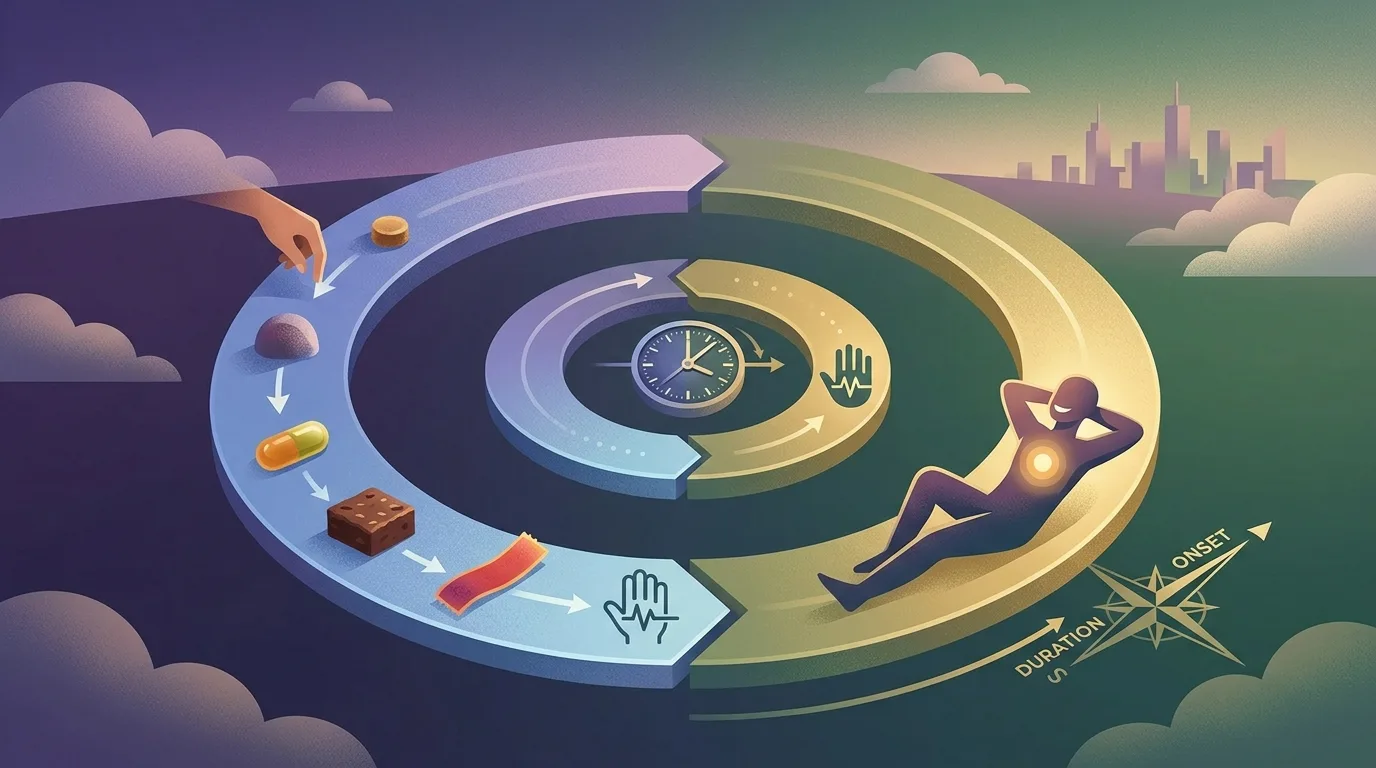
You ate a cannabis edible 30 minutes ago. Nothing. An hour passes. Still nothing. So you eat another one. Then, suddenly, both hit at once and you're far more intoxicated than you intended. This scenario plays out daily across Canada because most people don't understand how long edibles actually take to kick in or how various factors affect their onset time.
The short answer: cannabis edibles typically take 30 minutes to 2 hours to kick in, but that's just the beginning of the story. The type of edible, what you've eaten, your metabolism, and even your experience level all dramatically change when you'll feel effects. This guide breaks down the exact timing for every edible format, backed by the digestive science that determines when THC enters your bloodstream.
The Edible Timing Chart: Onset, Peak and Duration by Format
Different edible formats absorb through different pathways in your body, which means vastly different timelines. Here's the comprehensive breakdown of what to expect from each type:
Gummies and Traditional Edibles (Swallowed)
Onset time: 45 minutes to 2 hours
Peak effects: 2 to 4 hours after consumption
Total duration: 4 to 8 hours (sometimes longer)
Empty stomach: 30 to 60 minutes onset
Full stomach: 90 minutes to 3 hours onset
Standard gummies like Galaxy Gummies or baked goods are the most common edible format. They must pass through your entire digestive system before THC reaches your bloodstream. When you swallow an edible, it travels to your stomach, then your small intestine, where THC is absorbed into your bloodstream and processed by your liver before reaching your brain.
The liver converts delta-9-THC into 11-hydroxy-THC, a more potent metabolite that crosses the blood-brain barrier more efficiently. This is why edible highs feel different and often more intense than smoking or vaping, even at equivalent doses.
Sublingual Tinctures and Oils
Onset time: 15 to 45 minutes
Peak effects: 1 to 3 hours
Total duration: 4 to 6 hours
Stomach status: Minimal impact (absorbed through mouth tissue)
Tinctures and oils held under the tongue absorb directly through the mucous membranes in your mouth, bypassing your digestive system entirely. This sublingual absorption allows THC to enter your bloodstream much faster. However, many people don't hold tinctures long enough. For optimal sublingual absorption, hold the oil under your tongue for at least 60 to 90 seconds before swallowing.
Hard Candies and Lozenges (Buccal Absorption)
Onset time: 20 to 60 minutes
Peak effects: 1.5 to 3 hours
Total duration: 4 to 6 hours
Stomach status: Partial impact (dual absorption pathway)
Hard candies dissolve slowly in your mouth, allowing some THC to absorb through your cheeks and under your tongue while the rest gets swallowed and digested normally. This creates a hybrid absorption pattern with effects coming in two waves. The first, lighter wave arrives from buccal absorption within 20 to 40 minutes, followed by a stronger second wave from the swallowed portion 60 to 90 minutes later.
Drinks and Beverages
Onset time: 20 to 90 minutes
Peak effects: 1.5 to 3 hours
Total duration: 3 to 6 hours
Empty stomach: 15 to 30 minutes onset
Full stomach: 60 to 120 minutes onset
Cannabis beverages absorb faster than solid edibles because liquids pass through your stomach more quickly. Some advanced formulations use nano-emulsion technology to create water-soluble THC particles that absorb even faster, sometimes within 15 minutes. However, standard oil-based cannabis drinks follow typical edible timing.
Capsules and Pills
Onset time: 45 minutes to 2 hours
Peak effects: 2 to 4 hours
Total duration: 6 to 8 hours
Empty stomach: 30 to 60 minutes onset
Full stomach: 90 minutes to 3 hours onset
Cannabis capsules behave like standard edibles but often take slightly longer because the capsule shell must dissolve first. Gel capsules typically dissolve faster than hard vegetarian capsules. Taking capsules with a small amount of healthy fat (like a spoonful of peanut butter or a few nuts) can improve absorption since THC is fat-soluble.
Why Empty vs Full Stomach Changes Everything
Your stomach contents might be the single biggest variable in edible onset time. Understanding this factor prevents both frustrating delays and accidental overconsumption.
The Empty Stomach Fast Track
When you take an edible on an empty stomach, it moves through your digestive system with minimal competition. Your stomach processes the edible quickly and passes it to your small intestine where THC absorption happens. This typically cuts onset time by 30 to 50 percent compared to a full stomach.
However, faster isn't always better. Empty stomach consumption often leads to more intense effects and a quicker peak, which can feel overwhelming for inexperienced users. The high may also feel more anxious or racy because it comes on rapidly without the buffering effect of food.
The Full Stomach Delay
A full stomach, especially one loaded with fats and proteins, dramatically slows edible onset. Your digestive system must process everything else first before it gets to your edible. A large meal can delay onset by an hour or more.
Interestingly, eating a moderate amount of fatty food alongside your edible can actually enhance absorption once it does begin. THC binds to fat molecules, improving bioavailability. The ideal approach for most people is eating a light snack containing some healthy fats about 30 minutes before taking an edible, rather than taking it on a completely empty or completely full stomach.
The Science Behind Edible Absorption and Metabolism
Understanding what happens inside your body explains why edibles behave so differently from other cannabis consumption methods. When you eat a cannabis edible, you trigger a complex metabolic process that determines when and how intensely you feel effects.
The Journey Through Your Digestive System
After you swallow an edible, it enters your stomach where stomach acid begins breaking it down. The THC remains largely intact during this phase. Next, the partially digested edible moves into your small intestine, specifically the duodenum and jejunum sections where most nutrient absorption occurs.
In the small intestine, THC molecules cross through the intestinal wall and enter your bloodstream. But they don't head straight to your brain. Instead, they travel through the hepatic portal vein directly to your liver, a routing known as first-pass metabolism.
The Liver's THC Transformation
Your liver contains enzymes, particularly CYP2C9 and CYP3A4, that metabolize delta-9-THC into various metabolites. The most significant is 11-hydroxy-THC, which is more psychoactive than regular THC and crosses the blood-brain barrier more efficiently. This metabolite is responsible for the characteristically intense and body-focused high that edibles produce.
The liver conversion process takes time, which contributes to the delayed onset. It also explains why edible effects feel different from smoking. When you smoke or vape cannabis, THC goes directly to your brain through your lungs without liver metabolism, producing delta-9-THC effects rather than 11-hydroxy-THC effects.
Genetic variations in liver enzymes explain why some people process edibles faster or slower than others. Someone with highly active CYP enzymes might feel effects in 30 minutes, while someone with less active enzymes might wait 90 minutes or longer, even under identical conditions.
Individual Factors That Change Your Edible Timeline
Beyond the edible format and your stomach contents, several personal factors influence how quickly you feel effects and how long they last.
Body Weight and Composition
Larger individuals generally need higher doses to feel equivalent effects, but body weight has less impact on onset time than you might expect. Body composition matters more than total weight. THC is fat-soluble and distributes into fatty tissue, so individuals with higher body fat percentages may experience slightly delayed onset as THC gets stored in fat cells rather than immediately circulating to the brain.
Metabolism Speed and Age
Your baseline metabolic rate affects how quickly you process edibles. People with faster metabolisms typically experience quicker onset and shorter duration. Age plays a role here, as metabolism naturally slows with age. Younger adults often feel edible effects 15 to 30 minutes faster than older adults taking the same product.
Tolerance and Experience Level
Regular cannabis users develop tolerance, requiring higher doses to achieve the same effects. However, tolerance has minimal impact on onset time. A daily user and a first-timer eating the same gummy will typically feel initial effects at roughly the same time; the experienced user just won't feel them as intensely. The exception is ultra-high-tolerance users who may notice delayed onset because their body processes and eliminates THC more efficiently.
Cannabis Use Frequency
Interestingly, people who use cannabis multiple times per day may actually experience faster edible onset than occasional users. This happens because regular THC exposure increases the number of cannabinoid receptors in the digestive tract, potentially improving absorption efficiency. However, this slight speed advantage is offset by the need for much higher doses.
Common Mistakes That Lead to Overconsumption
Most negative edible experiences stem from impatience. Understanding these common mistakes helps you avoid them.
The Second Dose Problem
The classic error: eating more because you don't feel anything yet. You take an edible at 7pm, feel nothing by 8pm, and eat another dose. Then at 8:30pm, both doses hit simultaneously and you're uncomfortably high for the next six hours. This scenario is so common it has become a cannabis culture cliché.
The solution is simple but requires patience. Wait at least 2.5 hours before considering a second dose, and preferably wait the full three hours. Mark the time when you consume your edible and commit to waiting. Set a timer on your phone if needed. If you're trying a new product or format, wait even longer, up to four hours, because individual variation means you might be a slow metabolizer.
Inconsistent Dosing
Not all edibles are created equal. A 10mg gummy from one manufacturer might hit differently than a 10mg gummy from another due to variations in formulation, ingredient quality, and manufacturing consistency. When trying a new brand, always start with a lower dose than you normally use, even if the THC content appears equivalent to your usual product.
Ignoring the Timing Table
Different edible formats require different waiting periods. Someone accustomed to sublingual tinctures that kick in within 30 minutes might get impatient with traditional gummies that take 90 minutes. Always consult the timing chart earlier in this article and adjust your expectations based on the specific format you're using.
For Canadian consumers interested in trying properly dosed edibles with consistent timing, products like Buddha Boys Gummies offer clearly labelled dosing that helps you track and predict your experience more reliably.
How to Time Your Edible Experience Perfectly
With the timing knowledge from this guide, you can plan edible consumption to match your needs, whether you're managing symptoms, relaxing for the evening, or preparing for sleep.
Planning for Social Situations
If you want to feel effects during a specific event (a movie, dinner with friends, a concert), work backwards from the desired onset time. For standard gummies on a partially full stomach, take your edible 90 minutes before you want to feel effects. For sublingual tinctures, 30 to 45 minutes of lead time is sufficient.
Always build in a buffer. It's better to feel effects slightly early than to spend your entire event waiting and wondering. You can't speed up an edible once you've taken it, but you can always take it earlier than needed.
Evening and Sleep Timing
Many people use edibles for sleep but miscalculate timing and either fall asleep before effects kick in or take them too late and wake up still feeling high. For sleep purposes, take your edible 2 to 2.5 hours before your target bedtime. This allows effects to peak around the time you're ready to sleep rather than hours earlier or after you've already dozed off.
For daytime symptom management, consider sublingual options or beverages that offer faster onset and shorter duration, allowing better control over your schedule. Learning about different cannabis formats and their effects helps optimize your experience, much like understanding the differences between indica and sativa strains helps you choose the right flower.
First-Timer Protocol
If you're new to edibles, follow the conservative approach outlined in our beginner edible dosing guide. Start with 2.5mg to 5mg, wait the full three hours, and consume in a comfortable, safe environment with no time pressure. Your first experience should be about learning your body's response, not about achieving maximum effects.
When Edibles Take Longer Than Expected
Occasionally, edibles take significantly longer than the standard timeframes. Several factors might be at play.
Medication Interactions
Certain medications affect the liver enzymes that metabolize THC. Medications that inhibit CYP3A4 or CYP2C9 enzymes can slow THC metabolism, delaying onset and prolonging duration. Common medications in this category include some antibiotics, antifungals, and grapefruit juice (which isn't a medication but strongly inhibits CYP3A4).
If you take prescription medications regularly, research potential interactions with cannabis or consult a healthcare provider familiar with cannabis medicine. The interaction doesn't necessarily mean you can't use edibles, but it does mean you might need to adjust your timing expectations and dosing.
Individual Variation
Some people are simply slow metabolizers. If you consistently experience onset times at the far end of the range (2+ hours for gummies, 60+ minutes for tinctures), you likely have less active liver enzymes. This isn't necessarily problematic; it just means you need to plan accordingly and exercise even more patience than average users.
Frequently Asked Questions About Edible Onset Time
You can't significantly speed up edibles once consumed, but you can optimize absorption by taking them on a partially empty stomach with a small amount of healthy fat, staying hydrated, and engaging in light physical activity like walking, which may slightly improve circulation and digestion. Sublingual tinctures offer the fastest onset if you need quicker effects.
Extended onset times happen due to a full stomach delaying digestion, slower individual metabolism, genetic variations in liver enzymes, or interactions with medications that slow THC processing. Large, fatty meals can delay onset by 90 minutes or more compared to taking edibles on an empty stomach.
Most edibles reach peak effects 1 to 2 hours after initial onset. Since standard gummies typically kick in around 60 to 90 minutes, peak effects usually occur 2.5 to 4 hours after consumption. Sublingual products peak faster, usually within 60 to 90 minutes of initial effects appearing.
No, dosage strength doesn't significantly affect onset time. A 5mg gummy and a 50mg gummy from the same manufacturer will typically kick in at the same time; the higher dose will just produce stronger effects. Onset depends on absorption and metabolism, not THC quantity.
Wait another hour before considering additional dosing. Some people naturally metabolize edibles very slowly. After 4 hours with no effects, you might be a non-responder (rare) or the product may have degraded THC. Never double-dose before the 3-hour mark, as delayed onset can still occur.
Regular users may experience marginally faster onset due to increased cannabinoid receptors in the digestive tract, but the difference is minimal, usually just 10 to 15 minutes. Tolerance affects intensity much more than timing. First-timers and daily users typically feel initial effects around the same time.
The Bottom Line on Edible Timing
Cannabis edibles offer a smoke-free consumption method with long-lasting effects, but they require patience and planning. Standard gummies and baked goods take 45 minutes to 2 hours to kick in, peak at 2 to 4 hours, and last 4 to 8 hours total. Sublingual tinctures work faster at 15 to 45 minutes but with shorter duration. Your stomach contents, metabolism, and the specific product format all dramatically influence these timelines.
The most important rule: wait at least 2.5 hours, preferably 3 hours, before considering a second dose. More people regret taking too much too soon than regret being patient. Respect the timing table, understand your body's patterns, and you'll avoid the overwhelming experiences that give edibles a bad reputation.
As you gain experience, you'll learn your personal patterns and can fine-tune timing to match your needs. Start conservatively, track your experiences, and adjust gradually. The edible experience, when properly timed, offers unique benefits that other consumption methods can't match.
Shop Premium Cannabis Edibles in Canada
Browse our selection of precisely dosed edibles with consistent effects and reliable timing. Same-day delivery available in Ottawa and Gatineau, Canada-wide shipping everywhere else.
View Edibles