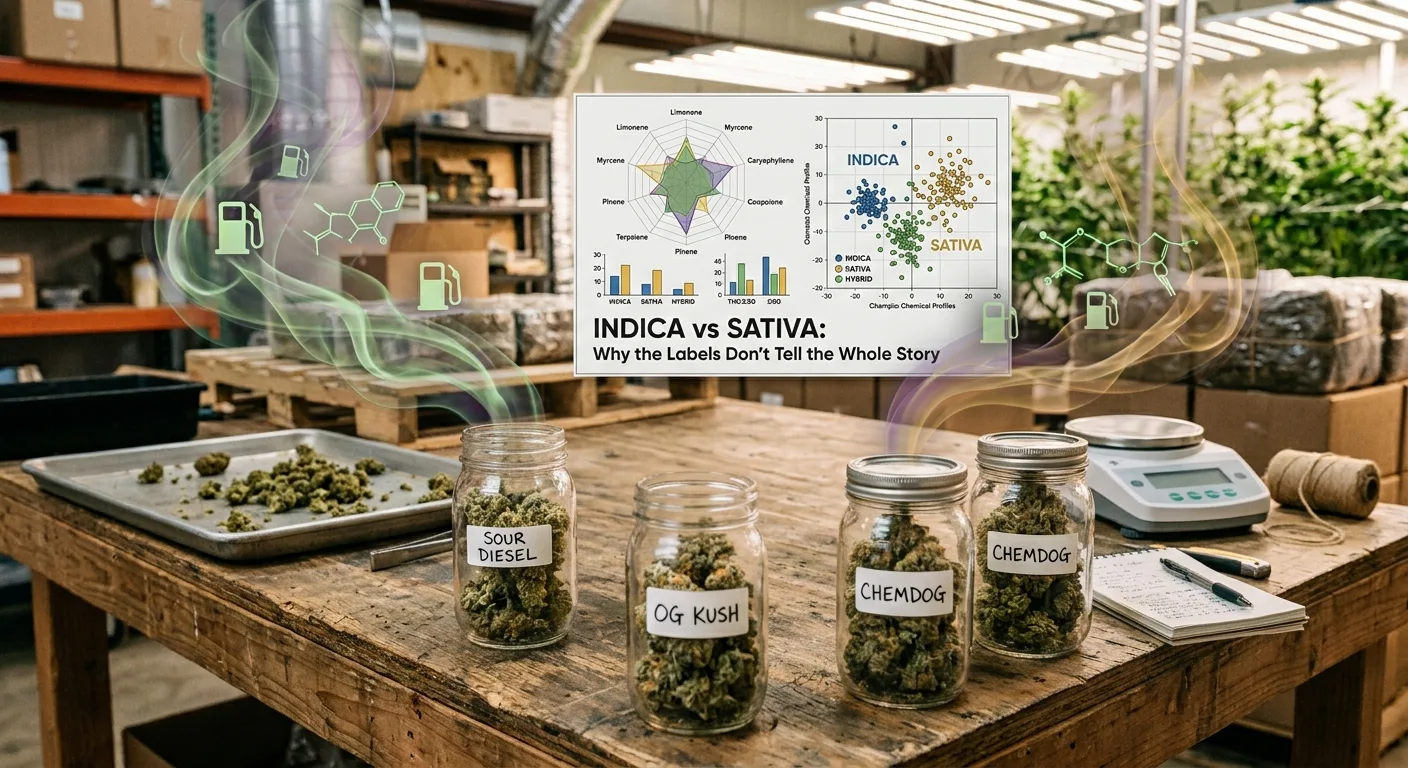
Walk into any cannabis dispensary in Canada and you'll be asked the same question: "Are you looking for indica or sativa?" For decades, this binary classification has dominated how we talk about cannabis. Indica supposedly relaxes you into couch-lock bliss, while sativa energizes and sparks creativity. It's simple, memorable, and taught to every budtender on day one. There's just one problem: the indica-sativa distinction is a surprisingly weak predictor of the effects you'll actually experience.
Before you dismiss this as cannabis heresy, consider what modern research reveals. The effects of any cannabis strain depend far less on whether the plant is short and bushy (indica) or tall and wispy (sativa) and far more on its specific terpene profile and cannabinoid ratios. Two strains both labelled "indica" can produce wildly different experiences, while an indica and a sativa with similar chemical compositions might feel nearly identical. In this article, we'll unpack why the traditional classification system persists despite its limitations, what actually determines your high, and how to choose cannabis based on chemistry rather than outdated categories.
The Origin Story: Where Indica and Sativa Labels Come From
The indica-sativa taxonomy wasn't invented by stoners or budtenders. It comes from 18th-century botanical classification, when Swedish naturalist Carl Linnaeus first described Cannabis sativa in 1753. Thirty-two years later, French biologist Jean-Baptiste Lamarck identified a second species he called Cannabis indica, based on plants collected in India. These classifications were based purely on physical characteristics and geographic origin, not effects.
Sativa plants evolved in equatorial regions (Central and South America, Southeast Asia) where they developed tall, thin structures to maximize light absorption in humid, dense jungle environments. Their narrow leaves, longer flowering cycles, and airy bud structure all represent adaptations to hot, wet climates.
Indica plants originated in harsher mountainous regions (Afghanistan, Pakistan, northern India) where they evolved compact, bushy shapes to withstand wind and cold. Their broad leaves, dense buds, and shorter flowering times helped them survive in challenging environments with shorter growing seasons.
Here's the critical point: these morphological differences describe plant structure, not psychoactive effects. Lamarck never smoked the plants he classified. The association between indica's physical traits and sedating effects, or sativa's structure and energizing highs, came much later and was based largely on anecdotal reports and marketing rather than rigorous science.
How the Effects Myth Took Hold
The indica-equals-sedation and sativa-equals-energy framework gained traction in the 1970s and 1980s as cannabis culture became more sophisticated. Growers and consumers noticed patterns: many Afghan indica landraces did seem more relaxing, while equatorial sativas often felt more cerebral. But correlation isn't causation. What they were actually detecting were differences in chemical composition that happened to align with plant morphology in those specific landrace strains.
Decades of crossbreeding have thoroughly scrambled these correlations. Modern cannabis is overwhelmingly hybrid, with genetics from both indica and sativa lineages. A strain might display indica plant structure but possess a terpene profile that produces sativa-like effects, or vice versa. The labels persist because they provide a convenient shorthand, not because they accurately predict outcomes.
What Actually Determines Your High: Cannabinoids and Terpenes
If indica-sativa labels don't reliably predict effects, what does? The answer lies in two key categories of compounds: cannabinoids and terpenes. Understanding these chemicals transforms cannabis selection from guesswork into informed choice.
Cannabinoids: The Primary Psychoactive Drivers
Cannabis produces over 100 different cannabinoids, but two dominate the conversation. THC (tetrahydrocannabinol) is the primary psychoactive compound responsible for the "high" feeling, including euphoria, altered perception, and increased appetite. CBD (cannabidiol) is non-intoxicating but influences the overall experience by modulating THC's effects and providing its own therapeutic benefits.
The THC-to-CBD ratio matters immensely. High-THC, low-CBD strains (20%+ THC, <1% CBD) tend to produce more intense, sometimes anxiety-inducing effects. Balanced ratios (1:1 or 2:1 THC:CBD) often feel more manageable and clear-headed. High-CBD, low-THC varieties provide minimal intoxication but may offer relaxation and pain relief.
Interestingly, many old-school cannabis consumers remember weed from the 1970s and 1980s as being "different" from today's strains. They're right, but not because indica-sativa genetics have changed. Selective breeding has dramatically increased average THC levels (from 3-5% in the 1970s to 15-25% today) while often reducing CBD and other minor cannabinoids. This altered cannabinoid profile, not the indica-sativa ratio, explains why modern cannabis feels stronger and sometimes more anxiety-prone.
Terpenes: The Unsung Heroes of Cannabis Effects
If cannabinoids are cannabis's engine, terpenes are the steering wheel. These aromatic compounds give each strain its distinctive smell and taste, but their role goes far beyond fragrance. Terpenes interact with cannabinoids in what researchers call the "entourage effect," where the whole plant's compounds work synergistically to produce effects greater than the sum of their parts.
The most abundant cannabis terpenes include:
Myrcene is the most common terpene in cannabis, giving strains earthy, musky notes reminiscent of cloves. It's thought to promote relaxation and enhance THC's ability to cross the blood-brain barrier. High-myrcene strains often feel sedating,and yes, many indica-dominant varieties happen to be myrcene-rich, which partly explains the indica-relaxation association.
Limonene smells exactly like citrus peels and is associated with elevated mood and stress relief. Strains high in limonene often feel uplifting and energizing, regardless of whether they're labelled indica or sativa.
Pinene (which exists as alpha-pinene and beta-pinene) delivers fresh pine or rosemary aromas. It may promote alertness and memory retention while potentially counteracting some of THC's short-term memory impairment. Pinene-dominant strains tend to feel clear-headed and focused.
Caryophyllene provides peppery, spicy notes and uniquely interacts with the body's CB2 receptors, potentially offering anti-inflammatory effects without psychoactivity. It's often found in strains reported to help with pain and stress.
Linalool carries the floral scent of lavender and is associated with calming, sedative effects. It's the terpene most responsible for cannabis strains that truly deliver on the "relaxation" promise.
Two strains with identical THC percentages but different terpene profiles will produce distinctly different experiences. A high-THC strain rich in myrcene and linalool will likely feel relaxing and sedating. That same THC level paired with limonene and pinene might feel energizing and cerebral. This chemical reality matters far more than whether a budtender calls it indica or sativa.
The Modern Cannabis Reality: Everything Is a Hybrid
Here's an uncomfortable truth for the indica-sativa framework: virtually every strain you'll encounter in a Canadian dispensary is a hybrid. Decades of crossbreeding mean pure landraces are rare specialty items, not everyday offerings. When you see "indica-dominant" or "sativa-dominant" labels, you're getting information about genetic lineage and plant structure, not a guarantee about effects.
Consider popular strains like Blue Dream, Girl Scout Cookies, or Gorilla Glue. All are complex hybrids carrying genetics from both indica and sativa lineages. Their effects depend on how specific phenotypes express particular cannabinoid and terpene profiles, which can vary even between plants of the same strain grown in different conditions.
This genetic complexity is why two people can smoke the same strain and report completely different experiences. One person's energizing sativa might be another's couch-lock indica. Variables like individual brain chemistry, tolerance, consumption method, dose, and even what you ate that day all influence outcomes. The strain's chemical profile sets the stage, but your unique biology performs the play.
Why Dispensaries Still Use Indica-Sativa Labels
If the classification system is so flawed, why does every dispensary in Ottawa, Gatineau, and across Canada still organize products this way? Several pragmatic reasons keep the labels alive despite their scientific shortcomings. The indica-sativa framework provides an accessible entry point for new consumers who would be overwhelmed by discussions of terpene profiles and cannabinoid ratios. It's easier to remember "indica for nighttime, sativa for daytime" than to parse the nuances of myrcene-versus-limonene dominance.
The labels also tap into decades of cannabis culture and collective experience. Even if the correlation isn't perfect, many consumers have built associations based on trying numerous strains labelled indica or sativa. Their accumulated experience creates a rough mental map, even if that map contains significant inaccuracies.
From a business perspective, the system works for product organization and marketing. Dispensaries need some way to categorize hundreds of strains, and "indica-sativa-hybrid" provides three neat buckets. More accurate systems based on chemical profiles would require extensive lab testing, consumer education, and infrastructure changes that most businesses haven't implemented.
The good news is this is changing. Progressive dispensaries now include terpene information and detailed cannabinoid profiles alongside traditional classifications. This evolution lets consumers who want deeper knowledge make more informed choices while still providing the familiar indica-sativa framework for those who prefer simplicity.
How to Actually Choose Cannabis: A Chemotype-Based Approach
Armed with knowledge about what really drives cannabis effects, how should you approach selection? Here's a framework based on chemistry rather than outdated categories, something we prioritize when helping customers place orders through our mail-order service.
Step 1: Identify Your Desired Outcome
Start with what you want to achieve. Common goals include relaxation and sleep, energy and focus, pain relief, anxiety reduction, creative inspiration, or social enhancement. Being specific helps narrow the chemical profile you're seeking.
Step 2: Consider Cannabinoid Ratios
For most recreational users seeking a balanced high, look for moderate THC (12-18%) with at least some CBD (1-5%). This range provides pleasant effects without overwhelming intensity. If you want stronger psychoactivity, higher THC (18-25%+) delivers, but expect more intense experiences that may include anxiety, especially with low CBD levels. For therapeutic use with minimal intoxication, high-CBD, low-THC ratios (20:1 CBD:THC or higher) provide benefits without significant psychoactive effects.
Step 3: Examine the Terpene Profile
This is where informed selection really happens. For relaxation and sleep, prioritize strains high in myrcene, linalool, or caryophyllene. Products like Pink Death Star often exhibit these sedating terpene profiles. For energy and focus, seek limonene, pinene, or terpinolene dominance. For balanced, versatile effects, look for diverse terpene profiles without a single dominant compound.
Many Canadian licenced producers now include this information on packaging or websites. If your dispensary doesn't provide it, ask. Budtenders increasingly have access to lab results and can guide you toward strains with specific chemical profiles.
Step 4: Start Low, Go Slow, and Document
Whatever you choose, begin with a low dose, especially when trying new strains. Cannabis affects everyone differently, and the only way to know how a specific chemical profile works for you is through careful experimentation. Keep notes about what you tried, the effects you experienced, and any lab data you have access to. Over time, you'll identify patterns in which cannabinoid-terpene combinations work best for your unique biology and goals.
Comparison Table: Traditional vs. Modern Cannabis Selection
| Aspect | Traditional Indica/Sativa Model | Modern Chemotype-Based Approach |
|---|---|---|
| Primary Classification | Plant structure and lineage (indica/sativa/hybrid) | Cannabinoid ratios and terpene profiles |
| Effect Prediction Accuracy | Weak (30-50% correlation) | Strong (70-85% correlation) |
| Scientific Basis | Historical botanical taxonomy | Pharmacology and biochemistry |
| Consumer Accessibility | Very simple (3 categories) | Complex (requires education) |
| Personalization Potential | Low (one-size-fits-all categories) | High (tailored to individual needs) |
| Information Required | Strain name and category | Lab testing data (cannabinoids + terpenes) |
| Best Use Case | Quick decisions for beginners | Informed selection for consistent results |
Real-World Examples: When Indica-Sativa Labels Mislead
Let's examine specific scenarios where the traditional classification system breaks down, using examples you might encounter at any Canadian cannabis dispensary.
Case Study: The "Energizing Indica"
Durban Poison is often classified as a pure sativa landrace from South Africa, and most consumers report uplifting, energetic effects. But consider a strain like Bubba Kush, typically labelled indica and expected to be sedating. Some phenotypes of Bubba Kush are high in pinene rather than myrcene, producing alert, focused effects despite the indica label. Users expecting couch-lock sedation might be surprised by mental clarity instead.
The lesson: the indica label promised one experience, but the terpene profile delivered another. A consumer who chose based on chemistry would have known what to expect.
Case Study: The "Relaxing Sativa"
Conversely, some sativa-dominant hybrids like certain Jack Herer phenotypes contain significant myrcene and linalool. Despite the sativa classification suggesting energy and cerebral stimulation, these chemotypes produce mellow, relaxed effects that contradict the label. If you took Jack Herer expecting to clean your apartment, you might find yourself pleasantly melted into your couch instead.
The Consistency Problem
Even within the same strain from the same grower, cannabinoid and terpene levels can vary between harvests. Environmental factors during growth,light exposure, nutrients, temperature, humidity,all influence chemical expression. This means "Pink Death" from one batch might be myrcene-dominant and sedating, while the next batch could be pinene-heavy and more alert. The strain name stayed the same, but the chemistry that determines effects changed.
This variability is why consistent, batch-specific lab testing matters more than strain names or indica-sativa labels. Progressive dispensaries provide Certificates of Analysis (COAs) showing exact cannabinoid percentages and terpene profiles for each specific lot they sell.
The Future of Cannabis Classification
The cannabis industry is slowly moving toward more scientifically sound classification systems. Rather than indica-sativa-hybrid, forward-thinking experts propose organizing cannabis into three chemotypes based on cannabinoid profiles, which Dr. Ethan Russo and other researchers have championed as more accurate frameworks.
Type I varieties are THC-dominant (high THC, negligible CBD), producing strong psychoactive effects. Type II varieties are balanced (roughly equal THC and CBD), offering moderate intoxication with CBD's modulating effects. Type III varieties are CBD-dominant (high CBD, low THC), providing therapeutic benefits with minimal psychoactivity.
Some researchers propose even more granular systems that classify cannabis by dominant terpene, creating categories like "myrcene-dominant relaxation strains" or "limonene-dominant uplifting strains." While more accurate, these systems require significant consumer education and industry infrastructure changes.
In practical terms, you'll likely see hybrid approaches for years to come: familiar indica-sativa-hybrid labels for accessibility, supplemented with detailed cannabinoid and terpene data for informed consumers. The key is knowing how to interpret and use the chemical information when it's available, rather than relying solely on simplified categories.
Practical Tips for Canadian Cannabis Consumers
While the industry evolves, here's how to navigate cannabis selection in the current market. When shopping at dispensaries or browsing licenced retailers across British Columbia, Alberta, or other provinces, ask budtenders specific questions beyond "indica or sativa." Request information about dominant terpenes, THC-to-CBD ratios, and whether lab results are available. Quality dispensaries train staff to discuss chemistry, not just categories.
If possible, smell before you buy. Your nose detects terpenes, and aromatic preferences often correlate with enjoyable effects. Citrus scents suggest limonene, pine indicates pinene, and earthy musk means myrcene. Trust your sensory response as part of the selection process.
Keep a consumption journal documenting strains tried, their chemical profiles if known, dose consumed, consumption method, and effects experienced. Over time, patterns emerge. You might discover you consistently enjoy high-limonene strains regardless of indica-sativa classification, or that you need at least 2% CBD to avoid anxiety with high-THC products.
Don't assume effects will match labels. Approach each new strain as an experiment, starting with low doses until you understand how that specific chemical profile affects you. This cautious approach prevents unpleasant surprises and helps you build reliable knowledge about what works for your unique biology.
Finally, remember that set and setting matter as much as strain selection. The same cannabis that feels energizing before a hike might feel sedating when consumed on a couch after dinner. Your mindset, environment, and context all influence the experience alongside the chemical profile.
Find Your Perfect Strain Based on Chemistry, Not Labels
Our cannabis specialists can help you select products based on terpene profiles and cannabinoid ratios that match your specific goals. Whether you're in Ottawa, Gatineau, or anywhere across Canada, we provide detailed product information and personalized guidance.
Explore Our SelectionFrequently Asked Questions
Not necessarily. While many indica-dominant strains do produce relaxing effects, this correlation is weak and inconsistent. The actual effects depend on the strain's specific terpene profile and cannabinoid ratios, not its indica-sativa classification. A sativa strain high in myrcene and linalool may be more sedating than an indica strain rich in pinene and limonene.
Focus on three key factors: the THC-to-CBD ratio, the dominant terpenes, and your desired outcome. For relaxation, look for strains high in myrcene, linalool, or caryophyllene. For energy and focus, seek limonene, pinene, or terpinolene. Moderate THC levels (12-18%) with some CBD (1-5%) typically provide balanced effects suitable for most users.
The indica-sativa-hybrid framework persists because it provides an accessible entry point for new cannabis consumers and a familiar organizational system. While not scientifically precise, these labels tap into decades of cannabis culture and collective experience. Progressive dispensaries are increasingly supplementing these traditional categories with detailed cannabinoid and terpene information for more informed selection.